UK Space Agency and O2 partner on driverless cars tech

Above:
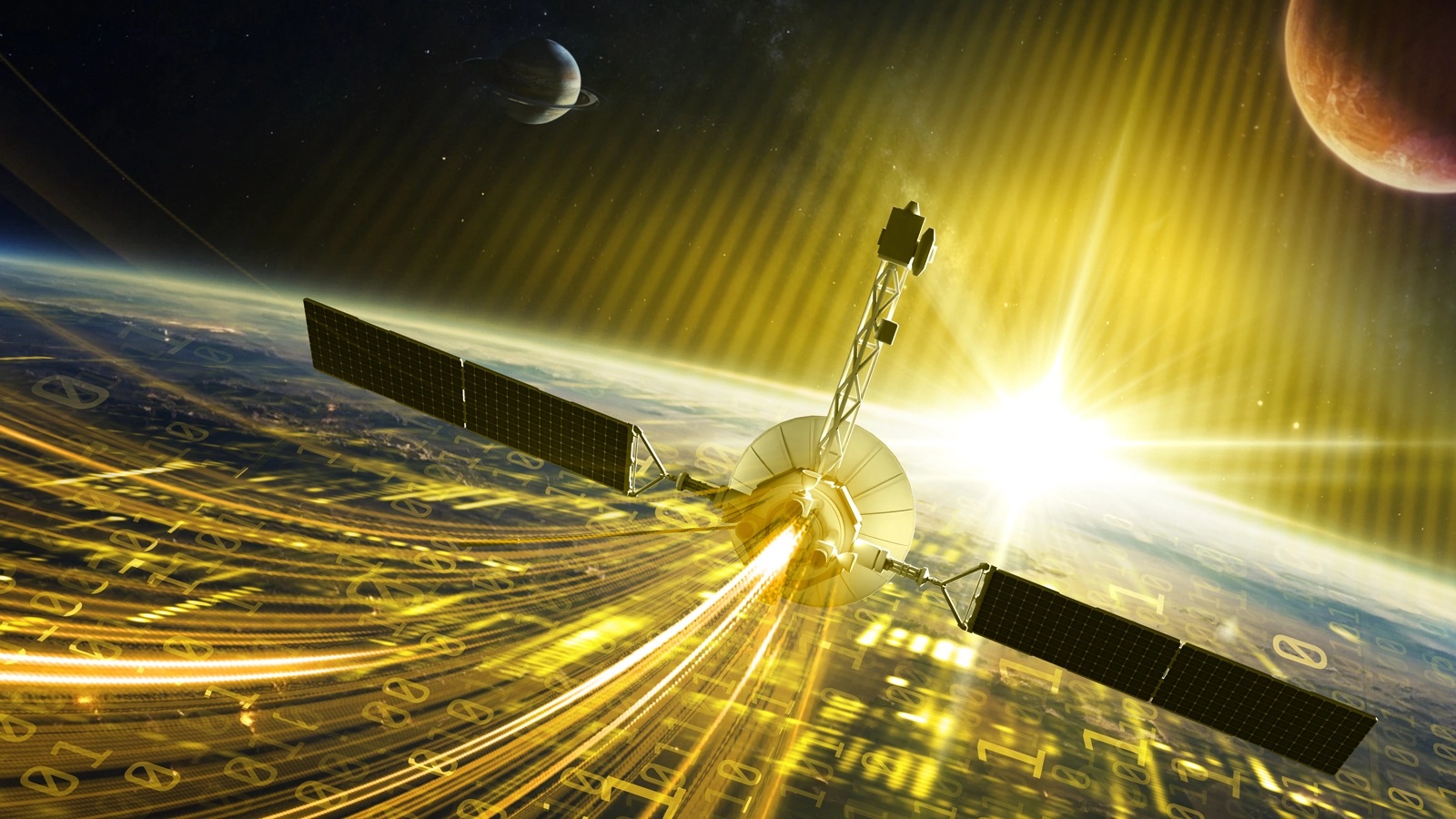
A graphic showing a vehicle receiving a data connection from a telecoms satellite.
Courtesy UK Space Agency
Building the technology to link autonomous vehicles to telecoms satellites means that you will be able to take your car wherever you want to go
The new Darwin programme aims to test seamless highspeed data connections using 5G and satellites. Next generation telecoms satellites will ensure that vehicles stay connected outside of towns and cities which typically have good mobile signals.

Connected and autonomous vehicles (CAVs) will transform travel with safer, smoother and smarter road journeys through high levels of automation facilitated by being able to communicate with other vehicles and to road infrastructure around them.
However, they require robust and seamless high-speed data connections to operate their complex systems effectively.
O2 research shows that CAVs are expected to generate unprecedented levels of data – 4TB per hour – highlighting the need for next generation connectivity.
Business Secretary Greg Clark said: "Our world-beating space and auto industries have a proven track record in driving forward pioneering research, while the UK’s satellite services are constantly enhancing services such as the quality of our communications, healthcare and environmental monitoring.
"This new partnership between Government and industry will build on our world-leading reputation in the development and manufacture of satellites even further, to bring together two of the UK’s great strengths – automotive and space. Putting us at the forefront of the next generation of self-driving cars of tomorrow – a key ambition in our modern Industrial Strategy."
Since 2014, the Government has invested significantly into the research and development of CAVs – including £120 million in CAV projects, with a further £68 million coming from industry contributions.
Catherine Mealing-Jones, Director of Growth, UK Space Agency, said: "Autonomous vehicles require robust high-speed mobile data connections to operate effectively, so building the technology to link autonomous vehicles to telecoms satellites means that you will be able to take your car wherever you want to go, not just where there’s decent mobile signal.
"The future of mobility is one of the UK government’s Industrial Strategy Grand Challenges, so I’m delighted to support Project Darwin to ensure that this critical technology is developed in Harwell, bringing expertise, jobs and growth to Britain."
This research will be based at the Harwell Science and Innovation Campus, Oxfordshire and is co-funded through the UK Space Agency’s investment in the European Space Agency’s programme of Advanced Research in Telecommunications Systems (ARTES).
Other partners are Oxford and Glasgow universities, telecoms business O2 Telefonica, Spanish satellite operator Hispasat and the Darwin Innovation Group Oxford.
Darwin is developing an ARTES ‘Partner Study’ programme with UK support (first phase £2m) to help define all the different elements needed to deliver the larger programme. The future of mobility is one of the UK government’s Industrial Strategy Grand Challenges. UK Space Agency is working closely with Darwin and O2 to support this ambition in the UK.
Derek McManus, COO at O2 said: "Project Darwin is an important piece of the connected and autonomous vehicle puzzle. The research taking place at Harwell during the next four years will be vital in the creation of new transport ecosystems for the UK public and the the companies that will offer these services. Our approach to this project is part of our wider strategy to collaborate with British businesses, partners and start-ups to unlock the possibilities of 5G for customers and wider UK economy."
The 5G connectivity delivered by converged networks will also support remote and rural enterprise and provide ubiquitous communications, one of the UK Space Agency’s strategic priorities in telecoms.
Dr Stephan von Delft, University of Glasgow Adam Smith Business School, said: "Ecosystems that connect data, technologies and users create opportunities for business model innovation. However, new business models for 5G connected ecosystems will not emerge fully formed. Firms must therefore systematically explore, test and adapt new business models as conditions change. Our research aims to support Project Darwin in this process."
Daniela Petrovic, Darwin Innovation Group co-founder said: "Our team at Harwell is thrilled to gather key innovation partners like Telefonica, UK Space Agency and ESA, together with a number of start-ups from Oxfordshire with whom we have longstanding relationships, to join forces in this exciting innovation.
"Our aim is that Mobility as a Service (MaaS) developed by project DARWIN will benefit society in multiple ways: by creating new apprenticeships in this newly developing area, informing policies and regulations related to connected and autonomous vehicles, and creating a new industry vertical.”