University of Nottingham opens Zero Carbon Innovation Centre


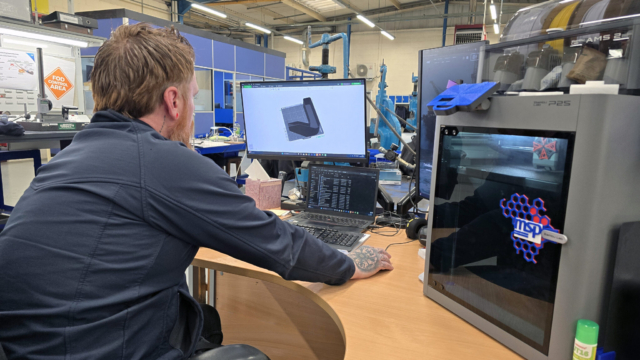
Image courtesy University of Nottingham
The centre will deliver innovation in transport technology, green hydrogen production and power solutions for industry and create jobs for the regional economy.
The ZCIC will deepen the university’s research and development (R&D) and manufacturing partnerships with industry across aerospace, automotive, marine, rail, off-highway and energy sectors. At the centre, partners will benefit from research projects as well as commercially contracted testing and R&D programmes. They will be able to co-locate to the centre to collaborate with researchers and have access to incubator labs and office space.
With investments from East Midlands Freeport, Research England’s UK Research Partnership Investment Fund (UKRPIF) and match-funding by the two universities, the centre will drive innovation, create high-value jobs and provide businesses with a clear path to transition from developing new technologies to potentially establishing operations at the Freeport.
Claire Ward, Mayor of the East Midlands, said: “The launch of the Zero Carbon Innovation Centre marks a major milestone for our region, placing us at the forefront of innovative research and advancements in transport technology and clean energy solutions. This centre will not only drive the development of sustainable, zero-carbon technologies but also create significant economic opportunities – including new jobs and business growth across the region. I’d like to congratulate everyone involved in making this happen, particularly the East Midlands Freeport, whose vision and support are helping establish the East Midlands as a key player in the future of transport and sustainable innovation.”
Based at Nottingham’s Jubilee Campus and with a site at Loughborough University, the ZCIC brings a range of open access innovation capabilities to the region including electrical machine manufacturing, robotics, digital twinning and green hydrogen generation. A new electrical machine manufacturing line will enable end-to-end manufacturing, allowing flexible reconfiguration for low volume, high value production of advanced machines with state-of-the-art performance and power. This will accelerate technology insertion into manufacturing to support production in region and nationally.
Minister for Local Growth and Building Safety, Alex Norris, said: “I am pleased to see the East Midlands Freeport take a big step forward in driving growth through innovation in transport, a sector in which this region has long been an industrial leader. The new centre will help secure the East Midlands’ role in the future of green transport, accelerate the government’s Plan for Change mission for growth and help deliver on the UK’s ambition to be a clean energy superpower.”
The digital twinning lab at the ZCIC will enable development of model-based physics simulations, monitoring, prognostics and health management of propulsion powertrains and power generation applications. It will provide an advanced digital twin platform enabling system integration, validation and verification and will be connected to the megawatt-class physical testing capabilities of the nearby Power Electronics and Machines Centre (PEMC) and the forthcoming Hydrogen Propulsion Systems Lab.
Jane Norman, President and Vice Chancellor at University of Nottingham, said: “We are very excited about this partnership with East Midlands Freeport, Research England and the two universities. Together we are expanding the region’s world-class research and innovation capacity to drive growth locally and decarbonise globally. Heavy transport is known as a very hard to decarbonise sector – a challenge that demands the very best and brightest minds. We want the world to know this is the place where those minds come together to develop zero carbon solutions.”
Romina Davoudi, Head of Programme Delivery at the Aerospace Technology Institute, said: “The Zero Carbon Innovation Centre is set to drive cutting-edge research and development in sustainable transport and energy technologies. Building on years of pioneering aerospace research, much of it funded through the ATI Programme, the ZCIC will play a crucial role in fast-tracking sustainable technologies from research to deployment.
“The ATI is proud to have helped accelerate aerospace innovation in the East Midlands, which can now be applied across multiple sectors to deliver real-world impact through the ZCIC.”

The Zero Carbon Innovation Centre adds to a cutting-edge lineup of zero carbon R&D and manufacturing capabilities on Jubilee Campus at the University of Nottingham. These include the Power Electronics and Machines Centre (PEMC), home to one of the world’s largest groups of electrification researchers, as well as Omnifactory, a national smart manufacturing demonstrator and testbed for smart manufacturing systems. To this will soon be added the Hydrogen Propulsion Systems Lab, funded through £70 million of investments primarily secured with Research England and industry co-investment partners.
At Loughborough University, a novel battery-electrolyser demonstration facility is being created with a manufacturing prototype now developed. Loughborough also has complementary business incubation, commercialisation and scale-up facilities at the Loughborough Science and Enterprise Park (LUSEP), with an existing CleanTech cluster of organisations.
Sign up for our newsletter and get our latest content in your inbox.
Similar Reads



Sign up for our newsletter. Select all sectors relevant to you.
Related