

World’s first pilot facility converts non-recyclable waste plastic to SAF

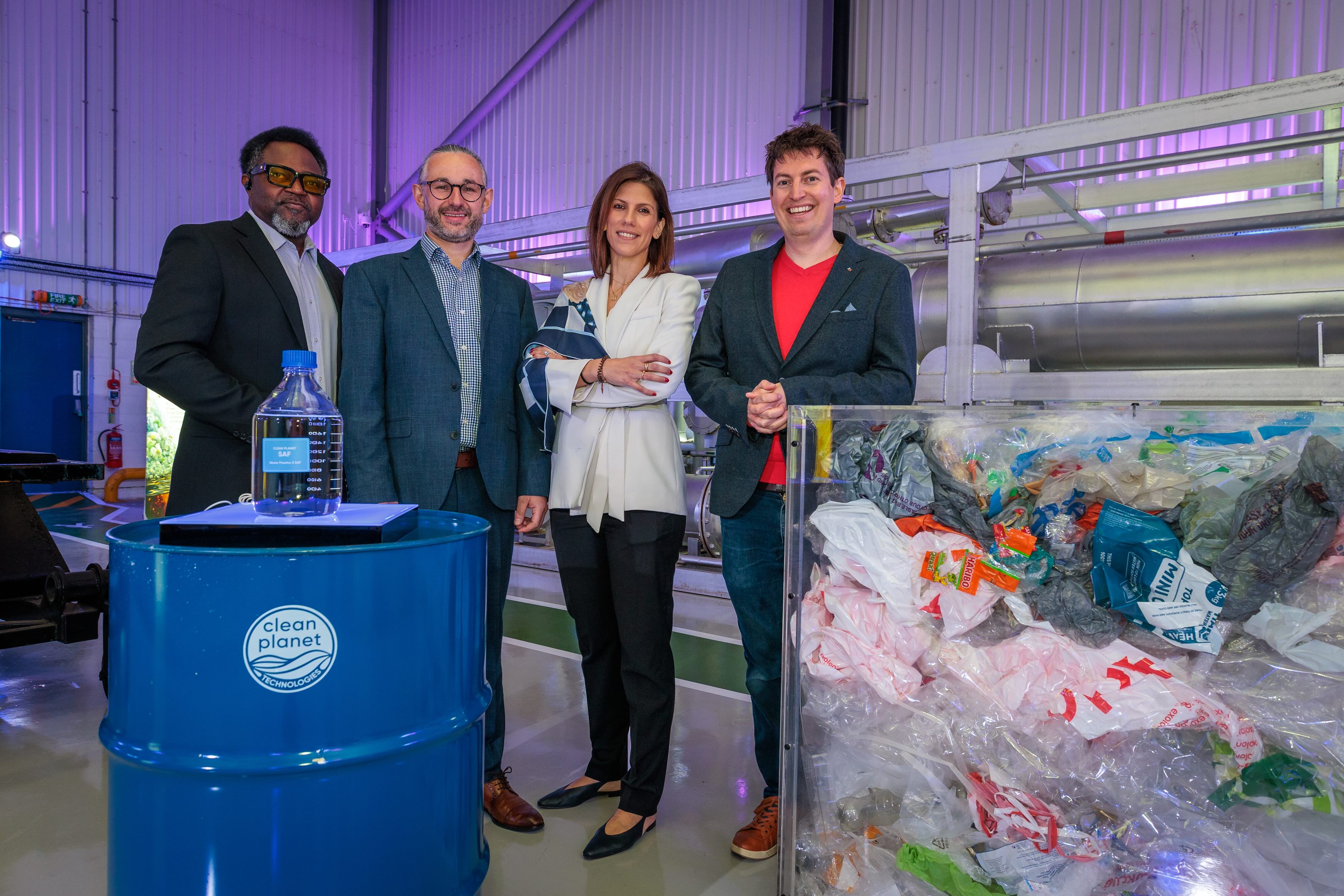
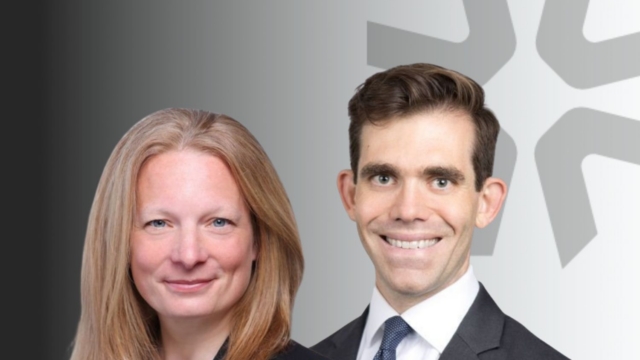
Above: (left to right) Dr Andrew Odjo, CEO at Clean Planet Technologies, Matthew Jee, Director of the UK SAF Clearing House, Dr Katerina Garyfalou, Chief Operating Officer at Clean Planet Technologies and Bertie Stephens, CEO of Clean Planet Group with examples of the waste plastic that is turned into Sustainable Aviation Fuel (SAF).
Courtesy Clean Planet Technologies
Dedicated to converting hard-to-recycle waste plastics into SAF, the new Sustainability Innovation Centre is based at Discovery Park in Sandwich, Kent and is operated by Clean Planet Technologies. The Centre is set up to research and develop new technologies to deal with non-recyclable plastic waste, beginning with conversion into jet fuel.
The UK creates five million tonnes of waste plastics each year, 80% of which cannot be recycled, such as carrier bags and food packaging film. Globally the world’s commercial aircraft consume between seven and eight million barrels of jet fuel per day, equivalent to 7-8% of total global daily oil demand.
Dr Andrew Odjo, Chief Executive Officer at Clean Planet Technologies, said: “Our process first heats the waste plastic with a chemical reaction to turn it into a liquid, rather than burning it. This is then treated with our patented process to remove impurities and create SAF that meets stringent commercial aviation specifications.
“Every day, around 100,000 commercial flights operate globally while approximately 30,000 tonnes of plastic enters the ocean. That’s the equivalent of us dumping 2,000 garbage trucks full of plastic into the world’s oceans, rivers and lakes every single day. Our pilot facility will demonstrate this waste can be turned into a premium product with a quantifiable commercial demand, as well as reducing the lifecycle carbon footprint of the aviation industry. We monitor how much energy the process uses and overall, it cuts the lifecycle greenhouse gas emissions by more than 70% compared to traditional fossil jet fuel.
“With currently less than 1% of global aviation fuel produced from sustainable sources, the scale of the environmental opportunity presented by our technology means the opening of our facility is an important step towards the UK’s ambition to support sustainable aviation.”
The pilot facility plays a critical role in bridging innovation and commercial development, integrating several stages into one single, controlled system optimised to transform hard-to-recycle plastics into SAF. It has been designed to support fuel and feedstock testing, validation and progression through the American Society for Testing and Materials (ASTM) qualification process, with financial support already in place from the Department for Transport-funded UK SAF Clearing House.
Dr Katerina Garyfalou, Chief Operating Officer at Clean Planet Technologies, added: “The Sustainability Innovation Centre is set up to demonstrate our patented waste-plastics-to-SAF process at pilot scale, supporting fuel testing, validation and progression.
“The important thing is that our pilot facility will support the growth of others, helping the UK to meet its SAF mandate. UK government policy to decarbonise aviation fuel states that 2% of UK jet fuel demand must be SAF, increasing to 10% in 2030 and 22% in 2040.”
The key steps of the process are:
- Shredding: Waste plastics are pre-processed and shredded to a uniform size.
- Pyrolysis: The material is fed into one of the centre’s two pyrolysis units, with the largest capable of processing up to one ton of plastic per day. In this oxygen-free environment, the plastics are thermocatalytically converted into a synthetic crude oil. This melts the plastic, rather than burning it.
- Purification: Impurities and contaminants in the synthetic crude oil are removed.
- Distillation: The pyrolysis oil is transferred to a distillation unit, where it is separated into relevant fractions and optimised for upgrading into higher-value fuels.
- Upgrading: The fractions are then processed through Clean Planet Technologies’ patented hydroprocessing system, which uses hydrogen to further remove impurities and transform the properties of the product to meet stringent SAF specifications.
- SAF product: The resulting ultra-clean, ultra-low sulphur fuel suitable for aviation use is sent for testing, blending and evaluation as part of the ASTM qualification pathway as SAF.
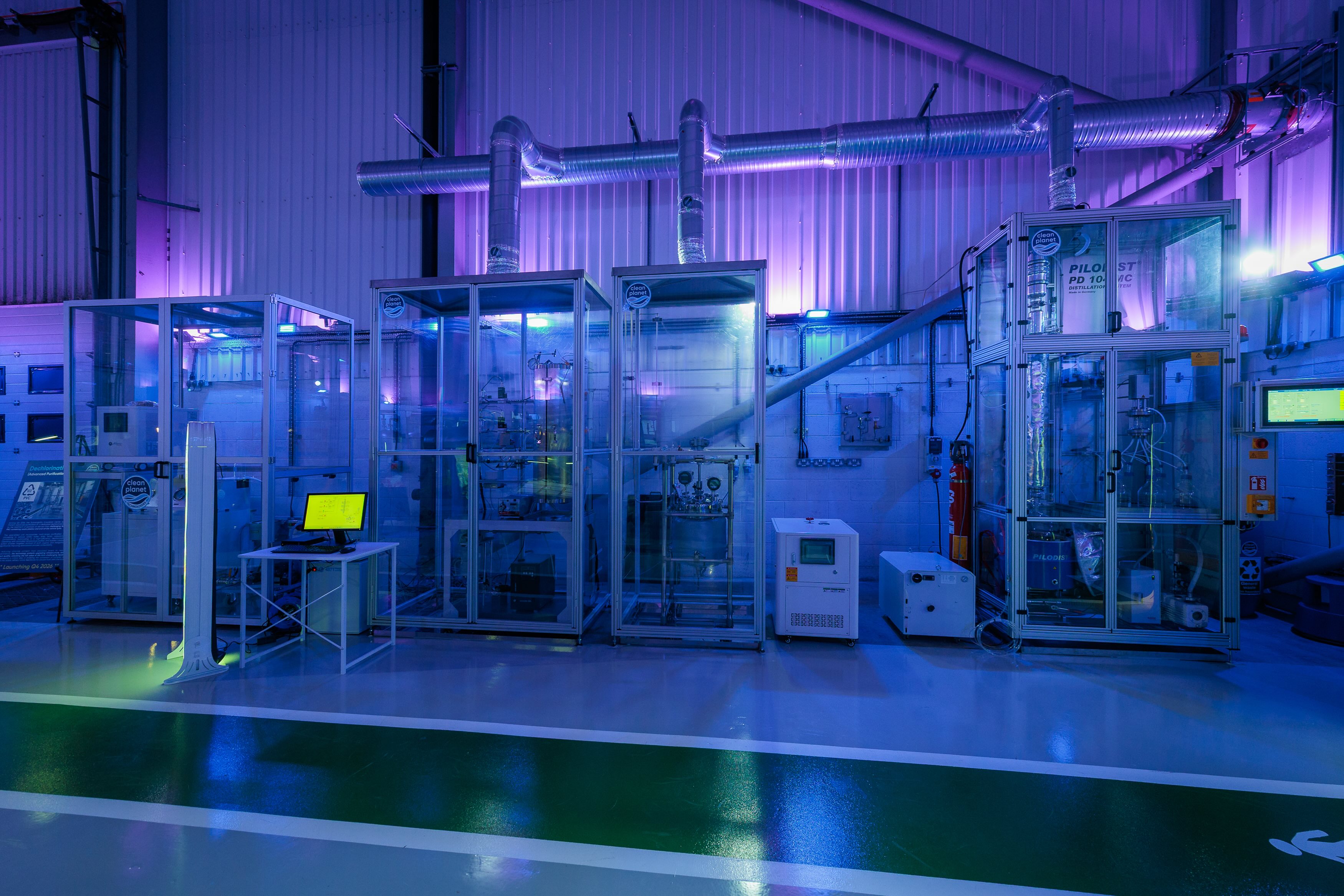
Above: A selection of technology inside the pilot facility.
Courtesy Clean Planet Technologies
The fundamentals of the process (pyrolysis, purification, distillation and hydroprocessing) are all technologies which are currently used independently at commercial scale, meaning scaling up the process is not a challenge.
Clean Planet Group was founded in 2018 by Dr Andrew Odjo, Adel Louertatani, Bertie Stephens and Fernando Diamond. CEO Bertie Stephens said: “Our pilot facility addresses two strategic challenges simultaneously: plastic waste management and aviation decarbonisation. By converting non-recyclable plastics – materials that would otherwise have gone to landfill or been incinerated – into low-carbon aviation fuel, the facility supports both circular economy objectives and the reduction of lifecycle greenhouse gas emissions."
Sign up for our newsletter and get our latest content in your inbox.
Similar Reads


Sign up for our newsletter. Select all sectors relevant to you.
Related