
General Atomics

ZeroAvia’s SuperStack Flex LTPEM expands UAV & VTOL capabilities

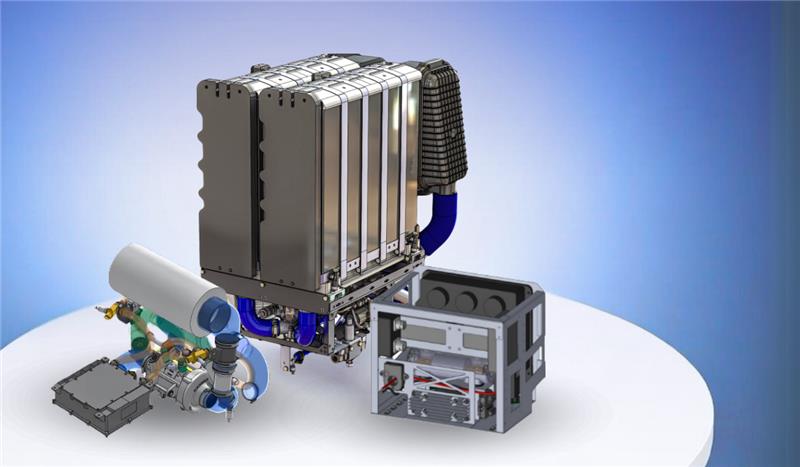
ZeroAvia's SuperStack Flex highly-customisable Low Temperature Proton Exchange Membrane (LTPEM) fuel cell architecture has achieved over 1.0kW/kg specific net power at a full system level, including thermal management system and has been successfully demoed in a 150kW net power configuration for a major customer.


Image courtesy ZeroAvia

 
The industry leading testing results have been made possible thanks to ZeroAvia’s innovative use of additive manufacturing techniques and will expand UAV / VTOL capabilities of the systems, as well as opening new applications in aerospace and other sectors.  
 
Using selective laser sintering (SLS) powder-bed additive manufacturing processes, ZeroAvia has been able to perform high velocity cycles of design, build and test, and quickly combine typical parts or their functions into new monolithic structures. The key parts in the SuperStack Flex’s balance of plant – Anode, Cathode and Coolant Manifolds, thermal management, humidification and air compression systems – have been reduced from over 200 parts to less than 100, with ~50% weight and volume reductions. Fewer parts mean lighter, more compact, more reliable and less costly systems.   
 
The ZeroAvia SuperStack Flex is a modular fuel cell power generation platform that can be scaled up or down between 100kW and 600kW net total continuous power applications. The lightweight, aviation optimised balance-of-plant, has been developed as a best-fit approach for many Unmanned Air Vehicles (UAV) with further potential applicability across aerospace and in marine and ground vehicles.  
 
As well as its flexibility for different power requirements, the SuperStack Flex design enables separation of the core systems, meaning it can be highly versatile and efficient to integrate into different airframes, overcoming space constraints.  
 
The flexibility of the SuperStack Flex system enables customers to incorporate the technology and accelerate their R&D on fuel cell powered platforms. ZeroAvia’s focus on certification of its fuel cell engines and its traction with the CAA and FAA, provides confidence to customers working towards regulatory approval of their platforms.

Val Miftakhov, Founder and CEO,  ZeroAvia, said: “Our team has really knocked it out of the park and delivered some truly world-leading engineering here. We are creating step-change aerospace fuel cell systems at a fraction of the usual development time and cost. SuperStack Flex can be customised to an aircraft OEM’s precise custom needs, power requirements and aircraft layout, so we can get them flying on fuel cells quickly and thus improve the flight duration, lifecycle and the total cost of ownership of their aircraft.”

The breakthroughs in low temperature fuel cell technologies in the SuperStack Flex development closely follow other major milestones for ZeroAvia in early 2025: the company’s 600kW electric propulsion system (EPS) received its FAA G-1 issue paper and a first customer purchase of the standalone 600kw EPS.

Related

Edgewing opens engineering hub in Italy with UK site to follow
The GCAP fighter jet
Edgewing opens engineering hub in Italy with UK site to follow
The first of three engineering hubs designed to support the development of the future GCAP fighter has opening, with similar sites in the UK and Japan coming soon.
Aerospace Defence

9 Oct 2026

Marshall Aerospace begins new chapter as Aurelius acquisition completes
Marshall Aerospace C-130s
Marshall Aerospace begins new chapter as Aurelius acquisition completes
The completion of AURELIUS' acquisition of Marshall Aerospace marks a new chapter in the company's illustrious history, which spans more than a century of engineering excellence, innovation and service.
UK and Germany back SaxaVord in new European space launch deal
SaxaVord Spaceport, Shetland
UK and Germany back SaxaVord in new European space launch deal
The UK and Germany have agreed to deepen space launch cooperation, with Scotland's SaxaVord Spaceport securing European access to orbit.
Aerospace Defence Space

9 Oct 2026

Sentinel Photonics brings multiple laser detection sensors into one hub
Sentinel Photonics' LASARD MAX Connect
Sentinel Photonics brings multiple laser detection sensors into one hub
With one single hub that joins up laser detection sensors, operators can now see, share and act on laser threats across a wide area in real time.
AI to help SMEs win defence contracts: Inside Strategical’s solution
Aerospace SME using AI to win defence contracts
AI to help SMEs win defence contracts: Inside Strategical’s solution
Smaller suppliers can struggle to turn technical capability into defence orders. Strategical is using AI to make specialist bidding expertise more accessible and help businesses focus on work they can realistically secure.
Defence Member News

10 Oct 2026

Edgewing opens engineering hub in Italy with UK site to follow
The GCAP fighter jet
Edgewing opens engineering hub in Italy with UK site to follow
The first of three engineering hubs designed to support the development of the future GCAP fighter has opening, with similar sites in the UK and Japan coming soon.
Aerospace Defence

9 Oct 2026

UK and Germany back SaxaVord in new European space launch deal
SaxaVord Spaceport, Shetland
UK and Germany back SaxaVord in new European space launch deal
The UK and Germany have agreed to deepen space launch cooperation, with Scotland's SaxaVord Spaceport securing European access to orbit.
Aerospace Defence Space

9 Oct 2026

Excelerate Technology to build UK CNI robotic security solution
Satellite in Earth orbit
Excelerate Technology to build UK CNI robotic security solution
In a project co-funded by the European Space Agency Business Applications and Space Solutions (ESA BASS) and supported by the UK Space Agency, Excelerate Technology will build and demonstrate how space-enabled assets can provide innovative safety and security solutions, including protection of Critical National Infrastructure (CNI) at a site in the UK.
World Space Week: How British technology will help ESA return to the Moon
ESA Argonaut
World Space Week: How British technology will help ESA return to the Moon
As Europe prepares to return to the Moon, British-developed LEIA LiDAR technology will help ESA's Argonaut lander autonomously identify safe touchdown zones on the lunar surface.
Space

5 Oct 2026

Sentinel Photonics brings multiple laser detection sensors into one hub
Sentinel Photonics' LASARD MAX Connect
Sentinel Photonics brings multiple laser detection sensors into one hub
With one single hub that joins up laser detection sensors, operators can now see, share and act on laser threats across a wide area in real time.
Big cargo drones complete first BVLOS delivery to North Sea wind farm
Skyports and Ørsted North Sea wind farm cargo drone trial
Big cargo drones complete first BVLOS delivery to North Sea wind farm
Skyports and Ørsted conducted a complex North Sea cargo drone trial, illustrating how heavy loads can safely and efficiently be delivered offshore beyond visual line of sight (BVLOS).
Aerospace Security

9 Oct 2026

UK Government and UKRI invest £54m to prevent future disease outbreaks
Poultry facility
UK Government and UKRI invest £54m to prevent future disease outbreaks
The UK Government and UKRI are investing £54 million in biosecurity research to tackle antimicrobial resistance, improve disease outbreak preparedness, develop next-generation vaccines and strengthen protection against emerging biological threats.
Security

8 Oct 2026