Semiconductor facility launches in Southampton

A new facility using cutting edge electron beam technology to build the next generation of semiconductor chips - and the first of its kind in Europe - was opened yesterday at the University of Southampton by Science Minister Lord Vallance.


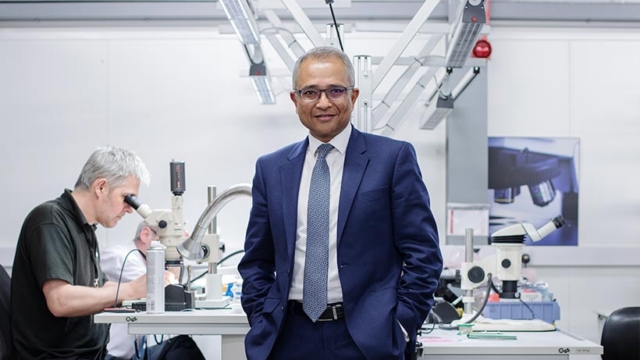
Image courtesy DSIT

The new E-beam lithography facility is just the second in the world and first outside Japan, providing incredible accuracy that is critical to designing the tiny components that power technologies of the future, from medical diagnostics to defence systems.

Semiconductors – the small chips that power devices from smartphones to satellites – already contribute an estimated £10 billion to our economy each year, with the sector projected to grow to an estimated £17 billion by 2030.

Strengthening the sector offers a major opportunity to drive the growth at the heart of our Plan for Change, through boosting innovation and jobs. It also supports the UK’s wider Industrial Strategy to grow key advanced manufacturing sectors and secure global competitiveness.

E-beam lithography uses a focused beam of tiny particles called electrons to create patterns in materials with unrivalled resolution – allowing researchers to create features thousands of times smaller than a human hair.

Science Minister, Lord Vallance, said: "Britain is home to some of the most exciting semiconductor research anywhere in the world – and Southampton’s new E-beam facility is a major boost to our national capabilities.

"By investing in both infrastructure and talent, we’re giving our researchers and innovators the support they need to develop next-generation chips right here in the UK.

"Our £4.75 million skills package will support our Plan for Change by helping more young people into high-value semiconductors careers, closing skills gaps and backing growth in this critical sector."

The Science Minister’s visit to Southampton comes alongside new research being published yesterday, which shows that one of the biggest barriers to achieving growth in the UK’s burgeoning semiconductor industry is a lack of emerging talent. With a single semiconductor worker contributing an average of £460,000 to the economy annually, the sector’s economic potential is huge.

In response, the government has launched a new £4.75 million semiconductor skills package to help build the talent base needed to fuel this high-growth industry. The package will also help strengthen R&D capacity at leading universities, such as Southampton, which are central to UK semiconductor innovation and talent development.

By supporting local talent pipelines and university–industry collaboration, the programme will contribute to both regional and national economic growth, fuelling our Plan for Change and reinforcing the role the semiconductors industry is set to play in the Industrial Strategy.

The package includes:

  • £3 million for undergraduate bursaries, offering £5,000 each to 300 students starting Electronics and Electrical Engineering degrees this year, alongside specialist semiconductor content to raise awareness of the field, with a focus on courses that include semiconductor design and manufacturing.
  • £1.2 million for chip design training, with new chip design courses to teach practical chip design skills to undergraduates, postgraduates, and lecturers, as well as a feasibility study for new postgraduate conversion courses.
  • Almost £550,000 for school outreach, giving 7,000 students aged 15–18 and 450 teachers hands-on semiconductor experience in partnership with local employers, helping raise awareness and diversify the future workforce. This programme will be focused on existing UK semiconductor clusters – such as Newport, Cambridge, and Glasgow – helping to strengthen these ecosystems and create long-term career opportunities.

This targeted skills support will underpin the long-term success of the UK semiconductor sector – helping to attract more students into high-value careers, fill key vacancies and support UK leadership in critical and emerging technologies that will be instrumental to grow the economy.

University of Southampton’s Professor Graham Reed, who leads its Optoelectronics Research Centre (ORC), said: "The introduction of the new E-Beam facility will reinforce our position of hosting the most advanced cleanroom in UK academia.

"It facilitates a vast array of innovative and industrially relevant research and much needed semiconductor skills training."

Related

EgyptAir will fly to three London airports as it launches Gatwick and Stansted, adds Edinburgh
Airbus A321neo Egyptair on static display at an airshow
EgyptAir will fly to three London airports as it launches Gatwick and Stansted, adds Edinburgh
EgyptAir will also be ending Boeing 777 flights to London Heathrow as of this month, replacing them with a mix of A350s and 787s.
Aerospace

21 Nov 2026

What is flowdown in an aerospace contract?
Marshall Aerospace-C-130 people working
What is flowdown in an aerospace contract?
Aerospace manufacturing relies on a complex network of suppliers and subcontractors, all working to meet strict technical and quality requirements. Contractual flowdown plays a key role in communicating these obligations throughout the supply chain, supporting consistency, accountability and compliance at every stage of production.
Aerospace

21 Nov 2026

Frewer Engineering completes leadership succession with ownership transfer
Dr Richard Lock, MD at Frewer Engineering
Frewer Engineering completes leadership succession with ownership transfer
Surrey engineering consultancy Frewer Engineering has completed a planned ownership transition, with managing director Dr Richard Lock acquiring a majority stake from founder Peter Frewer.
Aerospace Member News

20 Nov 2026

UK manufacturing orders rebound, with aerospace and defence demand providing a boost
British Army
UK manufacturing orders rebound, with aerospace and defence demand providing a boost
British manufacturing output rose in November for the first time since May 2024, driven by strong aerospace and defence orders, CBI says.
Defence Uncategorized

20 Nov 2026

Aircraft return to RAF Brize Norton after runway reopened
RAF Brize Norton runway
Aircraft return to RAF Brize Norton after runway reopened
Aircraft returned to RAF Brize Norton after a 16-week dispersal while the runway was replaced, forming part of a £180 million programme to strengthen RAF Brize Norton’s airfield infrastructure for the future.
Defence Member News

20 Nov 2026

Kromek receives £2.5m radiation detectors order from MoD
Arnab Basu, CEO of Kromek
Kromek receives £2.5m radiation detectors order from MoD
The UK Ministry of Defence has placed a second order with Kromek for its wearable D5 RIID radiation detection device, valued at £2.5 million.
Defence Member News

20 Nov 2026

Why don’t rockets launch from the UK?
Starshield's proliferated low-Earth orbit architecture provides inherent resiliency and constant connectivity to on-orbit assets, while SpaceX's proven rapid launch capability provides expedient and economical access to space.
Why don’t rockets launch from the UK?
While the UK is often described as a poor location for rocket launches, the reality is more complicated. Its geography creates challenges for some missions, but also gives emerging spaceports in Scotland and Shetland a valuable niche in the fast-growing small-satellite market.
Space

21 Nov 2026

ESA awards OHB €102m ClearSpace-1 contract
ClearSpace Titel V2
ESA awards OHB €102m ClearSpace-1 contract
Following the selection of OHB as the prime contractor for the European Space Agency's ClearSpace-1 programme, Europe has moved a step closer to realising Europe’s first active space debris removal mission.
Member News Space

20 Nov 2026

Viasat launches VIA to work across all in-flight connectivity networks
A cloud-delivered media platform that runs on any in-flight connectivity network - including via satellite - has been launched by Viasat, which can enable airlines to deliver their own branded experience across their fleets.
Met launches handheld facial recognition pilot for frontline identity checks
New Scotland Yard sign
Met launches handheld facial recognition pilot for frontline identity checks
The Metropolitan Police have launched a six-month trial of a new handheld facial recognition tool that allows officers to verify a person's identity without their consent by comparing a photograph taken on a police-issued mobile device against the force's custody image database.
Security

20 Nov 2026

Hexagon and Red Bull look beyond engineering degrees to find manufacturing’s future talent
Formula 1 car at Red Bull's MK7 campus
Hexagon and Red Bull look beyond engineering degrees to find manufacturing’s future talent
At Red Bull’s Milton Keynes campus, Hexagon brought students and employers together to explore how interests in gaming, data and problem-solving could become a route into manufacturing — and what industry needs to do to open those doors.
Expert shares what SMEs should do in the first two hours of an energy or cyber disruption
Server racks creating data center corridor 3d
Expert shares what SMEs should do in the first two hours of an energy or cyber disruption
Cyber attacks, grid failures and rising electricity demand are creating new business risks. Dr Phil Wu explains the three actions SMEs should take in the first two hours of a disruption.
Security

19 Nov 2026