
General Atomics

Dstl trials bomb disposal robots

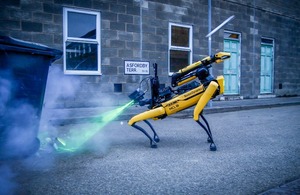
Robot dogs that can defuse explosives are set to revolutionise bomb disposal operations and significantly reduce the risk to military personnel, whether operating in the UK or overseas.


Image courtesy MoD

A new live trial led by Ministry of Defence scientists has seen advanced robotic systems, including robot dogs, successfully detecting and defusing bomb threats.

The Defence Science and Technology Laboratory (Dstl) trials took place over four days and included:   

  • Remote classification and identification of threats using sensors on robots  
  • Defusing of bombs from a robot dog
  • Drones with AI autonomous threat and people detection
  • Robots conducting tasks such as opening doors and climbing stairs 

The trial supports key components of the UK Government’s Plan for Change, safeguarding national security whilst rapidly advancing new technologies and showing defence as an engine for growth.  

Dstl worked alongside British and international industry, L3Harris, Marlborough Communications Ltd and AeroVironment (Tomahawk Robotics) on the trials which showed that they could enhance Explosive Ordnance Disposal (EOD) capability by:  

  • Reducing the need to put a bomb disposal operator in harm’s way by increasing the number of tasks that robots can perform remotely;  
  • Improving the effectiveness of robots, reducing the burden to the operator, allowing delicate and precision movements to be completed reliably;
  • Using drones equipped with AI to identify threats and monitor safety cordons, increasing the pace of operations and reducing disruption to the public.  

The trials involved a series of scenarios, where the robot was asked to perform various tasks including opening and closing doors autonomously, navigating stairs, inspecting improvised explosive devices (IEDs) and consequently firing disruptors at the IEDs to render them safe.

These innovations will transform EOD operations by minimising the human exposure to danger, improving operational efficiency and maintaining public safety.  

Minister for Defence Procurement and Industry, Maria Eagle, said: "This advanced technology demonstrates our commitment to protecting the military personnel who keep our nation safe, at home and abroad.   

"By working with industry and combining cutting-edge robotics with existing expertise, we’re ensuring our bomb disposal teams have the best possible tools to carry out their vital work safely and effectively.

"These advancements help the government deliver our Plan for Change and ensure defence is an engine for growth – protecting our national security while supporting rapidly evolving technologies."

Bomb disposal operators praised the technology demonstrated in the trial and provided beneficial feedback to shape the next phase of Dstl investment in robotics for the bomb disposal community. Dstl will use this feedback to continue to develop and enhance technology that provides increased security for the nation.  

Chief Science and Technology Officer, Dstl, Prof Andy Bell, said: "This is a great example of how Defence can achieve an advantage through the exploitation of technology, fusing together military and commercial systems to keep our people and country safe from deadly threats.

"Working in partnership with industry and academia, Dstl is delivering mission success through science and technology advantage."

Dr Paul Bosscher, Advanced Concept Engineer at L3Harris, said: “The demo provided the ideal platform for us to gain some valuable feedback on the dual-arm system from MoD operators who expect to use it during real-life EOD missions.

“It also opened up interesting discussions about the potential applications of the capability beyond EOD, with specialists from other fields such as chemical, biological, radiological, nuclear and explosives detection exploring how the capability might benefit their work.”

Related

Edgewing opens engineering hub in Italy with UK site to follow
The GCAP fighter jet
Edgewing opens engineering hub in Italy with UK site to follow
The first of three engineering hubs designed to support the development of the future GCAP fighter has opening, with similar sites in the UK and Japan coming soon.
Aerospace Defence

9 Oct 2026

Marshall Aerospace begins new chapter as Aurelius acquisition completes
Marshall Aerospace C-130s
Marshall Aerospace begins new chapter as Aurelius acquisition completes
The completion of AURELIUS' acquisition of Marshall Aerospace marks a new chapter in the company's illustrious history, which spans more than a century of engineering excellence, innovation and service.
UK and Germany back SaxaVord in new European space launch deal
SaxaVord Spaceport, Shetland
UK and Germany back SaxaVord in new European space launch deal
The UK and Germany have agreed to deepen space launch cooperation, with Scotland's SaxaVord Spaceport securing European access to orbit.
Aerospace Defence Space

9 Oct 2026

Sentinel Photonics brings multiple laser detection sensors into one hub
Sentinel Photonics' LASARD MAX Connect
Sentinel Photonics brings multiple laser detection sensors into one hub
With one single hub that joins up laser detection sensors, operators can now see, share and act on laser threats across a wide area in real time.
AI to help SMEs win defence contracts: Inside Strategical’s solution
Aerospace SME using AI to win defence contracts
AI to help SMEs win defence contracts: Inside Strategical’s solution
Smaller suppliers can struggle to turn technical capability into defence orders. Strategical is using AI to make specialist bidding expertise more accessible and help businesses focus on work they can realistically secure.
Defence Member News

10 Oct 2026

Edgewing opens engineering hub in Italy with UK site to follow
The GCAP fighter jet
Edgewing opens engineering hub in Italy with UK site to follow
The first of three engineering hubs designed to support the development of the future GCAP fighter has opening, with similar sites in the UK and Japan coming soon.
Aerospace Defence

9 Oct 2026

UK and Germany back SaxaVord in new European space launch deal
SaxaVord Spaceport, Shetland
UK and Germany back SaxaVord in new European space launch deal
The UK and Germany have agreed to deepen space launch cooperation, with Scotland's SaxaVord Spaceport securing European access to orbit.
Aerospace Defence Space

9 Oct 2026

Excelerate Technology to build UK CNI robotic security solution
Satellite in Earth orbit
Excelerate Technology to build UK CNI robotic security solution
In a project co-funded by the European Space Agency Business Applications and Space Solutions (ESA BASS) and supported by the UK Space Agency, Excelerate Technology will build and demonstrate how space-enabled assets can provide innovative safety and security solutions, including protection of Critical National Infrastructure (CNI) at a site in the UK.
World Space Week: How British technology will help ESA return to the Moon
ESA Argonaut
World Space Week: How British technology will help ESA return to the Moon
As Europe prepares to return to the Moon, British-developed LEIA LiDAR technology will help ESA's Argonaut lander autonomously identify safe touchdown zones on the lunar surface.
Space

5 Oct 2026

Sentinel Photonics brings multiple laser detection sensors into one hub
Sentinel Photonics' LASARD MAX Connect
Sentinel Photonics brings multiple laser detection sensors into one hub
With one single hub that joins up laser detection sensors, operators can now see, share and act on laser threats across a wide area in real time.
Big cargo drones complete first BVLOS delivery to North Sea wind farm
Skyports and Ørsted North Sea wind farm cargo drone trial
Big cargo drones complete first BVLOS delivery to North Sea wind farm
Skyports and Ørsted conducted a complex North Sea cargo drone trial, illustrating how heavy loads can safely and efficiently be delivered offshore beyond visual line of sight (BVLOS).
Aerospace Security

9 Oct 2026

UK Government and UKRI invest £54m to prevent future disease outbreaks
Poultry facility
UK Government and UKRI invest £54m to prevent future disease outbreaks
The UK Government and UKRI are investing £54 million in biosecurity research to tackle antimicrobial resistance, improve disease outbreak preparedness, develop next-generation vaccines and strengthen protection against emerging biological threats.
Security

8 Oct 2026