Engineering and defence jobseekers lower career ambitions, survey finds

Research from Tribepad finds that more than half of rejected jobseekers in engineering, manufacturing, aerospace and defence have lowered their ambitions.

Engineer male advance robotic machine designer team talking with electronic component part supplier business consulting in heavy machinery industry concept.
Photo: stock.adobe.com

More than half of jobseekers rejected for roles in engineering, manufacturing, aerospace and defence have lowered their career ambitions, according to new research from recruitment technology company Tribepad.

The company’s Confidence Collapse Report found that 52% of applicants in these sectors had lowered their expectations following unsuccessful job applications, compared with 47% across all sectors.

Almost a third (32%) had applied for jobs below their skill level, while 29% had lowered their salary expectations, compared with 20% nationally. A further 23% had stopped applying for more senior positions.

The findings raise questions about how recruitment practices affect the availability of experienced workers in sectors that rely on specialist technical skills.

Repeated rejection affects confidence

Tribepad commissioned OnePoll to survey 2,000 UK adults who had looked for work within the previous three years. The research was conducted between 8 and 24 July 2026.

Of those surveyed, 1,736 had experienced an unsuccessful application or rejection. The engineering, manufacturing, aerospace and defence findings are based on 103 respondents who had applied for jobs in these sectors.

  • More than half (51%) of this group reported losing motivation following rejection. 
  • Another 42% felt anxious about future applications 
  • 41% had lost confidence 
  • 33% felt hopeless about finding a suitable role
Tribepad Confidence Collapse Report
Graph: Tribepad

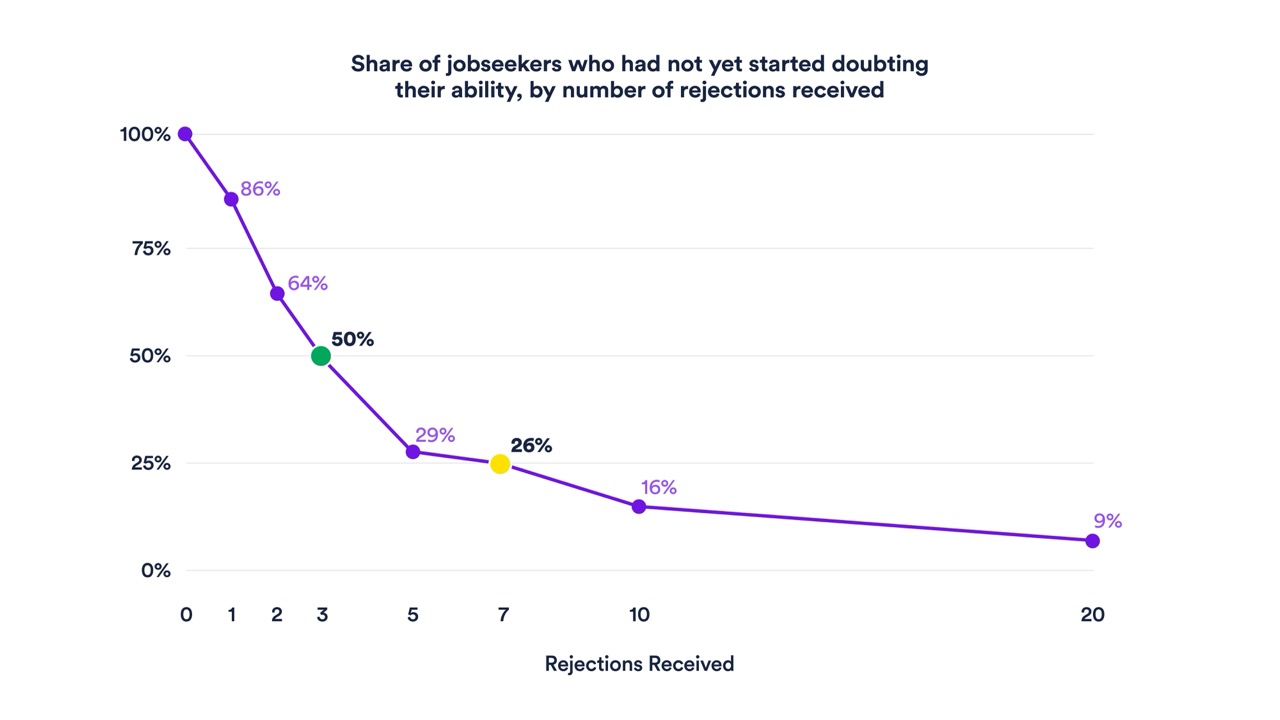
Across all sectors, the research found that repeated rejection could quickly affect candidate confidence. Among respondents who could identify when they began doubting their abilities, half reached that point within three unsuccessful applications. Almost three-quarters (74%) did so within seven.

  • 40% of respondents identified a lack of feedback or an explanation for rejection as the main reason their confidence had suffered
  • 22% pointed to repeated rejection as causing their lack of confidence
Tribepad Confidence Collapse report
Chart: Tribepad

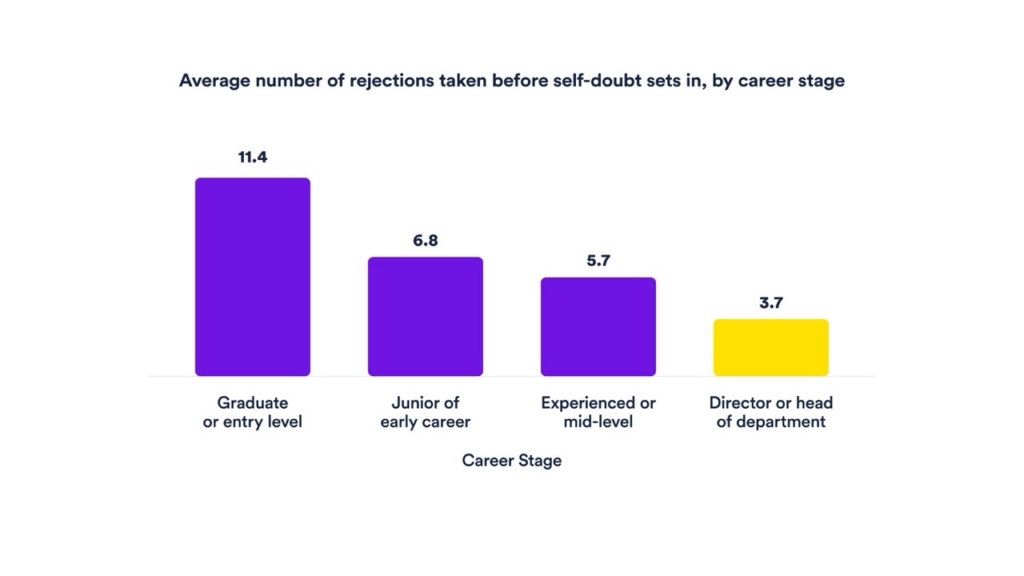
The report also found that more senior applicants may lose confidence sooner. Directors and heads of department began questioning their prospects after an average of 3.7 rejections, compared with 11.4 among graduates and entry-level applicants.

Lack of feedback damages confidence

Neil Armstrong, CEO of Tribepad, said: “What we found is people are aiming lower. They stop going for career progression and knock a few thousand off what they ask for. They apply for the job below the one they’re qualified for.”

He warned that employers could be overlooking the abilities of people who remain in work or continue applying for jobs.

“Employers can’t take rejection out of hiring. They can be far clearer about why someone hasn’t progressed. Communicated properly, a no is a decision about a single role. Told badly, or not at all, it feels like a verdict on what somebody is worth.”

AI recruitment raises further concerns

The increased use of AI tools in recruitment may also be contributing to applicants’ loss of confidence. 

  • Among those seeking engineering, manufacturing, aerospace and defence roles, 52% believed AI had been involved in rejecting an application, compared with 42% across all sectors.
  • Two-thirds (67%) of applicants in these industries had changed how they applied for jobs because they thought automated systems might be assessing them.

Across the wider survey, 72% could not say with certainty whether a person had reviewed their CV. However, only 3% pointed to AI or automated decision-making as the main cause of their loss of confidence.

Implications for UK employers

The findings come as the UK labour market has become more competitive. Figures cited in Tribepad’s press release put UK vacancies at 691,000 in July to September 2026, down 37,000 from a year earlier.

For aerospace, defence, engineering and manufacturing employers, the research suggests that qualified applicants may be seeking lower-paid or less demanding roles after repeated rejection.

Tribepad recommends that employers provide clearer information about recruitment timescales, explain where automated systems are used and improve feedback to unsuccessful applicants. It also advises companies to measure the experience of rejected candidates alongside conventional recruitment measures.

Related

University of Surrey develops electronic eye to monitor solar storms
HEPI prototype ‘electronic eye’ sensor
University of Surrey develops electronic eye to monitor solar storms
Under a £400,000 contract with the European Space Agency (ESA) and the UK Space Agency (UKSA), a team of researchers at the University of Surrey will develop an ultra-compact monitor to reveal the effects of radiation from solar storms on space infrastructure, aircraft and terrestrial systems like satellites.
Aerospace Space

18 Nov 2026

Global commercial aircraft orders surge 88% in Q3 2026, says new ADS report
British Airways A319 taxis at London Heathrow, UK, 17 November 2010
Global commercial aircraft orders surge 88% in Q3 2026, says new ADS report
Global commercial aircraft orders surge as record demand creates major opportunities and production challenges for UK aerospace manufacturers.
Aerospace

17 Nov 2026

Farnborough Airshow 2028 reaches 93% capacity as earliest-ever sell-out looms
Farnborough International Airshow
Farnborough Airshow 2028 reaches 93% capacity as earliest-ever sell-out looms
With 93% of exhibition and chalet space already secured, the Farnborough International Airshow 2028 is heading towards a historic early sell-out.
Aerospace Defence Events

17 Nov 2026

Royal Navy to deploy Arondite’s Cobalt AI software across UK Commando Force
Image: MOD Crown Copyright/LPhot Hutchins
Royal Navy to deploy Arondite’s Cobalt AI software across UK Commando Force
The Royal Navy has awarded Arondite a multi-million pound contract to equip the UK Commando Force with AI-enabled battlefield decision-making software.
Defence

18 Nov 2026

UK defence engineers showcase innovation at QinetiQ Powerboat Challenge
Teams competing in QinetiQ's Industry Powerboat Challenge 2026
UK defence engineers showcase innovation at QinetiQ Powerboat Challenge
10 industry teams tested their engineering skills at QintetiQ’s Industry Powerboat Challenge, highlighting innovation and the next generation of maritime talent.
Defence Member News

18 Nov 2026

HM King Charles opens new National Cyber Force HQ
HM King Charles III opens new NCF HQ at Ribble House, Samlesbury, Lancashire.
HM King Charles opens new National Cyber Force HQ
The new headquarters of the National Cyber Force (NCF) at Ribble House in Lancashire has been officially opened by HM King Charles III, where he gained insights into the vital role of the NCF in strengthening the UK’s cyber capability.
Defence Security

17 Nov 2026

University of Surrey develops electronic eye to monitor solar storms
HEPI prototype ‘electronic eye’ sensor
University of Surrey develops electronic eye to monitor solar storms
Under a £400,000 contract with the European Space Agency (ESA) and the UK Space Agency (UKSA), a team of researchers at the University of Surrey will develop an ultra-compact monitor to reveal the effects of radiation from solar storms on space infrastructure, aircraft and terrestrial systems like satellites.
Aerospace Space

18 Nov 2026

BAE Systems selected as NASA PRIMA partner
NASA’s PRIMA far-infrared space observatory, built on BAE Systems’ Evolve+ platform.
BAE Systems selected as NASA PRIMA partner
Alongside a number of international space industry providers, BAE Systems will support NASA’s PRIMA mission to survey the history and evolution of the universe and bridge current scientific gaps.
Member News Space

18 Nov 2026

First Light Fusion and STFC’s CLF partner on FLARE fast ignition
First Light Fusion team at STFC’s Central Laser Facility (CLF)
First Light Fusion and STFC’s CLF partner on FLARE fast ignition
A new collaboration between First Light Fusion and STFC’s Central Laser Facility (CLF) will develop the rapid heating stage of FLARE, advancing its progress towards low cost, high gain inertial fusion.
Your business has been hacked: What should happen in the first 24 hours?
Cyber security operations
Your business has been hacked: What should happen in the first 24 hours?
A cyber attack can stop operations within minutes. New NCSC guidance explains the critical decisions businesses must make in the first 24 hours.
Security

18 Nov 2026

HM King Charles opens new National Cyber Force HQ
HM King Charles III opens new NCF HQ at Ribble House, Samlesbury, Lancashire.
HM King Charles opens new National Cyber Force HQ
The new headquarters of the National Cyber Force (NCF) at Ribble House in Lancashire has been officially opened by HM King Charles III, where he gained insights into the vital role of the NCF in strengthening the UK’s cyber capability.
Defence Security

17 Nov 2026

Getlink plans drive-through biometric border checks at Eurotunnel terminals
Image: Getlink Group
Getlink plans drive-through biometric border checks at Eurotunnel terminals
Getlink plans camera-supervised biometric passport and fingerprint checks at Folkestone and Calais to prevent disruption as the EU’s new border system arrives.
Security

17 Nov 2026