Advancing UK Aerospace, Defence, Security & Space Solutions Worldwide
  • Home
  • /
  • Space
  • /
  • BAE Systems completes testing of NASA’s SPHEREx Observatory

Space

BAE Systems completes testing of NASA’s SPHEREx Observatory
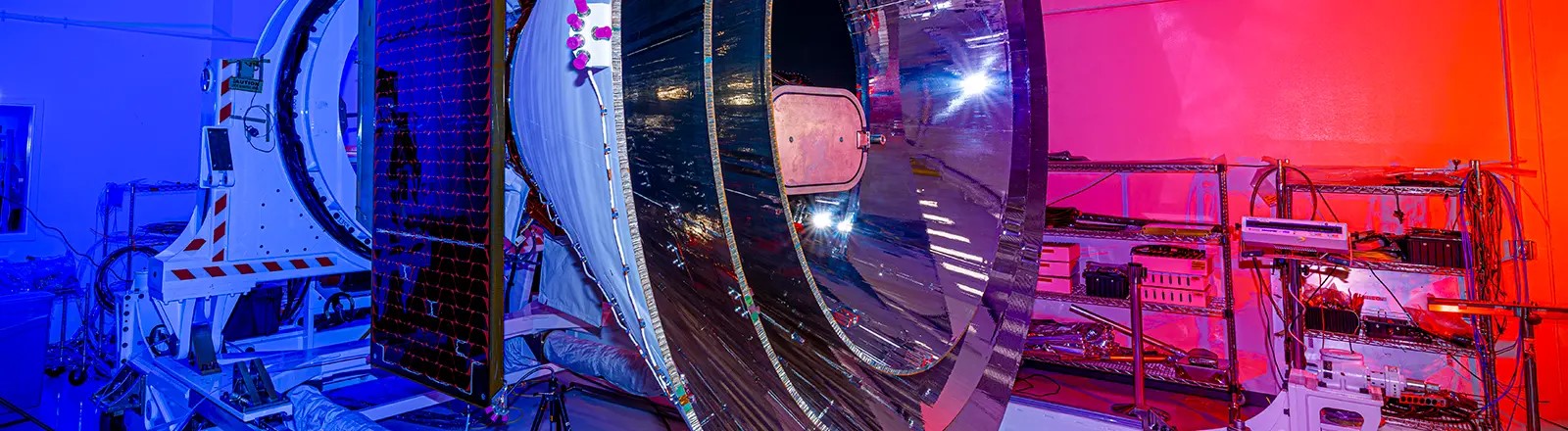
BAE Systems has completed environmental testing of NASA’s Spectro-Photometer for the History of the Universe, Epoch of Reionisation and Ices Explorer (SPHEREx) Observatory.

Image courtesy BAE Systems

This mission will conduct all-sky spectral surveys for the first time and provide scientists with new insights into the formation of the universe and the galaxies that inhabit it.

Over the course of its minimum two-year mission, SPHEREx will utilise an advanced imager to survey the entire sky in near-infrared light four times, providing the most high-resolution color maps of the universe ever created and gathering data on more than 450 million galaxies, along with millions of stars in our solar system.

Advertisement
ODU RT

These surveys will help to shed light on fundamental questions about the cosmos, map the 3D distribution of galaxies to study the expansion of the universe since the Big Bang, track the faint glow of ancient galaxies for clues as to how they formed and grew over time, and seek out how life-sustaining ingredients like water play a role in the development of planets.

“SPHEREx will allow us to look back into the early universe and provide new insights into how and why it came to be as it is,” said Alberto Conti, vice president and general manager of BAE Systems Space & Mission Systems. “We’re excited to help uncover these enduring mysteries and to continue our long-standing support of NASA’s astrophysics missions.”

In addition to its primary science missions, SPHEREx will also work to identify targets of interest for more detailed observation by other satellites, such as the James Webb Space Telescope, and help lay a foundation for future missions like the Nancy Grace Roman Space Telescope.

Advertisement
ODU RT

BAE Systems built the satellite bus for the mission, along with the instrument’s telescope and cover. The other instrument elements were developed by the California Institute of Technology (Caltech) and NASA’s Jet Propulsion Laboratory. Caltech’s Dr. Jamie Bock is serving as the principal investigator for the mission.

BAE Systems also led the observatory’s integration and environmental testing program, which includes thermal vacuum chamber tests that simulate temperature and conditions in space, vibration and acoustic tests that mimic launch conditions, and electromagnetic interference and compatibility tests to ensure the spacecraft isn’t vulnerable to electrical disruptions. With testing completed, BAE Systems will now enter final preparations for shipment and launch.

SPHEREx is scheduled to launch no earlier than February 2025.

Advertisement
FIA2026 animated banner
Bright Ascension software helps support AAC Clyde Space VIREON satellites

Space

Bright Ascension software helps support AAC Clyde Space VIREON satellites

7 April 2026

Bright Ascension's flight software has helped support the successful launch of two VIREON Earth observation satellites, developed by AAC Clyde Space.

Artemis II lifts off: destination Moon with the Orion spacecraft

Space

Artemis II lifts off: destination Moon with the Orion spacecraft

2 April 2026

Reid Wiseman, Victor Glover, Christina Koch and Jeremy Hansen have taken off from Kennedy Space Center, bound for the Moon. More than 50 years after Apollo, this first crewed flight beyond low Earth orbit marks a historic milestone for NASA’s Artemis programme. The stakes are twofold: to validate the Orion spacecraft's systems and hardware essential ...

Space Scotland hosts international forum in Edinburgh

Space Events

Space Scotland hosts international forum in Edinburgh

2 April 2026

Senior diplomats from 20 countries and some of Scotland’s most innovative space companies gathered in Edinburgh to turn international interest into tangible partnerships at 'Space Connects the World: Consular Corps Scottish Space Forum'.

ESM-2 set to power Artemis II crew to the Moon

Space

ESM-2 set to power Artemis II crew to the Moon

31 March 2026

As the world prepares for the launch of Artemis II - the first crewed mission to the Moon in over 50 years - the Orion European Service Module (ESM-2) is fully integrated, fuelled and 'go' for flight.

Advertisement
ODU RT
Scottish space companies pioneer next-gen satellite comms with SpaceX launch

Space

Scottish space companies pioneer next-gen satellite comms with SpaceX launch

31 March 2026

Three new satellites built in Scotland have launched aboard SpaceX’s Transporter-16 mission, marking a significant step forward for UK leadership in laser communications, spacecraft manufacturing and the operation of satellite constellations.

Funding available to advance UK space tech

Space

Funding available to advance UK space tech

30 March 2026

UK businesses can apply for a share of up to £14.7 million in funding from the UK Space Agency, unlocking new opportunities to develop cutting-edge space technologies and strengthen the UK’s industrial capability.

Advertisement
ODU RT
Advertisement
Gulfstream banner