Advancing UK Aerospace, Defence, Security & Space Solutions Worldwide

Space

BepiColombo to fly-by Earth
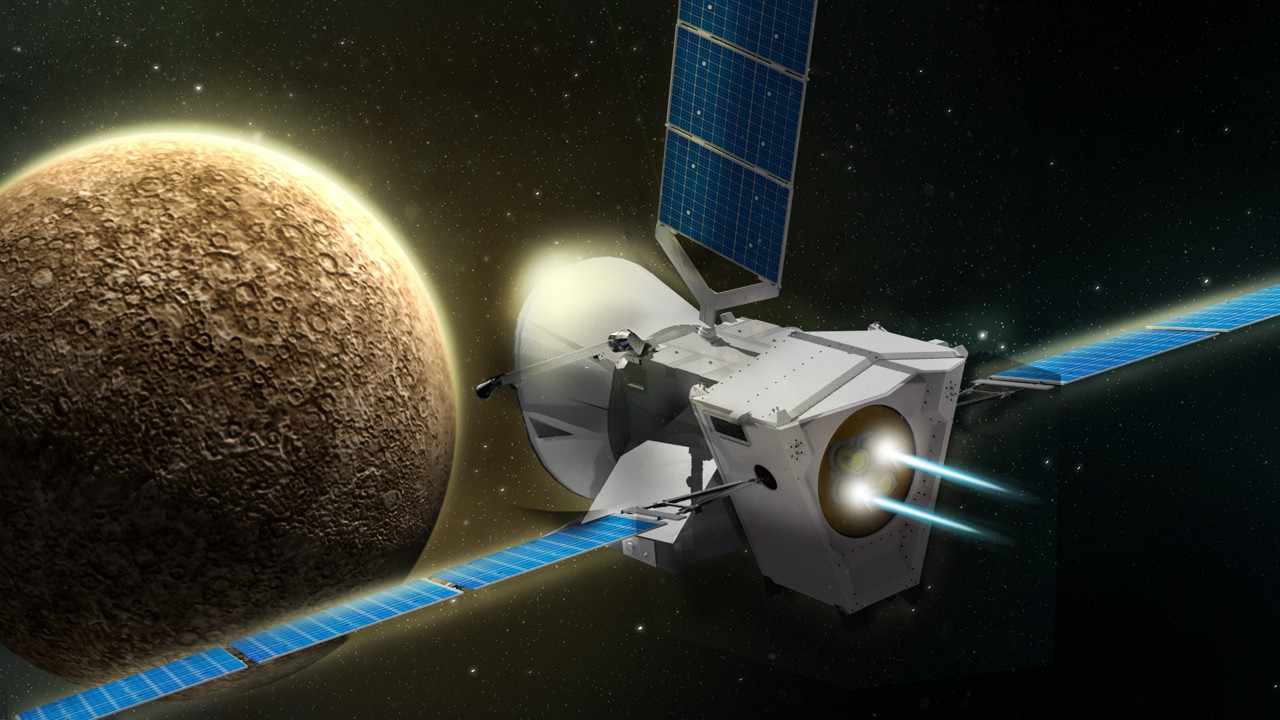
The Airbus built BepiColombo mission will make a fly-by past Earth on 10th April 2020 as it continues on its epic journey to Mercury.


Copyright Airbus

The joint European Space Agency and Japanese Space Agency spacecraft will swing past Earth at about 13,000 km away, closer than navigation satellites (GPS, Galileo). It will be BepiColombo’s final glimpse of Earth before it continues on its seven year, 8.5 billion kilometre journey to the Solar System’s innermost, smallest and least explored planet, Mercury. The last time the spacecraft saw Earth was 18 months ago in October 2018, when it was launched on an Ariane 5.

Advertisement
Leonardo animated rectangle

BepiColombo is not due to arrive at Mercury until 5th December 2025, but to get there safely and at the right speed to be captured by Mercury’s gravity, it must do nine flybys of the inner planets, one past Earth, two at Venus and six flybys at Mercury. After arrival, the spacecraft will capture data for a year with the possibility of extending the mission.

BepiColombo will collect measurements to study the composition, geophysics, atmosphere, magnetosphere and history of Mercury as well as testing Einstein’s theory of general relativity. The 16 scientific instruments will also provide insights into the characteristics of Mercury’s magnetic field and how it interacts with the solar wind.

Philippe Pham, Head of Earth Observation, Navigation and Science said: “This flyby marks a great achievement and major milestone for Airbus. Teams across five countries worked together to successfully develop and launch the spacecraft on a complex mission to Mercury.”

The journey will total some 8.5 billion km, completing 18 orbits around the Sun before entering the spacecraft’s operational orbit and beginning scientific exploration of the planet Mercury.

Advertisement
ODU RT


Advertisement
General Atomics LB
Viasat’s rocket telemetry service selected by INNOSPACE

Space

Viasat’s rocket telemetry service selected by INNOSPACE

12 December 2025

Korean launch provider INNOSPACE has selected Viasat’s rocket telemetry service for its first ever commercial launch, marking the first time this service will be used in a commercial mission carrying satellite payloads.

ITA Airways adopts Iris tech

Aerospace Space

ITA Airways adopts Iris tech

11 December 2025

Viasat has announced that ITA Airways is being equipped with Iris technology, paving the way to trajectory-based operations which can cut emissions and enhance airline efficiency.

Pilot programme to advance UK space ecosystem

Space

Pilot programme to advance UK space ecosystem

10 December 2025

Eighteen space businesses across the UK will receive funding and support from their local space cluster to accelerate their commercial growth, as part of a pilot initiative designed to strengthen the UK's space sector supply chain.

Cosmic trip set to help bacteria protect future space missions from radiation

Space

Cosmic trip set to help bacteria protect future space missions from radiation

10 December 2025

A new research collaboration which fuses fashion and science is set to send bacteria into space – and the outcomes could create radiation-sensitive fabrics capable of preventing skin cancer on Earth and protecting space explorers on the Moon.

Advertisement
Leonardo animated rectangle
Cobham Satcom and Gatehouse Satcom

Defence Security Space

Cobham Satcom and Gatehouse Satcom's Network Division to merge

8 December 2025

Cobham Satcom and Gatehouse Satcom today announced a strategic merger between Gatehouse Satcom and Cobham Satcom’s Network Division.

Pulsar Fusion wins support from ESA

Space

Pulsar Fusion wins support from ESA

5 December 2025

Bletchley based Pulsar Fusion has won an 18 month contract from the European Space Agency (ESA) to advance its Hall-Effect Thruster technology in preparation for future space missions.

Advertisement
ODU RT