

UK space start-up completes cancer drug experiment aboard ISS after £9.8m funding boost


A UK biotechnology company has completed a six-week experiment aboard the International Space Station (ISS) to produce pharmaceutical crystals that could eventually allow some cancer patients to receive treatment through injections at home rather than intravenous infusions in hospital.
London-based BioOrbit, which secured £9.8 million in seed funding earlier this year, used a specially developed manufacturing unit to grow protein crystals in microgravity. The company hopes the process will make it possible to produce highly concentrated cancer medicines that are difficult to manufacture on Earth.
UK Research and Innovation (UKRI) announced the successful completion of the mission on 23 October, describing it as an important step towards commercial pharmaceutical manufacturing in space.
BioOrbit launched its experimental platform, known as Baby BOX-E, aboard a SpaceX rocket from NASA’s Kennedy Space Center in Florida on May 15. The equipment was sent to the ISS, where it remained for approximately six weeks.
According to UKRI, the mission achieved what it described as the largest-scale production of protein crystals in space to date.
The company is now seeking to develop the technology for commercial manufacturing, with the longer-term aim of establishing a pharmaceutical production facility in orbit within the next decade.
How manufacturing medicines in space could work
BioOrbit’s research focuses on the way pharmaceutical proteins crystallise in microgravity.
On Earth, gravity can affect how crystals form, making it difficult to produce the uniform structures needed for certain concentrated drug formulations.
In the near-weightless environment of the ISS, proteins can form more consistent crystals, potentially allowing manufacturers to develop medicines with greater stability and higher concentrations.

This is particularly relevant to antibody-based cancer treatments, which often require large doses delivered through intravenous infusions.
Many of these medicines cannot easily be administered through conventional injection devices because highly concentrated liquid formulations can become too thick to pass through a needle.
BioOrbit believes that producing protein crystals in space could overcome some of these difficulties.
The crystals would be returned to Earth and processed into pharmaceutical formulations suitable for injection. The company’s objective is to allow patients to administer certain treatments themselves at home or at work, rather than travelling to hospital for lengthy infusions.
Dr Katie King, BioOrbit’s co-founder and chief executive, previously explained that crystallisation could make highly concentrated medicines easier to inject.
“Through using crystals, you can get these really concentrated formulations that will have a low enough viscosity that they can still flow through the needle,” she said.
The technology remains at the experimental stage. Any medicines developed through the process would still require clinical trials and regulatory approval before becoming available to patients.
BioOrbit secures record £9.8m investment
BioOrbit’s first orbital experiment follows a £9.8 million seed funding round, which UKRI describes as the largest secured by a start-up specialising in pharmaceutical manufacturing in space.
The investment was led by UK venture capital firm LocalGlobe and Paris-based Breega.
Founded in 2023 by King and oncology researcher Dr Leonor Teles, BioOrbit has developed its technology in London, with support from the European Space Agency Business Incubation Centre UK (ESA BIC UK).

The company estimates that its approach could reduce drug administration costs by up to 90%, although this remains a projection rather than a demonstrated saving.
It believes home administration could reduce pressure on hospitals and make treatment more convenient for patients living in remote areas or those with weakened immune systems.
King said the successful mission represented an important development in the company’s plans.
“This mission marks the beginning of a new era in how medicines can be manufactured,” she said.
“By manufacturing therapies in microgravity, we can unlock formulations that have the potential to make cancer treatment more accessible, more effective and far easier for patients to receive.”
King said the company had been developing the necessary orbital manufacturing technology since joining ESA BIC UK.
“Our vision is simple: to help move cancer treatment from the hospital ward to the home,” she added.
“Long term, we aim to establish a pharmaceutical manufacturing facility in space within the next decade, enabling patients to access life-changing treatments more conveniently than ever before.”
UK space industry support helps develop technology
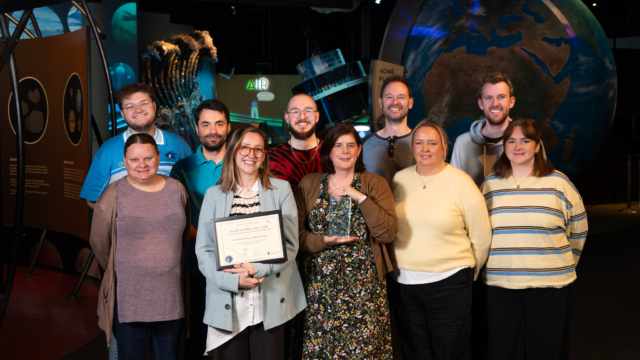
BioOrbit joined ESA BIC UK in 2023 through the Science and Technology Facilities Council’s (STFC) DeepTech Catalyst programme.
The incubation centre is delivered in partnership with the European Space Agency, UK Space Agency and University of Leicester. It provides early-stage companies with access to research facilities, technical expertise, funding opportunities and business development support.
The programme has supported 179 start-ups across the UK since its establishment in 2011.
According to an independent evaluation released to mark its 15th anniversary, ESA BIC UK has helped create or sustain more than 1,060 jobs and enabled participating companies to raise £340 million in private investment.
The evaluation found that every £1 spent on the programme generated £11 in additional economic benefit.
Paul Vernon, STFC’s executive director for business and innovation, said BioOrbit demonstrated how the UK’s space technology sector could support developments in healthcare.
“BioOrbit represents exactly the kind of bold, potentially world-changing innovation the ESA BIC UK was created to support,” Vernon said.
“By applying the unique environment of space to one of healthcare’s biggest challenges, the company is opening up exciting new possibilities for how complex cancer medicines could be manufactured and delivered.”
He added: “If successful, this technology could help enable cancer patients to receive less invasive treatment from their own homes.”
Vernon said the project also demonstrated the UK’s ability to combine scientific research, commercial investment and space manufacturing capabilities.
Commercial production remains several years away
BioOrbit has previously indicated that it could take at least five years for medicines developed using its technology to reach patients, given the need for clinical testing and regulatory approval.
The company intends to work with pharmaceutical manufacturers to develop commercial products and has reported interest from multinational drug companies in the UK and the United States.
Its proposed manufacturing approach could also be applied to medicines beyond cancer treatment.
BioOrbit has said that multiple BOX-E units could eventually operate together to increase production volumes, although commercial-scale manufacturing has yet to be demonstrated.
The company also secured a £250,000 UK Space Agency contract earlier this year to support pharmaceutical manufacturing in microgravity.
Other companies are exploring similar opportunities. US-based Varda Space Industries has conducted orbital pharmaceutical processing experiments using recoverable spacecraft and is working with United Therapeutics on research into treatments for rare lung diseases
Sign up for our newsletter and get our latest content in your inbox.
Similar Reads



Sign up for our newsletter. Select all sectors relevant to you.
Related