Advancing UK Aerospace, Defence, Security & Space Solutions Worldwide
  • Home
  • /
  • Space
  • /
  • CERES reconnaissance space system launched

Space

CERES reconnaissance space system launched
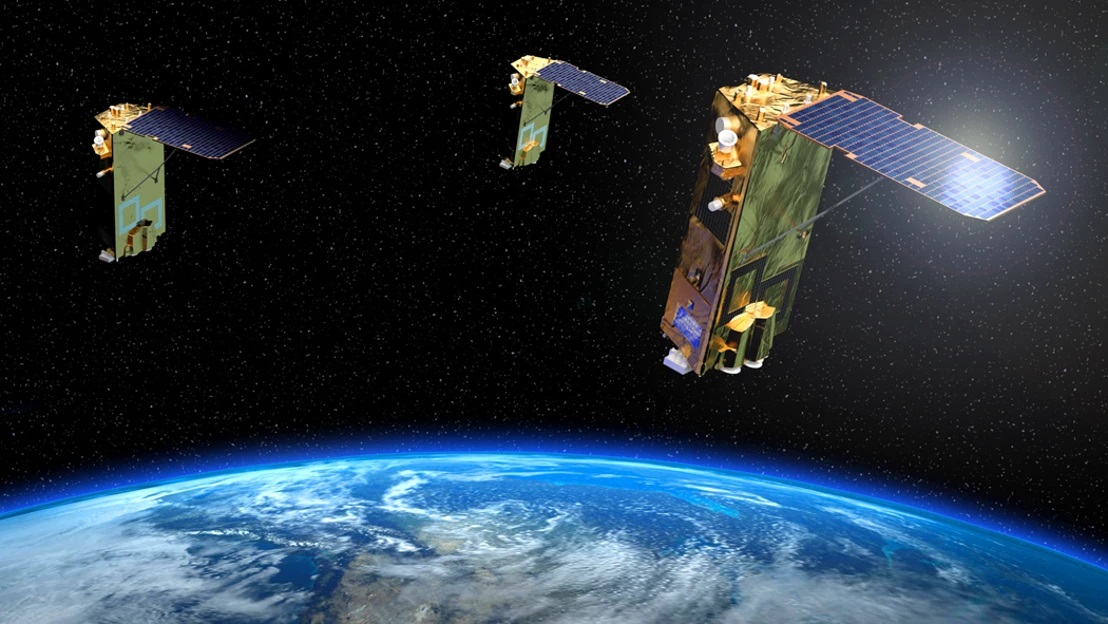
The CERES space system (Capacité de Renseignement Electromagnétique Spatiale or Space-based Signal Intelligence Capability) satellites - designed and built by Airbus Defence and Space and Thales for the French Armament General Directorate (DGA) - have been successfully launched from the European spaceport in French Guiana, on-board a Vega launcher.

Image courtesy Airbus and Thales

“We are ready to go with the next generation of space surveillance capability for France: CERES! Entrusting Airbus with the construction and full space system responsibility is a ringing endorsement of our expertise and the quality of our technology, acquired in particular from the ESSAIM and ELISA demonstrators,” said Jean Marc Nasr, Head of Space Systems at Airbus. “The three CERES satellites will provide France with its first satellite system for signal intelligence, thus confirming our ability to act as prime contractor for French space-based intelligence systems,” he continued.

Advertisement
PTC rectangle

CERES is designed to detect and geo-locate electromagnetic signals from radio communication systems and radars from areas where surface sensors cannot reach. From its low Earth orbit, CERES is free from airspace overflight constraints and can operate in all types of weather. The system will provide in-depth information to support military operations for the French Armed Forces, thus improving situational awareness.

“CERES will complete the French strategic and tactical defence intelligence capability with its first signal intelligence (SIGINT) satellite system. DGA trusts Thales to be in charge of the CERES end-to-end mission performance, for which we rely on our experience of more than 20 years in space-based SIGINT, especially with ESSAIM and ELISA, our unique know-how in satellite payloads and user ground segments, and our wide knowledge in SIGINT and electronic warfare in all environments”, said Philippe Duhamel, Executive Vice-President, Defence Mission Systems at Thales.

The system includes the space segment consisting of a swarm of three identical satellites carrying the SIGINT payload, as well as the user and ground control segments.

Airbus Defence and Space and Thales are co-contractors for the full end-to-end system. Airbus is responsible for the global system integration and the space segment comprising the three satellites, while Thales is responsible for full mission chain and system performance, going from on-board payload to user ground segment. In addition, Thales Alenia Space acted as a subcontractor to Airbus in supplying the satellites’ platforms. The French space agency, CNES, as assisting partner to the DGA, procured the launch services and the ground control segment.

CERES draws on Airbus and Thales’ experience acquired from the ESSAIM (communications intelligence) and ELISA (electronic intelligence) micro-satellite demonstrators launched in 2004 and 2011 respectively. The technical and operational lessons learnt from these systems were key to enabling the very high performance in electromagnetic detection and compatibility, demanded by this mission.

Advertisement
Security & Policing Rectangle


Advertisement
ECS leaderboard banner
EECL secures £1.5m contract with ESA

Space

EECL secures £1.5m contract with ESA

5 February 2026

Kingston-Upon-Thames based European Engineering Consultancy Ltd (EECL) has been awarded a £1.5 million contract by the European Space Agency (ESA) to deliver ground support equipment and environmental and space-qualification testing for a next-generation digital satellite payload.

Returning to STEM after career break becomes harder than ever

Aerospace Defence Security Space

Returning to STEM after career break becomes harder than ever

4 February 2026

Returning to STEM industries after a career break is now harder than ever, according to new research by STEM Returners, with bias against gender, age, ethnicity and a lack of recent experience penalising highly qualified people from getting a job.

UK-Japan partnerships advance quantum and future connectivity tech

Aerospace Defence Security Space

UK-Japan partnerships advance quantum and future connectivity tech

4 February 2026

Joint investments will advance quantum technology, boost digital connectivity and strengthen network resilience against cyber threats.

Investment in satellite timing infrastructure to strengthen UK resilience

Space

Investment in satellite timing infrastructure to strengthen UK resilience

3 February 2026

GMV are to lead the development of a secure Two-Way Satellite Time and Frequency Transfer system under the TOUCAN project - funded by the UK Space Agency through the European Space Agency's Navigation Innovation and Support Programme (ESA NAVISP) - which is an important part of the UK Government's Framework for Greater PNT Resilience.

Advertisement
ODU RT
Paul Bate to step down as UK Space Agency CEO

Space

Paul Bate to step down as UK Space Agency CEO

3 February 2026

Dr Paul Bate will be stepping down as Chief Executive of the UK Space Agency at the end of March 2026.

Viasat launches satellite service portfolio for government UAV ops

Defence Security Space

Viasat launches satellite service portfolio for government UAV ops

2 February 2026

Viasat today launched its next-generation satellite service portfolio, engineered to meet the evolving demands for government uncrewed aerial vehicle (UAV) operations worldwide, including intelligence surveillance and reconnaissance (ISR), emergency response and special operations.

Advertisement
PTC rectangle
Advertisement
Babcock LB Babcock LB