
General Atomics

Cranfield University develops plant blast barrier

New research has revealed how everyday plants can help protect the public from blast impacts, whilst transforming cities into greener, healthier spaces.


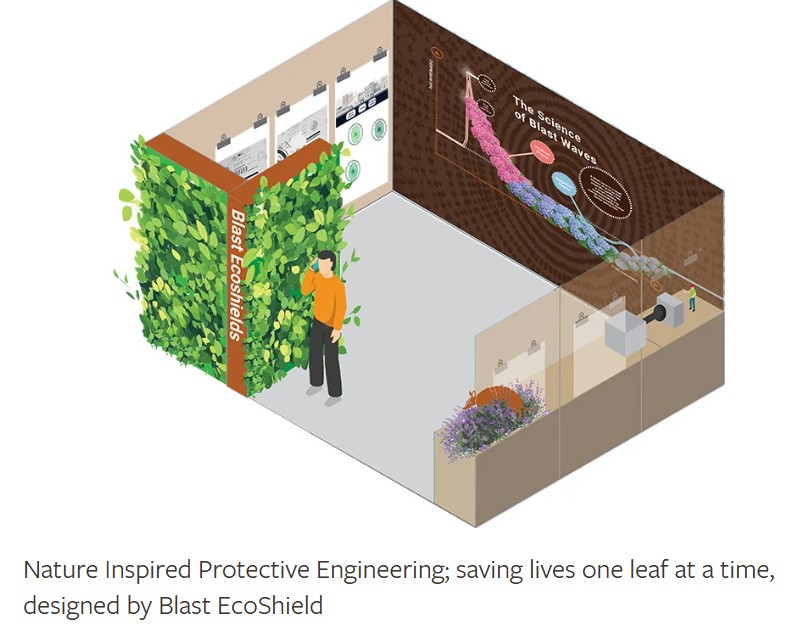
Above: The project, Blast Ecoshield, conceived and led by Cranfield’s Dr Rachael Hazael CEng, will be exhibited at the RHS Chelsea Flower Show 2026 for the first time.
Credit: Blast EcoShield / Cranfield University


The innovation is part of a four-year research project with experts that designed, experimentally validated and commercialised a potentially life saving product.

Blast Ecoshield, a modular plant barrier, will be exhibited at the RHS Chelsea Flower Show 2026 and has potential applications at arenas, large scale public events, high-profile venues such as conference centres and in protecting critical national infrastructure.

Conceived and developed by Dr Rachael Hazael, Reader in Applied Materials at Cranfield University, the groundbreaking work has explored how certain native plant species naturally behave like protective engineering materials.

A survivability specialist who has spent years researching protective materials, Dr Hazael has conducted over 50 extensive blast experiments to study how plants dissipate energy. The results showed that when arranged in specific ways, the living structures of plants can mitigate the impact of an explosive blast significantly.

Nature inspired engineering with real potential

“Plants have evolved over millions of years to survive extreme heat, pressure and movement,” explained Dr Hazael. “Some of those characteristics mirror the properties we design into protective clothing and blast-resistant materials. Once you join the dots and enhance these properties with engineering, the potential for using plants to help protect people becomes incredibly exciting. Nature offers brilliant engineering solutions; we just need to harness them.”

The project has identified plant types with just the right balance of flexibility and strength, focusing on native species that look good year-round, which support biosecurity and can even be colour matched for major events like state visits or sporting fixtures.

Bringing together explosive engineering, materials behaviour and horticultural design, the modular vegetated physical barriers give protection whilst remaining sustainable. The concept is now being developed into a university spin out, Blast EcoShield, with plans to bring the innovation to market.

A green way to keep people safe
The project aligns with a number of national and international policies including Environmental, Social and Governance (ESG) policy and outputs of the UN Climate Summit COP 27.

It also supports the Terrorism (Protection of Premises) Act 2025 (also known as Martyn’s Law), which focuses on improving public safety in crowded places.

Currently, large venues, city centres and event spaces rely on heavy barriers and security fencing to reduce vulnerability. Yet these can create a negative atmosphere for visitors. In contrast, green living walls offer a subtle, discreet, sustainable and effective protection for people and infrastructure.

The concept developed will improve wellbeing whilst meeting safety requirements.

As cities face growing pressures from climate change and public safety, this project could help shape a new generation of sustainable and safe urban design.

“Cities are already embracing greener design to tackle pollution, heat and mental health challenges,” said Dr Hazael. “If we can enhance that greenery so it also provides passive protection, it really is a win-win.”

A showcase at RHS Chelsea
Blast Ecoshield will be exhibited at RHS Chelsea’s GreenSTEM area in the Great Pavilion. The display will include a selection of the plant species tested in the research, blast experiment footage, demonstrations to show how plants interact with a simulated blast wave and an eco-friendly stand constructed from reclaimed materials including wood from aerodynamic wind tunnels. The stand is fully accessible with ramps and QR codes for audio commentary.

After the show, the entire garden will be relocated to the Defence College for Military Capability Integration at the UK Defence Academy, where Cranfield is academic provider to the UK Ministry of Defence. The garden will give students the opportunity to see how protecting people from explosive blasts can be done more sustainably.

Related

RAF roundels explained: Why Royal Air Force aircraft use different markings
RAF Red Arrows and Typhoon open Farnborough International Airshow 2022
RAF roundels explained: Why Royal Air Force aircraft use different markings
RAF roundels have identified British military aircraft for more than a century. Here's why Royal Air Force aircraft carry different markings, from Spitfires to today's stealthy F-35 fleet.
Aerospace Defence

3 Oct 2026

UK Government opens scheme to slash manufacturers’ electricity bills
Jonathan Reynolds
UK Government opens scheme to slash manufacturers’ electricity bills
Applications for the British Industrial Competitiveness Scheme (BICS) are now open to over 10,000 manufacturing businesses.
Aerospace Defence

2 Oct 2026

UK Government proposes airline fee reforms and tougher measures on disruptive passengers
Aircraft landing at Heathrow Airport
UK Government proposes airline fee reforms and tougher measures on disruptive passengers
New aviation proposals would end charges for seating young children with accompanying adults, restrict fees for simple booking errors and strengthen airline cooperation on repeat disruptive passengers.
Aerospace

2 Oct 2026

RAF roundels explained: Why Royal Air Force aircraft use different markings
RAF Red Arrows and Typhoon open Farnborough International Airshow 2022
RAF roundels explained: Why Royal Air Force aircraft use different markings
RAF roundels have identified British military aircraft for more than a century. Here's why Royal Air Force aircraft carry different markings, from Spitfires to today's stealthy F-35 fleet.
Aerospace Defence

3 Oct 2026

Royal Navy tests autonomous systems against threats to critical underwater infrastructure
Exercise Repmus 2026 in Portugal
Royal Navy tests autonomous systems against threats to critical underwater infrastructure
The Royal Navy used NATO's REPMUS exercise in Portugal to evaluate autonomous vessels, underwater gliders and other emerging capabilities designed to detect underwater threats and protect critical infrastructure.
Defence

2 Oct 2026

UK targets 30% rise in RAF A400M availability under £190m Airbus deal
Pictured here is an Royal Air Force A400M Atlas flying thought the machloop in Wales on the 21st November 2024.
UK targets 30% rise in RAF A400M availability under £190m Airbus deal
A £190m Airbus support deal will target a 30% increase in RAF A400M availability while sustaining more than 350 UK jobs through April 2029.
Defence

2 Oct 2026

SatVu’s HotSat-3 launches on SpaceX mission to double thermal satellite capacity
SAtVu HotSat
SatVu’s HotSat-3 launches on SpaceX mission to double thermal satellite capacity
SatVu has launched HotSat-3 aboard SpaceX’s Transporter-18 rideshare mission, adding capacity for high-resolution thermal intelligence from space.
Member News Space

2 Oct 2026

Orbex’s UK manufacturing assets and IP acquired by Omnidea
Omnidea engineering testing platform
Orbex’s UK manufacturing assets and IP acquired by Omnidea
Portugal's Omnidea has purchased the manufacturing assets and intellectual property (IP) of British rocket manufacturer Orbex UK, which ceased operations in February this year and went into administration.
Member News Space

2 Oct 2026

Filtronic wins SpaceX contract to support Starlink network
ground station
Filtronic wins SpaceX contract to support Starlink network
Sedgefield headquartered Filtronic has won a $68.1 million (£51.52m) order from SpaceX to support its Starlink network, highlighting the growing global demand for UK-developed space technology.
Member News Space

1 Oct 2026

Cohort appoints Richard Mills as Group Strategy Director
Richard Mills
Cohort appoints Richard Mills as Group Strategy Director
Former Boeing executive Richard Mills will lead the growth strategy of Cohort and its seven subsidiaries which specialise in defence and security technology across the UK, Germany, Portugal and Australia.
BAE Systems proves complete counter-drone kill chain in Scotland trials
Container and Sensor
BAE Systems proves complete counter-drone kill chain in Scotland trials
BAE Systems has demonstrated its complete BATS counter-drone chain in Scotland, integrating sensors, electronic warfare and a gun system.
Security

1 Oct 2026

Doncaster Sheffield Airport takes another step towards reopening with new firefighting fleet
Doncaster Sheffield Airport fire appliance
Doncaster Sheffield Airport takes another step towards reopening with new firefighting fleet
Doncaster Sheffield Airport has ordered three specialist aviation firefighting vehicles as preparations continue for its planned reopening.