Advancing UK Aerospace, Defence, Security & Space Solutions Worldwide
  • Home
  • /
  • Space
  • /
  • Cranfield University unveils wind-powered WANDER-bot

Space

Cranfield University unveils wind-powered WANDER-bot
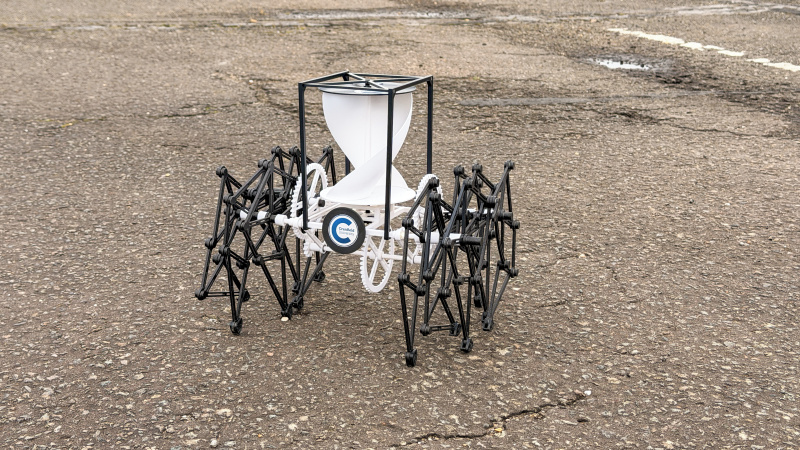
Researchers at Cranfield University have created WANDER-bot, a low-cost, 3D-printed robot that is powered by wind energy.

Image courtesy Cranfield University

Designed to spend long durations in hostile, windy environments such as certain deserts, polar regions or even other planets, WANDER-bot does notneed a battery to power movement, enabling longer operations without having to pause and recharge.

Movement accounts for around 20% of battery use in most robots, so running on natural energy makes WANDER-bot an efficient solution for long-term exploration or mapping of unknown terrains. As a result, any electronic elements added to future versions for data collection or transmission purposes could have their own smaller, lighter power source. Using natural energy also counters the issue of performance degradation over time in traditional power sources, such as solar cells and radioisotope thermoelectric generators.

Advertisement
ODU RT

Designed by Dr Saurabh Upadhyay and Sam Kurian, Research Associate in Space Engineering, the robot uses parts that are entirely 3D printed, with the design deliberately simple to allow for quick repair and replacement. This means that, in theory, you could print and construct WANDER-bot anywhere and make replacement parts in situ as needed, removing the need for time-consuming and costly resupply missions.

Inspiration for the robot’s eye-catching design came from Dutch artist Theo Jansen’s Strandbeesten creations. WANDER-bot uses the Jansen linkage mechanism in combination with a Savonius wind turbine to power its movement.

“There are many challenges when it comes to robotic exploration,” said Dr. Saurabh Upadhyay, Lecturer in Space Engineering at Cranfield University. “Battery capacity limits things like range, and technological complexity limits the ability to repair in an environment where human occupation would be minimal and their capability for manufacturing or maintenance is limited due to the harsh conditions.”

Advertisement
PTC rectangle

“WANDER-bot is a first step towards low-cost, repairable, self-sufficient robots that can explore environments that are currently difficult for humans to reach and work in, such as other planets, or places on Earth where it’s impractical for people to spend long periods of time.”

WANDER-bot was shown as a poster presentation at the European Space Agency’s ASTRA Conference 2025. This initial robot is a low TRL prototype, made to demonstrate how a robot can harness wind power to move. The next step will be to increase the manoeuvrability, giving WANDER-bot the ability to change directions and tackle more challenging terrain.

This research was supported by the UK-RAS Network+ at the University of Manchester and funded by the UK Engineering and Physical Sciences Research Council (EPSRC), part of UK Research and Innovation (UKRI).

Advertisement
Gulfstream banner
Orbit Fab and Airbus collaborate on satellite refuelling

Space Events

Orbit Fab and Airbus collaborate on satellite refuelling

12 March 2026

Orbit Fab are working with Airbus Defence and Space to assess the feasibility of incorporating Orbit Fab’s RAFTI refuelling valve into possible future Airbus geostationary satellites, as part of a project within the European Space Agency’s programme of Advanced Research in Telecommunications Systems, named RADICAL, funded by the UK Space ...

BAE Systems completes preliminary design review of USSF missile tracking system

Defence Space

BAE Systems completes preliminary design review of USSF missile tracking system

12 March 2026

BAE Systems has completed the Preliminary Design Review for the $1.2 billion US Space Force (USSF) Space Systems Command (SSC) Resilient Missile Warning & Tracking (RMWT) – Medium Earth Orbit (MEO) Epoch 2 programme to provide missile warning and tracking of advanced missile threats.

UK scientists help reveal ever-changing Universe

Space

UK scientists help reveal ever-changing Universe

12 March 2026

As the Vera C. Rubin Observatory issues live alerts of changes in the night sky, a UK innovation allows us to observe millions of unfolding astronomical events.

Dr Noelia Noël awarded STFC Leadership Fellowship in Public Engagement

Space

Dr Noelia Noël awarded STFC Leadership Fellowship in Public Engagement

12 March 2026

Dr Noelia Noël, Senior Lecturer in Astrophysics at the University of Surrey, has been awarded this year’s Leadership Fellowship in Public Engagement from the Science and Technology Facilities Council (STFC).

Advertisement
PTC rectangle
UK-first achieved in advanced materials

Aerospace Defence Space

UK-first achieved in advanced materials

11 March 2026

The UK has established its first sovereign manufacturing capability for ultrahigh temperature materials - vital for space, hypersonic and propulsion systems.

ALL.SPACE and Viasat advance Ka-band connectivity

Defence Security Space

ALL.SPACE and Viasat advance Ka-band connectivity

10 March 2026

ALL.SPACE today announced a strategic collaboration with Viasat and the successful certification of the ALL.SPACE Hydra terminal to operate on the Viasat Global Xpress (GX) network, which provides integrated military Ka-band spectrum access for government and defence missions.

Advertisement
ODU RT
Advertisement
Gulfstream banner