DASA launches £1.6m competition to get missiles talking
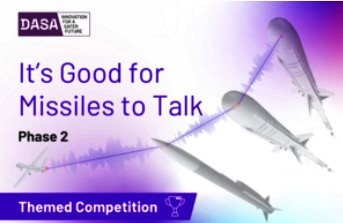
Image courtesy DASA / Meteor graphic copyright MBDA
The Defence and Security Accelerator (DASA has launched a new Themed Competition: It’s Good for Missiles to Talk Phase 2.
The aim is to identify and develop novel technologies that could be exploited in the development of a new category of missile – cooperative missiles.

Cooperative missiles can communicate with each other, share situational awareness and organise themselves to ‘work together’ efficiently, during an engagement and within operator-set constraints, to achieve a common objective.
The aim of the work is to:
- Develop technologies to deliver cooperative missiles
- Demonstrate how the capability could be integrated into future systems
The implementation of cooperative missiles will offer UK armed forces’ enhanced capability, providing a significant advantage in comparison to current capability. There are many benefits that can be realised. For example, considering collateral damage during missions or live safety data updates if non-combatants enter the battlefield post-launch. Cooperative missiles can share this vital information to ensure an abort function is carried out live during a mission, under human operator authority.
It is important to note that the operation of UK missile systems will always remain under human control and DASA are only interested in technologies that could enable cooperation between missiles within this context.
Key Dates and Funding
Up to £1.6 million (ex VAT) is available for this competition with an expectation to fund multiple proposals between £100,000 to £300,000 (ex VAT) over a maximum project duration of 12 months.
Submission deadline is midday (GMT) on Tuesday 20th February 2024.
A Q&A webinar will take place on Tuesday 12th December 2023 with 1-2-1 sessions taking place on Tuesday 19th December and Tuesday 16th January 2024.
The Challenge Areas
This competition has five challenges:
- Distributed target detection and identification
- Data processing on board and between missiles
- Enhanced navigation through cooperation
- Finding and engaging multiple targets distributed over a wide area
- Novel Missile Communication Systems
Phase 2 of this DASA competition builds on Phase 1 with more focused challenge areas. Proposals from innovators that seek to expand on their Phase 1 work are welcome, as well as innovators that are new the competition. Successful submissions into phase 2 will identify and increase the maturity of novel technologies to enable exploitation in future cooperative missile programs.
DASA encourages proposals where the innovation should output over a range of Technology Readiness Level (TRL) 3-5.
Successful proposals will present credible plans for progressing new, advanced technologies which could underpin a future cooperative missile.
Strategic partners
Throughout this competition UK missile strategic partners MBDA and Thales will provide technical support to the MoD competition team.
Supporting events
Tuesday 12th December 2023 - dial-in Q&A webinar. This session will provide further detail on the problem space from the MoD competition team and provide a chance to ask questions in an open forum. If you would like to participate, please register on the Eventbrite
page.
Tuesday 19th December 2023 and Tuesday 16th January 2024 – a series of 20 minute one-to-one teleconference sessions, giving you the opportunity to ask specific questions to the MoD competition team. If you would like to participate, please register on the below Eventbrite page. Booking is on a first come first served basis.
1-2-1 Session Tuesday 19th December 2023 – Eventbrite link
1-2-1 Session Tuesday 16th January 2024 – Eventbrite link
For full details and to submit a proposal, read the full Competition Document