DragonFire to be installed earlier on Royal Navy ships
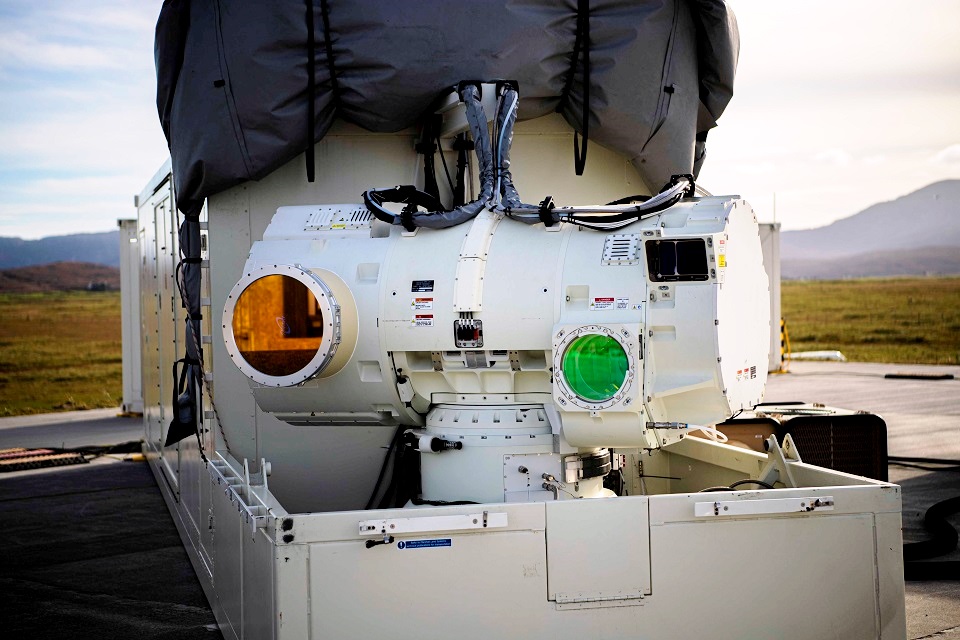
Image courtesy Dstl / MoD
The cutting-edge DragonFire laser will be installed on Royal Navy warships for the first time from 2027 – far quicker than previously envisaged – thanks to new defence procurement model which came into force this week.
Able to fire at any target visible in the air at around £10 a shot and with an accuracy equivalent to hitting a pound coin from a kilometre away, the powerful DragonFire weapon will provide highly effective defence against drone and missile threats.

Laser weapons were originally expected to be rolled out to UK armed forces in 2032.
However, under a raft of reforms to defence procurement that came into effect this week and prioritisation within defence, the weapon will now be operational around five years earlier than planned.
A key part of the new reforms is delivering a minimum deployable capability quickly to personnel and finalising development once in-service, ensuring that personnel can access the tools they need for an evolving threat.
Under contract from Defence Science and Technology Laboratory (Dstl), on behalf of the UK MoD, DragonFire has been developed in collaboration with UK industry partners MBDA, Leonardo and QinetiQ.
Defence Secretary, Grant Shapps said: "In a more dangerous world, our approach to procurement is shifting with it. We need to be more urgent, more critical and more global.
"Our widespread reforms will deliver the latest kit and weaponry for our Armed Forces faster and help identify export opportunities that can boost the UK economy.
"DragonFire shows the best of the UK at the forefront of military technology, and we will not delay in getting it in the hands of our military to face down the threats we’re facing."
The reforms will ensure more consistent delivery for the UK’s Armed Forces, helping avoid previous challenges where programmes have been over-complex, over-budget and over time.
In addition to the minimum deployable capability, the new reforms include:
- New checks and balances such as the UK Strategic Command-based Integration Design Authority providing expert advice on integration. This will improve coherence and avoid some of the challenges faced in previous procurements.
- Greater empowerment of defence scientists, government export leads, finance experts and industry partners to challenge and shape proposals before they receive the go-ahead.
- The new model will set programmes up for success by consulting a wide range of experts early in the acquisition process. This will enable the MoD to take the right, expert-informed decisions from the start, saving time later on.
- Increased focus on exportability at the start of a new programme, to prioritise developing kit that can be sold to allies globally.
- Earlier engagement with the UK defence industry to ensure quicker delivery of kit into the hands of our Armed Forces.
Laser-directed energy weapons can engage targets at the speed of light and use an intense beam of light to cut through the target, leading to structural failure or more impactful results if the warhead is targeted.
DragonFire has the potential to be a long-term low-cost alternative to certain tasks missiles currently carry out, such as shooting down attack drones.Investing in this cutting edge laser technology puts the UK at the forefront of defence capabilities. Moreover, playing a significant part in reducing the challenges faced by traditional stockpiles.
Dstl’s Chief Executive Paul Hollinshead said: "This is excellent news, and a real step forward in enabling operational advantage at pace for UK Defence.
"Dstl is all about preparing for the future and the DragonFire technology is a great example of that.
"Our scientists along with industry partners have worked tirelessly to bring laser technology to where it is today, one which I am proud to say is a UK sovereign capability."
The new procurement model approach is in addition to avoiding competition between the military Services for programmes to be approved and encouraging people to speak up in the face of emerging challenges for delivery – a key recommendation of Clive Sheldon KC’s report into the AJAX programme.
Defence Equipment & Support (DE&S), the MoD’s procurement arm, has recently redesigned the way it operates so it can get equipment into the hands of our armed forces faster. Its new operating model features a single-entry point which will engage with the military earlier in the process, to help set up projects for success.