Advancing UK Aerospace, Defence, Security & Space Solutions Worldwide
  • Home
  • /
  • Defence
  • /
  • Dstl pioneers future submarine command space

Defence

Dstl pioneers future submarine command space
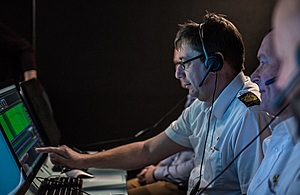
Dstl analysis is optimising information flow in the design of command space in future submarines to optimise information flow.


Above:
Submarine command space simulator.
Courtesy Dstl

The Command space in future submarines could be turned 'outside in' as a result of pioneering analysis commissioned by the Defence Science and Technology Laboratory (Dstl), which  is informing the design of command space in future submarines to optimise information flow.

Advertisement
PTC rectangle

Submarine command teams are facing an increasing challenge of manipulating escalating amounts of data and information as crew numbers are set to decrease. In these high pressure environments understanding and optimising how information flows and is presented is critical.

Working under the Command Team-working Experimental Test-bed (ComTET) programme, Dstl has engaged with the University of Southampton (Department of Transportation Research) who built a Submarine Control room simulator. Dstl supplied the simulation engine – a modified commercial gaming software called Dangerous Waters. To play the game and provide an appropriate amount of human behaviour data for analysis, university students, Dstl and Industry participants have been trained to be ‘submariners for day’ using a bespoke training package.

A second simulator has been built at Dstl’s Portsdown West site which replicates and will build upon the Southampton facility and will enable more sensitive data to be generated. Industry delivered Human Machine Interface (HMI) prototypes that ‘mash’ sensor information together in an approach that will pave the way for enabling future RN command teams to adopt ‘new ways of working’.

Dstl’s Technical Partner, Chris Parnell, commented: “Analysis generated during the first stage of the programme using the Southampton University simulator was very valuable. It demonstrated that co-location of operators highly dependent on each other for task completion creates greater efficiency in terms of information flow and increases Command team capacity. Having operators facing inwards creates conditions for much better shared situation awareness between the Command team; and placing the Officer of the Watch in the centre of the Command team leads to a more efficient tactical picture generation.”

Dstl is now undertaking human in the loop assessments of novel HMIs that will introduce ‘new ways of working’ for future submarine command teams. This will include alternative roles, new procedures, adjustments to manning and changes to training regimes.

Advertisement
ODU RT

The ComTET programme has been running since 2014. This was initially funded through the Chief Scientific Advisor’s Science & Technology programme and now as a Technology Demonstrator Programme sponsored by the Defence Nuclear Organisation (DNO) with governance and funding provided by the Submarine Delivery Agency (SDA).


Advertisement
General Atomics LB
NATO and Systematic to advance Land C2 training capabilities

Defence

NATO and Systematic to advance Land C2 training capabilities

30 January 2026

As part of the ongoing DEMETER Project, a new contract has been signed between NATO and Systematic to advance the delivery of both classroom and computer-based learning, ensuring seamless continuation and adaptation of current and future Land C2 training, while also securing the Alliance’s ability to provide learning throughout the capability ...

Cranfield recognised with Gold Employer Recognition Award

Aerospace Defence

Cranfield recognised with Gold Employer Recognition Award

30 January 2026

Cranfield University has successfully revalidated its prestigious Gold Employer Recognition Scheme status, awarded by the Ministry of Defence to organisations that support the Armed Forces community and share the values in the Armed Forces Covenant.

Typhoon reaches one million flying hours

Defence

Typhoon reaches one million flying hours

30 January 2026

The Typhoon combat aircraft programme has reached a historic milestone, passing one million flying hours – a landmark moment that comes at a critical time for national and European security.

Funding of £20m set to find Britain’s next defence unicorn

Aerospace Defence Security Space Events

Funding of £20m set to find Britain’s next defence unicorn

29 January 2026

The search for the UK’s next defence unicorn has kicked off with the launch of a bespoke £20 million fund to offer accelerated contracts to small, innovative British startups who have had limited or no business with the Ministry of Defence.

Advertisement
Security & Policing Rectangle
Metis launches Skyperion Lightweight

Aerospace Defence Security

Metis launches Skyperion Lightweight

29 January 2026

Lincoln based specialists in Radio Frequency (RF) and drone detection technologies, Metis, have launched their latest detection product, Skyperion Lightweight.

Data Link Solutions awarded US Navy contract to deliver MIDS JTRS

Defence

Data Link Solutions awarded US Navy contract to deliver MIDS JTRS

29 January 2026

The US Navy has awarded Data Link Solutions - a joint venture between BAE Systems and RTX's Collins Aerospace - a $248 million production contract to deliver hundreds of Multifunctional Information Distribution System Joint Tactical Radio System (MIDS JTRS) terminals for US forces and allies.

Advertisement
PTC rectangle
Advertisement
Babcock LB Babcock LB