ESA officially adopts ARRAKIHS as F2 Mission
-AMC-12062026.jpg)
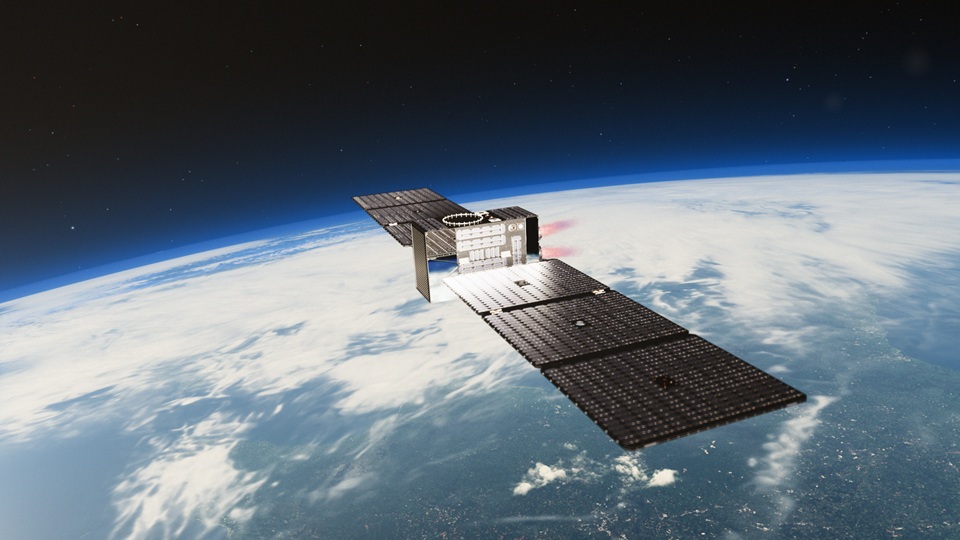
Above: ARRAKIHS simulation of the low surface brightness features in the halo of a spiral galaxy like the Milky Way.
Image courtesy Alex Camazón (IEEC) / AMC
Selected by ESA in 2022, ARRAKIHS (Analysis of Resolved Remnants of Accreted galaxies as a Key Instrument for Halo Surveys) was conceived to provide new insights into one of the major open questions in modern astrophysics: how galaxies form and evolve within the Standard Model of Cosmology.

The decision marks the beginning of the next major phase of the mission, during which the spacecraft and its scientific instrumentation will be built, integrated and space-qualified.
ESA’s adoption follows the successful completion of the conceptual and preliminary design milestones required for the mission, including the Preliminary Design Review (PDR) of the instrument and the delivery of the «Red Book», the definition study report describing the scientific, technical and programmatic implementation of ARRAKIHS.
Revealing the faint Universe
The low-surface-brightness diffuse-stellar halos around galaxies like the Milky Way preserve crucial information about how galaxies formed and evolved, revealing the combined effects of dark matter, galaxy mergers, and other processes that shape galaxies over cosmic time.
Rebekka Coles-Bieri (UZH), the mission's Science Coordinator, said: "Many of these structures are extremely faint and difficult to study systematically with existing observations. ARRAKIHS will thus open a new observational window onto the largely unexplored low-surface-brightness Universe, enabling the study of previously hidden stellar components of the galaxy haloes."
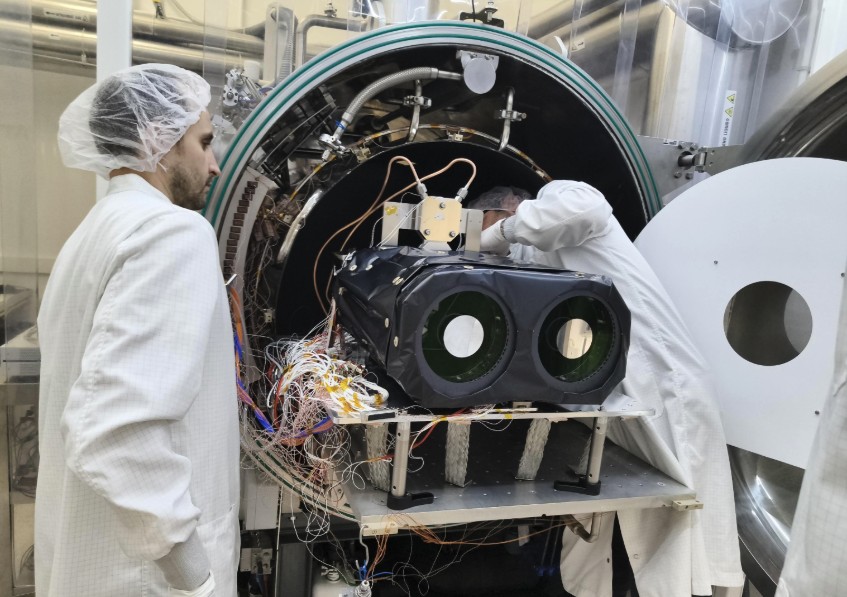
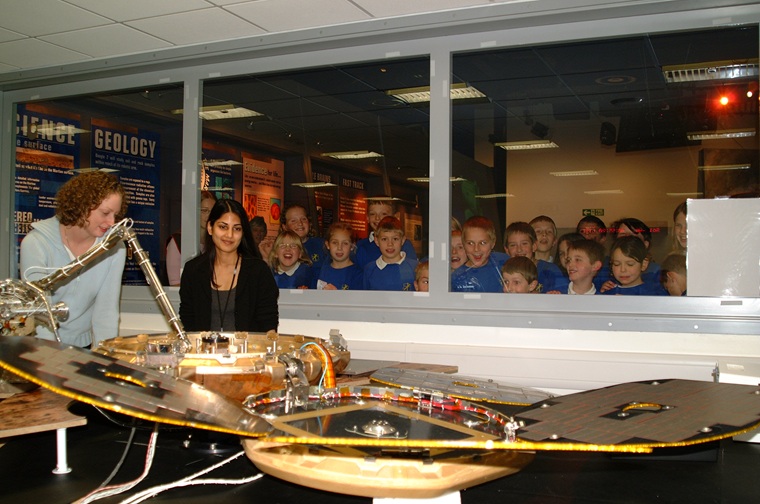
Above: Members of the ARRAKIHS instrument team working on the scientific payload.
Image courtesy Satlantis/ IDR/ UPM
An international collaboration
ARRAKIHS is developed through a collaboration between ESA and the ARRAKIHS Mission Consortium (AMC), led by Prof. Rafael Guzmán from the Instituto de Física de Cantabria (IFCA, CSIC–UC).
The consortium includes more than 250 scientists and engineers from seven ESA member states led by Spain, including Austria, Belgium, Norway, Portugal, Sweden and Switzerland, together with additional contributions from institutions and companies in the United Kingdom, France, Denmark, the Netherlands, the United States, Taiwan and Thailand.
At the University of Surrey, astrophysicists are leading the UK’s theoretical modelling work for the ARRAKIHS mission, helping scientists understand what the spacecraft’s observations will reveal about galaxies and dark matter.
The Surrey team is developing methods that use faint stellar streams surrounding galaxies to map the gravitational field of the Milky Way analogues and study the shape of the invisible dark matter haloes around them.
Dr Denis Erkal, UK Coordinator for the ARRAKIHS mission and Head of Surrey’s Astrophysics Research Group, said: “After four years of effort and collaboration to develop and refine the mission, it’s incredibly exciting to see ARRAKIHS officially adopted by ESA and moving into its next phase.
“I am particularly excited about the long stellar streams that ARRAKIHS will discover. These form when a dwarf galaxy is gradually pulled apart by the gravity of a larger galaxy, leaving behind long arcs of stars that trace its orbit. The beauty of these streams is that they allow us to see how stars orbit a galaxy without having to wait the billions of years needed for a star to complete an orbit. This, in turn, allows us to measure the properties of their dark matter haloes.”
Professor Michelle Collins, Professor of Astrophysics at the University of Surrey, said: “Having spent years studying dwarf galaxies and stellar haloes in the nearby Andromeda galaxy, it’s incredibly exciting to be part of a mission that will allow us to observe these faint structures in unprecedented detail for a large sample of galaxies. The outer regions of these galaxies contain vital clues about past mergers and interactions that have shaped galaxies over billions of years.”
From concept to adopted mission
Over the past few years, the international ARRAKIHS consortium has transformed a highly ambitious scientific concept into a fully established space mission within ESA’s Science Programme. This progress has been supported by major scientific and technological achievements, including developing new, high-resolution cosmological simulations and galaxy models, design of key subsystems of the flight instrument, the initial development of the ground-based infrastructure for scientific data and data analysis systems, and the operation of a ground demonstrator camera installed at the Javalambre Astrophysical Observatory, the acquisition of increasingly deep observations that further strengthen the mission’s scientific case.
With its official adoption by ESA, ARRAKIHS is now entering the construction phase in preparation for its launch in 2030.