Experiments studying child brain tumours and muscle ageing heading to space
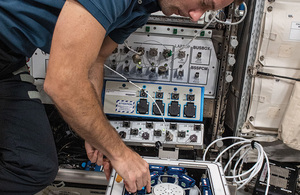
Above:
ESA astronaut Thomas Pesquet inserting 24 experiment units in the KUBIK incubator on the International Space Station.
Courtesy ESA
Due to be ready for launch in 2025, the experiments will be supervised by astronauts on board for up to six months before returning to Earth for the results to be analysed.

D(MG)2, led by the Institute of Cancer Research, received £1.2 million to look at diffuse midline glioma; the second most common type of “primary high grade” brain tumour in children that has, so far, been impossible to cure due to the amount of different cell types it contains.
MicroAge II, led by the University of Liverpool, was awarded £1.4 million funding for the second part of its project investigating how the microgravity environment makes astronauts’ muscles weaken in space, in an accelerated way to how muscles get weaker as we age on Earth.
Minister of State at the Department for Science, Innovation and Technology, George Freeman, said: "Space is the ultimate laboratory testbed with British scientists and astronauts harnessing the International Space Station for cutting edge research in nutrition, energy and biomedicine.
"This £2.6 million project funding will help UK scientists research how to prevent brain tumours in children and understand the biomedical processes of ageing: research with huge benefits for mankind and health systems around the world.
"Another example of the way UK strengths in different sectors from space to life science and cleantech drive technology leadership."
Dr Paul Bate, Chief Executive of the UK Space Agency, said: "This ground-breaking research highlights the power of space to push through barriers, revolutionise science and enhance our lives.
"Through a combination of national funding and our vital role in the European Space Agency, we’re ensuring UK scientists have access to the unique environment of the ISS for their research, which will benefit us all."
Announced during Brain Tumour Awareness Month, the ISS experiment for D(MG)2 will use microgravity to get a clearer picture of how diffuse midline glioma cells react with each other, so that potential new avenues for developing novel treatments can be identified.
Professor of Childhood Cancer Biology at The Institute of Cancer Research, Chris Jones, said: "Unfortunately, survival rates for patients with diffuse midline glioma have not changed substantially since Neil Armstrong’s daughter died of the disease in the early sixties. The last 15 years, however, have revolutionised our understanding of the biological complexity of these tumours, with exciting new therapies entering clinical trial at last.
"Experiments such as D(MG)2 aboard the International Space Station will improve our understanding of how cancer cells interact with each other within three-dimensional structures, and hopefully lead to new ideas for disrupting tumour growth that we can take forward back in the lab."
The ISS experiment for MicroAge II will use a lab-grown human muscle to observe the effects of microgravity and test whether mitochondria play an important role in muscle loss in space and determine whether applying tension can slow the degeneration process, which could help scientists to rapidly develop therapies to reduce muscle loss as we age.
The UK Space Agency supported MicroAge I, which flew to the ISS in December 2021 to test lab-grown muscle constructs, each the size of a grain of rice.
University of Liverpool’s Professor Malcolm Jackson said: "We are delighted to receive this generous funding from the UK Space Agency to develop our studies of the effects of microgravity on loss of skeletal muscle as a model from which we can further understand muscle loss during ageing.
"We will use newly developed techniques to study the role of changes in mitochondria, tiny structures that are responsible for supplying energy to cells, in driving the loss of muscle mass that occurs in microgravity.
"The role that a loss of tension on muscle plays in these mitochondrial changes will be examined using innovative hardware that we are developing with Kayser Space Ltd which modifies the amount of tension that the muscle experiences in microgravity.
"This will be used to test whether altered tension on muscle regulates the muscle loss in microgravity and to inform us on the process during muscle loss during ageing on Earth."
Equipment for the experiments is built by microgravity hardware specialists, Kayser Space, based in Oxfordshire.
Managing Director of Kayser Space Ltd, David Zolesi, said: "We are thrilled to be involved in these two new UK Space Agency funded programmes and to support scientists investigating these cutting-edge research fields.
"Our role, as experts in the design and supply of instruments and systems used in outer space and especially in crewed spaceflight, is to provide public and private research groups with the tools to conduct their research and obtain great results for the benefit and well-being of all humankind."