Founding members of Twinkle mission confirmed
 The founding members include institutions from North America (Vanderbilt University, Ohio State University, University of Toronto), Asia-Pacific (Nanjing University, National Tsing Hua University, University of Southern Queensland) and Europe (Ludwig Maximilians Universität, Cardiff University, University of Central Lancashire).

These founding members are now working together to design a powerful scientific program ahead of the satellite launch, making this a truly global and innovative space science collaboration. They join five other institutions who have also secured telescope time for their research teams.
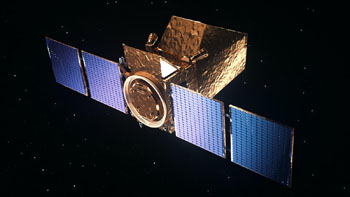
Once launched into low-earth orbit in 2024, the Twinkle satellite will deliver visible and infrared spectroscopy of thousands of targets, enabling Twinkle members to produce transformative research on exoplanet atmospheres, solar system objects, stars, and stellar discs as they aim to answer some of humanity’s greatest questions.
Twinkle will provide structured science surveys which will operate at a large scale, providing more than 70,000 hours of observational data during its lifetime.
Professor Matt Griffin, Cardiff University, said: "It's exciting to be a part of this mission that will be built and launched in just a few years, much faster than the normal timescale for space astronomy satellites.
"Its sensitive surveys of exoplanets and of bodies in the solar system will be unique and will lead to a huge improvement in our understanding of how planetary systems, including our own, have developed and evolved. Twinkle is in the vanguard of what is without doubt one of the most important themes of astronomy research for the coming decade."
Professor Derek Ward Thompson, University of Central Lancashire, added: “The Twinkle space mission offers some very exciting scientific possibilities. I am particularly fascinated by the prospect that we will be able to study the atmospheres of planets around other stars. This offers the opportunity to tell whether a particular planet is earth-like and potentially habitable or not, thereby increasing our ability to assess the likelihood of life elsewhere in the Universe.”
Twinkle is the first in a series of scientific satellites from Blue Skies Space. Each will combine the expertise of an international science team with proven satellite and payload suppliers, to deliver an advanced satellite at a fraction of the cost and time of a typical space mission of this complexity. Membership is open to scientists from all backgrounds and experience levels and available within days.
Professor Giovanna Tinetti, chief scientific officer, Blue Skies Space, said: “Exoplanet research is an exciting and fast growing international endeavour. We are delighted to see that Twinkle’s collaborative model is attracting scientists of all career stages from around the world.”
About Twinkle
Twinkle is the first in a new class of science satellites that will deliver ground-breaking data to astronomers worldwide. The seven-year space mission, launching in 2024, will provide scientists with greater insights into the composition of exoplanet atmospheres, solar system objects, stars, and stellar discs.
The satellite is based on a high-heritage Airbus Defence and Space platform and will carry a 0.45 m telescope with a visible to infrared spectrometer providing simultaneous wavelength coverage (0.5–4.5μm), enabling a deeper understanding of worlds outside and within our solar system.
Twinkle’s science programme is delivered through a growing international collaboration of scientists who will gain access to the massive data set from the observation of 1000’s of objects during the mission’s lifetime. Twinkle is the first commercial satellite being launched by UK-headquartered Blue Skies Space Ltd.