G3 Systems improves conditions for working canines
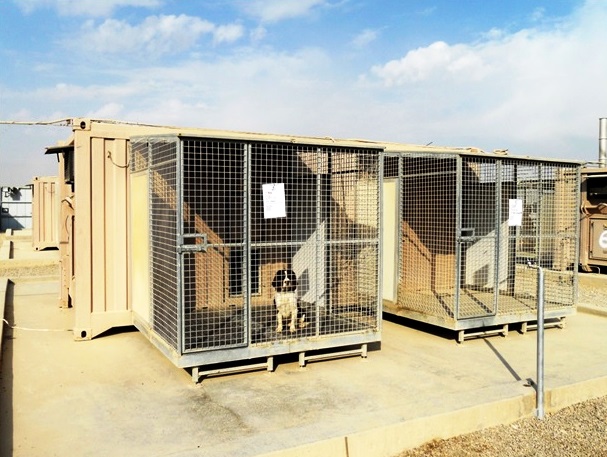
Above:
Deployable kennel systems from G3 Systems Ltd provide safe, comfortable accommodation for Police and Military working dogs.
Courtesy G3 Systems
Highly trained dogs are used to protect military bases and to detect arms, ammunition and explosives. Police forces use their dogs in crime prevention, crowd control and drug detection roles, while Fire and Rescue Services often use specially trained dogs for urban search and rescue (USAR) roles. These secure accommodation units come complete with integral cooling and heating systems to help control and maintain the temperature of the animals sleeping areas.

The new air conditioned kennels have helped Britain’s military working dogs cope with the blistering summer heat of Iraq and the extreme cold of Afghanistan, as well as providing a number of Police dogs with comfortable and secure accomodation when deployed to incidents and high profile events outside their normal area of operations.
Although the dogs are extremely fit and acclimated to working under strenuous conditions, the use of air conditioning means their kennels can be thermostatically controlled to maintain a steady temperature wherever they are operating. “Returning to such kennels, often after demanding and protracted tasks, helps maintain the dogs condition” said Paul Holt, Director, Business Development for G3 Systems Limited.
These fully deployable kennels are based upon DROPS compatible 20ft ISO containers that can each house four service animals. They can be easily shipped to new operational locations and set up within a short period, enabling the handlers and their dogs to quickly assume whatever task they are being deployed for. Importantly, no hand tools are needed for the deployment and construction of these shelters.
The containers convert into kennel units through the fast assembly of mesh panels, which provide internal sleeping areas, external kennel areas, feeding preparation and storage areas with integral water and electrical distribution. There is a small working space within the container for the handlers to prepare food and complete basic administration. Storage is provided to accommodate food supplies and basic kit for handling the dogs.
Standardised componentry throughout enables the deployable kennels to be easily maintained and reduces logistics and through-life costs, while transportation containers for each dog, which are collapsible to reduce storage when not in use, also provide a safe and comfortable means of moving the animals quickly by road or air transport as required.
The kennels and transport containers, which have been engineered by G3 Systems Ltd of Portland in Dorset, UK, are completely self-contained units with all equipment designed to fit inside the container.
Clients for these innovative systems have included military units in Afghanistan and Police forces around the world.