

Airlines should cover full climate cost if Heathrow expands, CCC says



The UK Government’s climate advisers have said airlines should pay to remove their remaining carbon emissions from the atmosphere if Heathrow Airport expands with a third runway.
The Climate Change Committee (CCC) says no credible pathway exists under current government policies for Heathrow expansion to be compatible with the UK’s legally binding climate targets.
In its new advice to the Government, published on 16 September, the CCC says ministers should legislate to require aviation to address all its emissions by 2050, either by cutting them directly or paying for permanent engineered carbon removals.
It describes that requirement as the only way the proposed expansion could be considered consistent with UK carbon budgets and the 2050 Net Zero target.
“Emissions from flying are projected to rise, even without Heathrow expansion, and the UK does not currently have a credible plan to bring them down,” CCC chair Nigel Topping said.
“Our advice today is clear – Heathrow expansion is not currently compatible with the UK’s Net Zero target. Government needs to ensure that the aviation industry takes responsibility for the emissions it creates and bears the costs of decarbonisation. Those conditions do not exist today.”
Aviation emissions have doubled since 1990
The CCC’s warning reflects aviation’s increasingly unusual position in the UK’s decarbonisation programme.
Aviation emissions have more than doubled since 1990, while emissions across the UK economy have roughly halved.
Under current government policies, aviation emissions would not fall at all between 2025 and 2050, even without a third runway at Heathrow.
Heathrow already accounts for around half of UK aviation emissions. The CCC calculates that the full impact of the proposed expansion would equal 6.9% of the UK’s remaining carbon emissions in 2050.
Industries including electricity generation, road transport and buildings are expected to cut emissions substantially, leaving aviation as one of the country’s largest sources of residual CO2.
Airlines would have to pay for carbon removal
The CCC argues that the Government should apply a “polluter pays” principle to aviation.
Airlines would first reduce emissions through measures including more efficient aircraft, sustainable aviation fuel (SAF) and managing growth in passenger demand.
But aircraft are still expected to produce significant quantities of CO2 in 2050. The CCC wants aviation to pay for engineered carbon removals to compensate for emissions that cannot be eliminated.
These differ from conventional carbon offsets, such as paying to protect forests or financing emissions reductions elsewhere.
Engineered removals physically remove CO2 from the atmosphere and store it. Potential technologies include direct air capture (DACCS) and bioenergy with carbon capture and storage (BECCS).
The CCC says the aviation industry should ultimately bear the cost of these CO2 extractions, not taxpayers.
Its report recommends that the Government “ensure that the aviation industry bears the full costs of decarbonising the sector, including the costs of sustainable aviation fuel and engineered removals.”
However, those costs could ultimately raise airfares.
Heathrow expansion increases the challenge
The CCC does not conclude that Heathrow cannot expand while the UK meets Net Zero. Instead, it says the Government has not yet put the policies in place that would make the two objectives compatible.
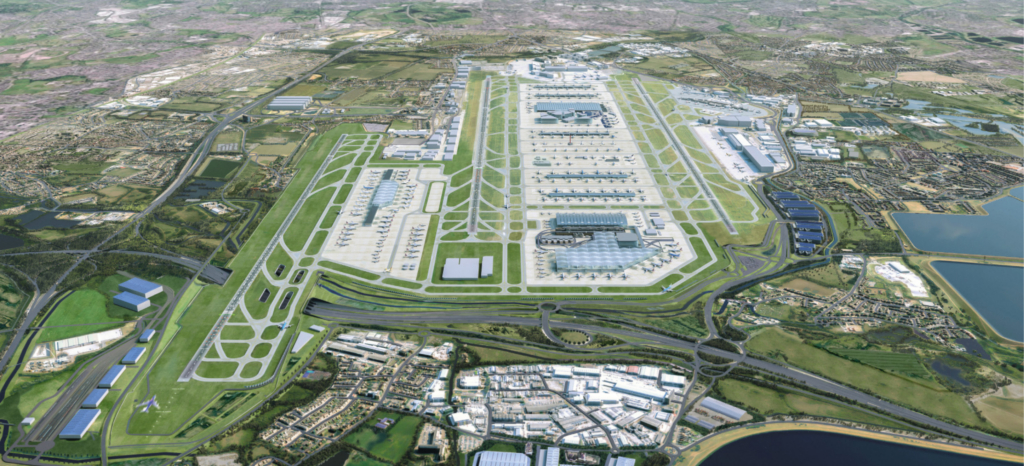
The committee recommends legislation requiring aviation to reach net zero by 2050, backed by a long-term policy framework covering the next 25 years. It also wants contingency measures in case technologies such as SAF and engineered carbon removals fail to develop as quickly or cheaply as expected.
The Government should also strengthen the climate test contained in the draft Heathrow Expansion National Policy Statement, according to the CCC.
The draft currently considers compatibility with carbon budgets. The committee says the test should also explicitly include the UK’s 2050 Net Zero target.
Government says expansion must meet Net Zero targets
The Department for Transport said Heathrow expansion would have to comply with the UK’s climate commitments.
“Any expansion proposal would need to align with our net zero targets,” a Department for Transport spokesperson said in a statement issued following the publication of the CCC’s report. “We’re investing £219 million in sustainable aviation fuel production and a further £43 million in cleaner technologies to support greener aviation, while expansion could deliver around £40 billion to the economy and support up to 60,000 local jobs.
“We will carefully consider CCC’s advice along with all responses received to the Heathrow expansion consultation.”
The Government says its SAF Mandate could deliver carbon savings of up to 6.3 million tonnes a year by 2040.
It also points to the economic case for expansion. Independent analysis commissioned by the Government estimates additional Heathrow capacity could add up to £2.6 billion to the UK economy in 2056, with as much as 40% of the benefit reaching areas outside London and the South East.
The Government estimates the wider economic benefits at around £40 billion and says expansion could support more than 60,000 local jobs by the mid-2050s.
Heathrow’s third runway faces a tougher climate test
The Government is reviewing the Airports National Policy Statement, which provides the planning framework for Heathrow expansion.
Its draft Heathrow Expansion National Policy Statement sets four tests covering climate change, air quality, noise and economic growth across the country.
The CCC’s advice raises the bar for the climate test.
Beyond future improvements in aircraft efficiency and SAF, the committee wants a legally enforceable system that makes aviation responsible for all of its remaining emissions.
That would effectively attach a carbon-removal cost to flying, with airlines paying progressively more as the UK approaches 2050 and airfares rising proportionally.
However, without such a framework, the CCC concludes that there is currently no credible pathway for Heathrow expansion within the UK’s climate commitments.
Sign up for our newsletter and get our latest content in your inbox.
Similar Reads





Sign up for our newsletter. Select all sectors relevant to you.
Related