IATA downgrades 2020 traffic forecast

Image courtesy IATA
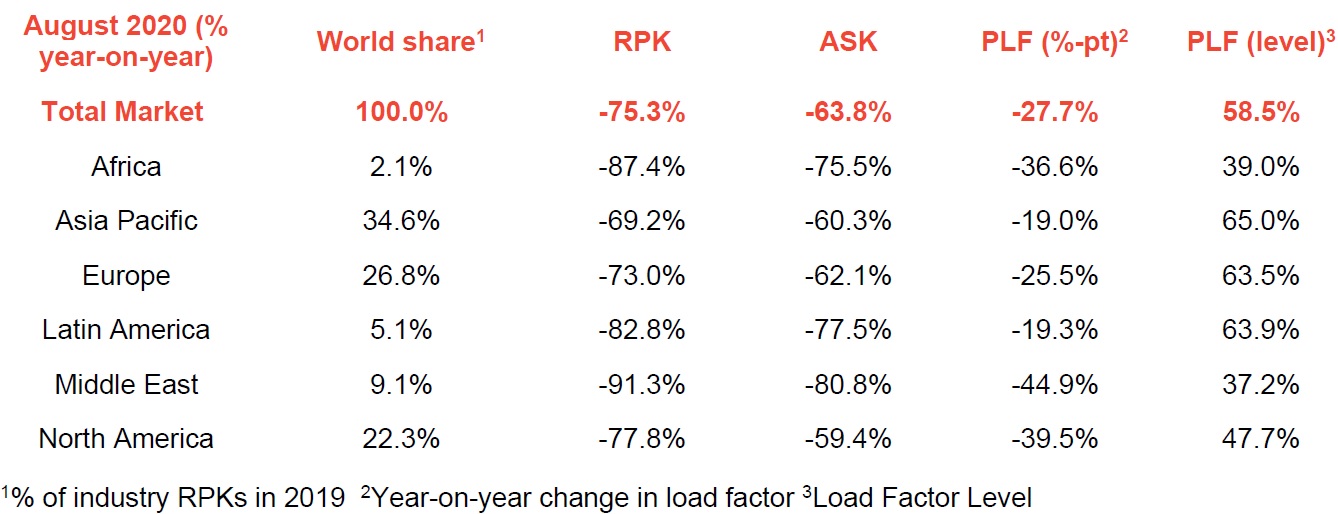
August passenger demand continued to be hugely depressed against normal levels, with revenue passenger kilometers (RPKs) down 75.3% compared to August 2019. This was only slightly improved compared to the 79.5% annual contraction in July. Domestic markets continued to outperform international markets in terms of recovery, although most remained substantially down on a year ago. August capacity (available seat kilometers or ASKs) was down 63.8% compared to a year ago, and load factor plunged 27.2 points to an all-time low for August of 58.5%.

Based on flight data, the recovery in air passenger services was brought to a halt in mid-August by a return of government restrictions in the face of new COVID-19 outbreaks in a number of key markets. Forward bookings for air travel in the fourth quarter show that the recovery since the April low point will continue to falter. Whereas the decline in year-on-year growth of global RPKs was expected to have moderated to -55% by December, a much slower improvement is now expected with the month of December forecast to be down 68% on a year ago.
Alexandre de Juniac (above), IATA’s Director General and CEO said: “August’s disastrous traffic performance puts a cap on the industry’s worst-ever summer season. International demand recovery is virtually non-existent and domestic markets in Australia and Japan actually regressed in the face of new outbreaks and travel restrictions. A few months ago, we thought that a full-year fall in demand of -63% compared to 2019 was as bad as it could get. With the dismal peak summer travel period behind us, we have revised our expectations downward to -66%.”
International Passenger Markets
August international passenger demand plummeted 88.3% compared to August 2019, mildly improved over the 91.8% decline recorded in July. Capacity sagged 79.5%, and load factor fell 37.0 percentage points to 48.7%.
- Asia-Pacific airlines’ August traffic sank 95.9% compared to the year-ago period, barely budged from a 96.2% drop in July, and the steepest contraction among regions. Capacity dived 90.4% and load factor shrank 48.0 percentage points to 34.8%.
- European carriers’ August demand plunged 79.9% compared to last year, improved from an 87.0% drop in July, as travel restrictions were lifted in the Schengen Area. However, more recent flight data suggests this trend has reversed amid a return to lockdown and quarantine in some markets. Capacity fell 68.7% and load factor dropped by 32.1 percentage points to 57.1%, which was the highest among regions.
- Middle Eastern airlines had a 92.3% fall in demand for August, compared with a 93.3% decline in July. Capacity collapsed 81.9%, and load factor sank 47.1 percentage points to 35.3%.
- North American carriers’ traffic tumbled 92.4% in August, little changed compared to 94.4% decline in July. Capacity fell 82.6%, and load factor plunged 49.9 percentage points to 38.5%.
- Latin American airlines had a 93.4% demand drop in August compared to the same month last year, versus a 94.9% drop in July. Capacity crumbled 90.1% and load factor dropped 27.8 percentage points to 56.1%, second highest among the regions.
- African airlines’ traffic sank 90.1% in August, slightly improved over a 94.6% decline in July. Capacity contracted 78.4%, and load factor fell 41.0 percentage points to 34.6%, which was the lowest among regions.
Domestic Passenger Markets
Domestic traffic fell 50.9% in August. This was a mild improvement compared to a 56.9% decline in July. Domestic capacity fell 34.5% and load factor dropped 21.5 percentage points to 64.2%.
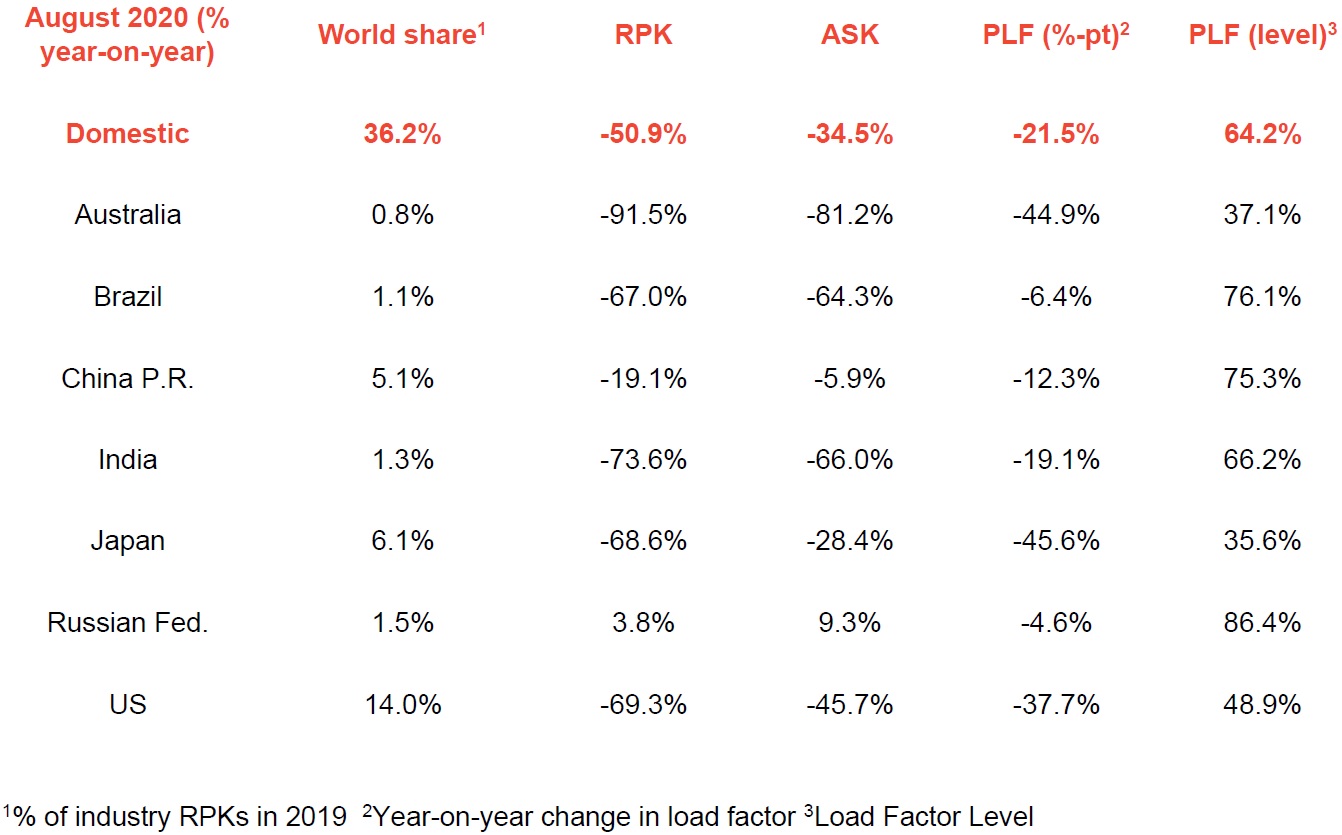
- US carriers’ August traffic was down 69.3% compared to August 2019, only a slight improvement compared to July, when traffic fell 71.5%. An increase in outbreaks and quarantines in key domestic markets contributed to the disappointing result.
- Russian airlines saw their domestic traffic rise 3.8% compared to August 2019, the first market to see an annual increase since the onset of the pandemic. Falling fares along with a boom in domestic tourism were among the main contributors to the positive swing.
“Traditionally, cash generated during the busy summer season in the Northern Hemisphere provides airlines with a cushion during the lean autumn and winter seasons. This year, airlines have no such protection. Absent additional government relief measures and a reopening of borders, hundreds of thousands of airline jobs will disappear. But it is not just airlines and airline jobs at risk.
"Globally, tens of millions of jobs depend on aviation. If borders don’t reopen the livelihoods of these people will be at grave risk. We need an internationally agreed regime of pre-departure COVID-19 testing to give governments the confidence to reopen borders, and passengers the confidence to travel by air again,” said de Juniac.