IATA reports strong passenger and cargo demand in 2025

Image courtesy IATA
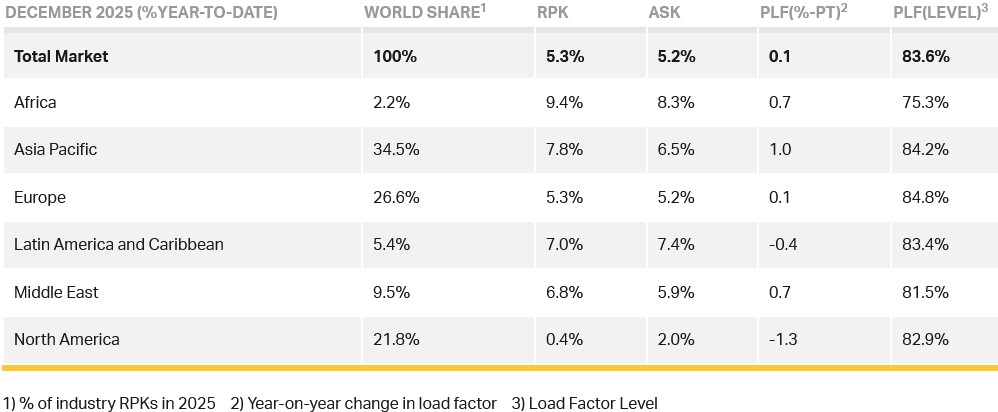
Total full-year demand in 2025 (measured in revenue passenger kilometres or RPKs) rose 5.3% compared to 2024. Total capacity, measured in available seat kilometres (ASK), was up 5.2% in 2025. The overall passenger load factor (PLF) reached 83.6%, up 0.1 ppt and a record for full-year traffic.

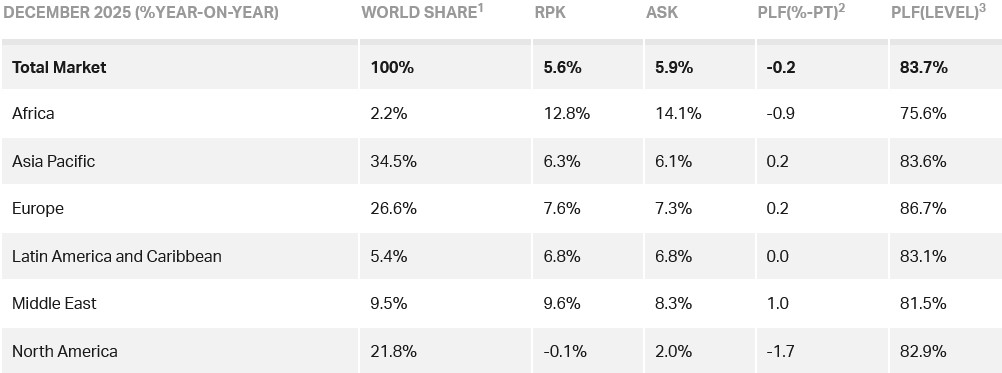
International full-year passenger demand in 2025 increased 7.1% compared to 2024 and capacity rose 6.8%. The full year international load factor was 83.5%, a rise of 0.2 ppt on 2024. This was also a record high for international PLF. Domestic full-year demand for 2025 rose 2.4% compared to the prior year, while capacity expanded by 2.5%. The load factor for the full year averaged 83.7%, down -0.1 ppt compared to 2024. December 2025 was a strong finish to the year with overall demand rising 5.6% year-on-year, capacity growing by 5.9%, and a load factor of 83.7%.
Willie Walsh (above), IATA’s Director General, said: “Twenty twenty-five saw demand for air travel grow by 5.3% with international demand growing by 7.1% and domestic by 2.4%. This returns industry growth to align with historical growth patterns after the robust post-COVID rebound. The strong and continuous increase in demand puts into sharp focus two key challenges, decarbonisation and supply chain.
The first, decarbonisation, will protect future long-term growth. Governments whose economies grow because of aviation and whose citizens thirst for connectivity need to provide the supportive fiscal policy framework to rapidly accelerate progress, particularly for the energy sector to grow Sustainable Aviation Fuel (SAF) production.
The second, supply chain challenges, was the biggest headache for airlines in 2025. People clearly wanted to travel more but airlines were continually disappointed with unreliable delivery schedules for new aircraft and engines, maintenance capacity constraints and resultant cost increases that are estimated to exceed $11 billion. Airlines scrambled to accommodate the demand by keeping aircraft in service longer and filling more seats on every flight. With load factors just shy of 84%, it’s clear that these measures were an effective band aid but we need a real solution. It’s vital that 2025 proves to be the nadir of the supply chain crisis, and 2026 marks a rebound. Every new aircraft means a quieter, cleaner fleet, with more capacity and flight options than at any previous point in history, which is what airlines and their customers want to see.”
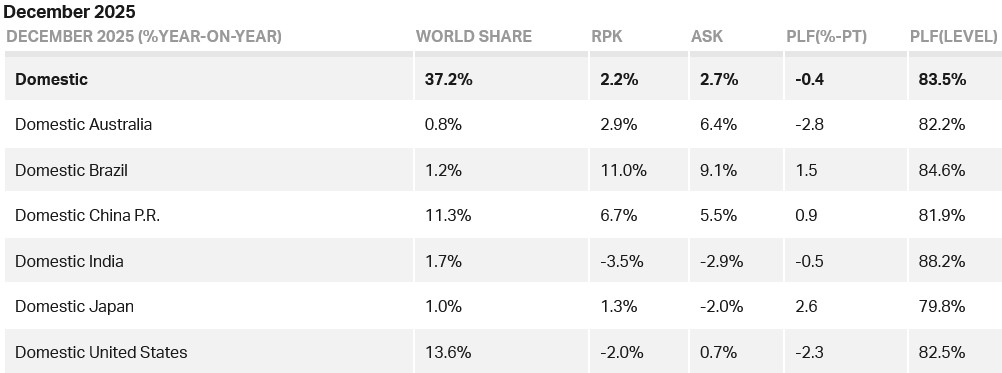
Air Passenger Market in Detail - December 2025
Air Passenger Market in Detail - Full Year 2025
Regional Breakdown - International Passenger Markets
Full-year international traffic rose by 7.1% compared to 2024, while capacity rose 6.8%. For the month of December, international demand grew by 7.7%, capacity increased 7.9%, and the load factor declined by 0.1 ppt (compared to December 2024) to 83.9%.
Asia-Pacific airlines posted a 10.9% rise in full year international 2025 traffic compared to 2024. Capacity rose 10.2% and the load factor rose 0.5 ppt to 84.4%. The region finished 2025 with the fastest growth rate and highest load factor of any region. December 2025 traffic rose 7.5% compared to December 2024.
European carriers’ full year traffic climbed 6.0% versus 2024. Capacity increased 5.9%, and load factor rose 0.1 ppt to 84.1%. For December, demand climbed 8.4% compared to the same month in 2024.
Middle Eastern carriers saw a 6.7% traffic rise in 2025 compared to 2024. Capacity increased 5.8% and load factor climbed 0.7 ppt to 81.6%. December demand climbed 9.5% compared to the same month in 2024.
North American airlines reported a 2.1% annual traffic rise in 2025 compared to 2024. Capacity increased 2.4%, and load factor fell -0.2 ppt to 83.9%. Both traffic and capacity growth were the slowest of any region in 2025. December 2025 traffic rose 3.5% compared to the year-ago period.
Latin American airlines posted an 8.6% traffic rise in 2025 over full year 2024. Annual capacity climbed 10.2% and load factor declined -1.2 ppt to 83.6% (the sharpest load factor fall of any region). December demand climbed 8.2% compared to December 2024.
African airlines’ annual traffic rose 7.8% in 2025 versus the prior year. Full year 2025 capacity was up 6.5% and load factor climbed 0.9 ppt to 74.9%. This was the lowest load factor among regions but a record high for Africa and the strongest load factor increase of any region. December 2025 traffic for African airlines rose 10.3% over December 2024.
Domestic Passenger Markets
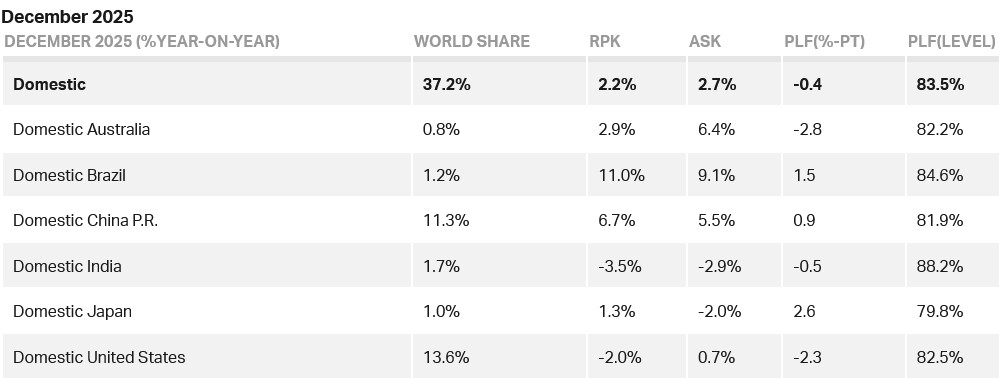
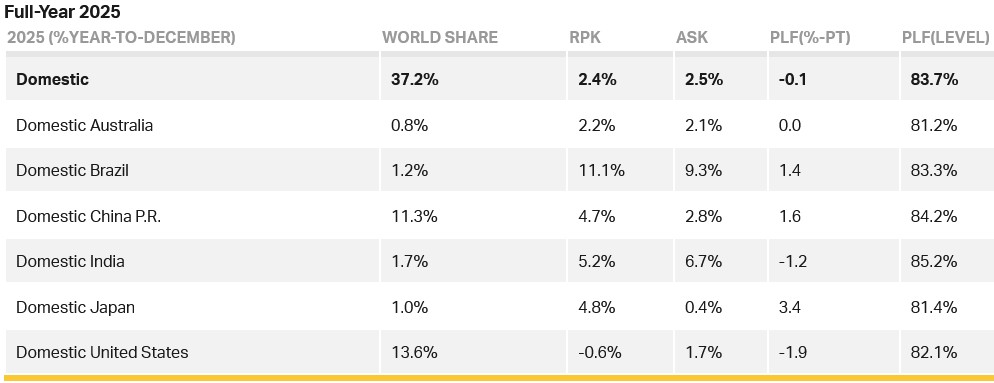
Domestic full-year demand reached record highs for passenger numbers and load factors. Growth slowed compared to the strong rebound in 2024. The standout performer for 2025 Domestic RPK was Brazil, which increased 11.1% over 2024. The United States saw its domestic market contract by -0.6%. The sharpest increase in load factor was in Japan (+3.4 ppt), in contrast to the United States, which registered the heaviest fall (-1.9 ppt). Although domestic Indian travel also had a sharp (-1.2 ppt) fall in load factor, it still registered the highest load factor overall (85.2%). Australia had the lowest load factor but this was still a relatively healthy 81.2%.
Air Cargo
IATA data for full year 2025 and December 2025 global air cargo market performance showed full-year demand for 2025, measured in cargo tonne-kilometres (CTK), increased 3.4% compared to 2024 (4.2% for international operations).
Full-year capacity in 2025, measured in available cargo tonne-kilometres (ACTK), increased by 3.7% compared to 2024 (5.1% for international operations). December 2025 brought the year to a close with continued strong performance. Global demand was 4.3% above December 2024 levels (5.5% for international operations). Global capacity was 4.5% above December 2024 levels (6.4% for international operations).
Additionally, IATA noted that full-year yields fell 1.5% year-on-year. This is the smallest decline in three years as a more normal supply-demand balance is achieved and the exceptionally strong yields of COVID and post-COVID continue to taper. Despite competitive pressure capping air cargo’s pricing power, yields remain 37.2% above 2019 levels.
Willie Walsh said: “Air cargo delivered a strong performance in 2025, with demand up 3.4% year-on-year. Global e-commerce strength drove volumes, even as trading relationships with the US faced rising tariffs, the removal of de minimis tariff exemptions and continuing policy uncertainty. Air cargo rose to the occasion. It adapted quickly to support global businesses and supply chains as they front-loaded product deliveries ahead of tariff impositions and adjusted to rising demand within Asia and between Asia and Europe as US-Asia trade stagnated.”
“Growth in 2026 is expected to moderate slightly to 2.4%, in line with historical trends. We can expect that demand will continue to be shaped by trade and geopolitical developments. Whatever trading patterns emerge, we can be confident that reliance on air cargo to keep global supply chains running will remain, with carriers responding to the challenge by deploying capacity and designing their networks for optimum flexibility.”
Several factors in the operating environment should be noted:
- Global trade in goods grew by 2.5% annually in 2024. Year-to-date, January to November, for 2025, the index grew 4.4% (versus 2.4% of same period in 2024).
- Jet fuel prices fell 3.1% in December and averaged 9.1% lower in 2025 than in 2024. However, higher crack spreads meant refiners captured more margin, offsetting part of the benefit for airlines.
- Global manufacturing sentiment strengthened in December to reach 50.9. New export orders fell slightly to 49.1 but remained below the 50-point expansion threshold, reflecting ongoing caution amid tariff uncertainty.
Regional Performance
Asia-Pacific airlines saw 8.4% year-on-year demand growth for air cargo in 2025, the strongest among the regions. Capacity increased by 7.4% year-on-year. December year-on-year demand increased 9.4% and capacity increased 8.3%.
North American carriers saw a 1.3% year-on-year decline in demand growth for air cargo in 2025, the only regional decline and the weakest performance globally. Capacity decreased by 1.1% year-on-year. December year-on-year demand decreased 2.2% and capacity decreased 2.6%.
European carriers saw 2.9% year-on-year demand growth for air cargo in 2025. Capacity increased by 3.1% year-on-year. December year-on-year demand increased 4.9% and capacity increased 3.9%.
Middle Eastern carriers saw 0.3% year-on-year demand growth for air cargo in 2025. Capacity increased by 4.5% year-on-year. December year-on-year demand increased 4.2% and capacity increased 10.6%.
Latin American and Caribbean carriers saw 2.3% year-on-year demand growth for air cargo in 2025. Capacity increased by 4.5% year-on-year. December year-on-year demand decreased by 4.1%, the lowest performance of all regions. Capacity increased 4.5%.
African airlines saw 6.0% year-on-year demand growth for air cargo in 2025. Capacity increased by 7.8% year-on-year. December year-on-year demand increased by 10.1%, the highest of all regions and capacity increased 9.8%.
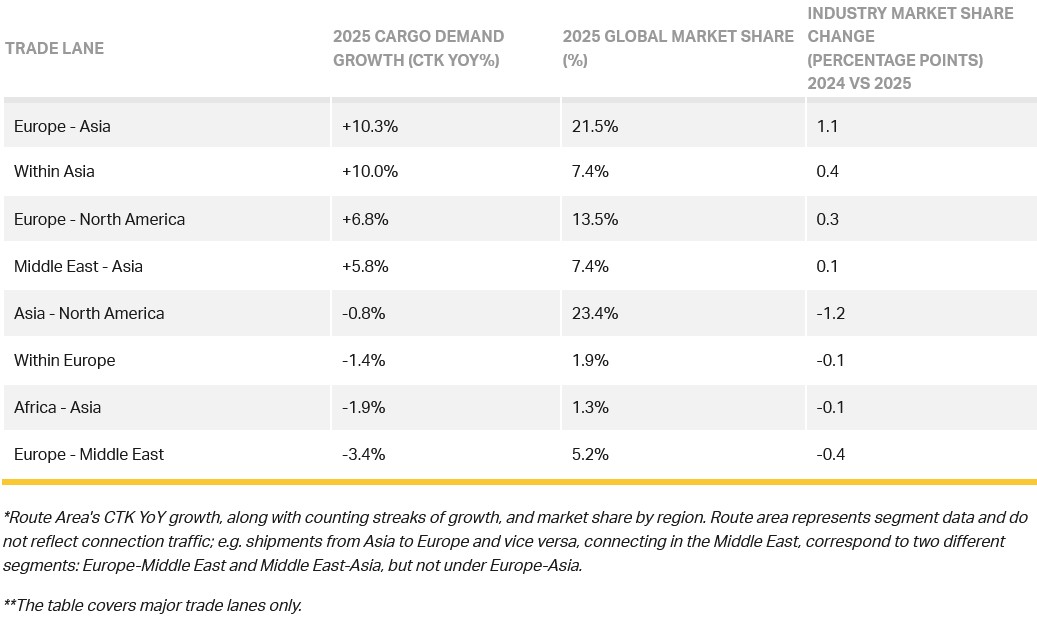
Trade Lane Growth
Twenty twenty-five trade lane data shows a clear shift in global air cargo flows from Asia–North America to Asia–Europe, driven by tariff pressures and the removal of the US de minimis exemption. The Within Asia, and the Middle East–Asia corridor also recorded strong growth.