Kromek launches new generation RayMon detector
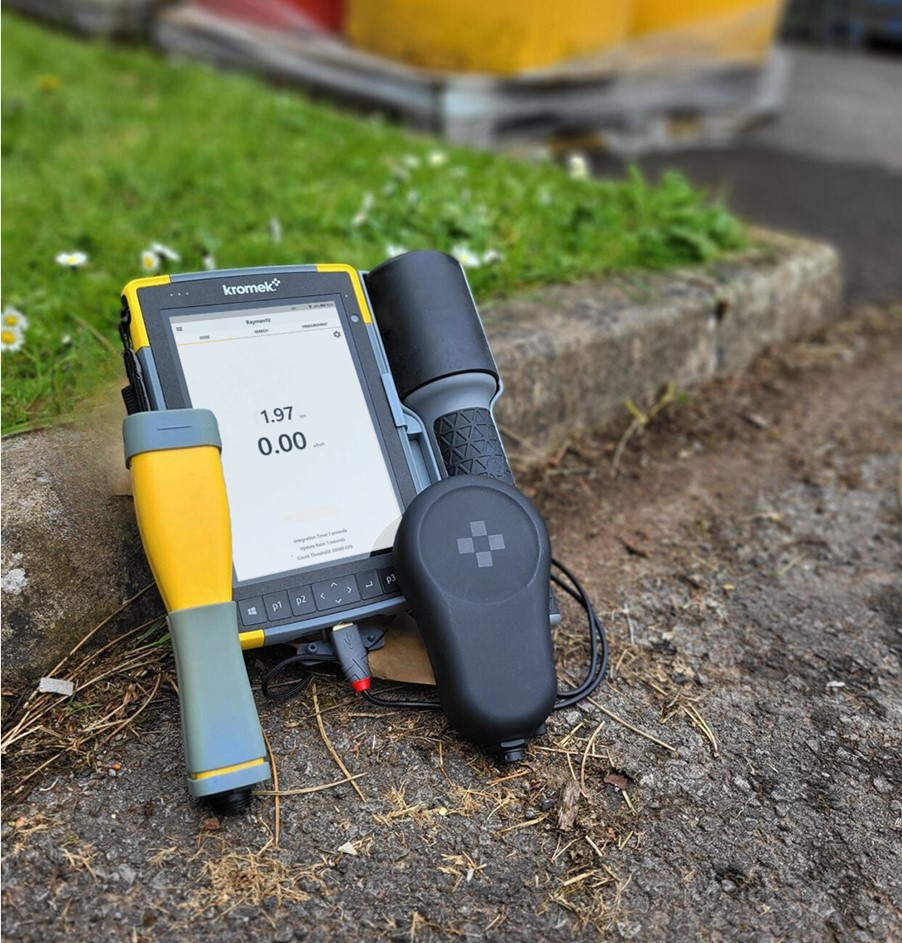
Above: The Kromek new generation RayMon with attachable CZT, NaI and Alpha Beta probes.
Courtesy Kromek
This is a high-performance handheld spectrometer with a set of interchangeable probes: CZT, NaI and Alpha Beta. It is ideal for protecting critical national infrastructure such as nuclear power stations or military installations and for security screening, civil defence, homeland security or peace keeping/peace support operations. It is portable, easy to deploy and can undertake previously-lab-based spectral analysis directly in the field with speed and precision.
The new generation RayMon has a built-in library of 94 radionuclides, to which custom nuclides can be added. Key information such as dose rate and counts per second can be viewed on the Dose Screen in real-time. In Search Mode, the clear visual graphs indicate when count rate is increasing or decreasing, directing the user to the location of the source. All reports and data files on the RayMon can either be exported onto a USB or shared via email.

Enhancing the RayMon’s capabilities are three additional probes: a high resolution CZT probe, a high sensitivity NaI (sodium iodide) smart probe and an Alpha Beta smart probe.
The CZT probe provides precise identification of radionuclides, even when faced with mixed or shielded sources. With its small form factor, operation at room temperature without the need for cooling, and direct conversion, the CZT Probe is a cost-effective and user-friendly alternative to HPGe detectors. Its small form factor alleviates the difficulty of taking measurements in hard-to-reach areas.
The NaI probe is designed for collecting count data in low-dose environments. The high sensitivity and efficiency of the 2” x 2” Sodium Iodide (NaI) crystal ensures even the weakest sources can be detected. Taking measurements in narrow areas is facilitated by the incorporation of silicon photomultiplier technology into Probe, giving the device its small form factor. The probe also includes a high dose sensor to ensure that measurements continue to be taken when the NaI probe becomes saturated with counts.
The Alpha Beta probe transfers Alpha or Beta count data onto the RayMon screen but can also store detector and calibration information itself. Its small size and lightweight build means the device can be used comfortably in one hand, with the RayMon in the other, for extended amounts of time.
Ahead of the launch of the new generation RayMon, Craig Duff, Kromek’s Commercial Director of Radiation and Nuclear Products, said: “The new generation RayMon is the most advanced detector designed specifically for the protection of critical national infrastructure. It is a product of the innovation of our in-house scientists and engineers who are able to respond quickly to meet new customer requirements.”
The new generation RayMon will make its public debut next week, alongside the full suite of Kromek’s handheld detectors, at the Society for Radiological Protection’s annual conference in Eastbourne between 14th-16th May.