NMIS reveals cold spray solution for copper rocket nozzle manufacturing
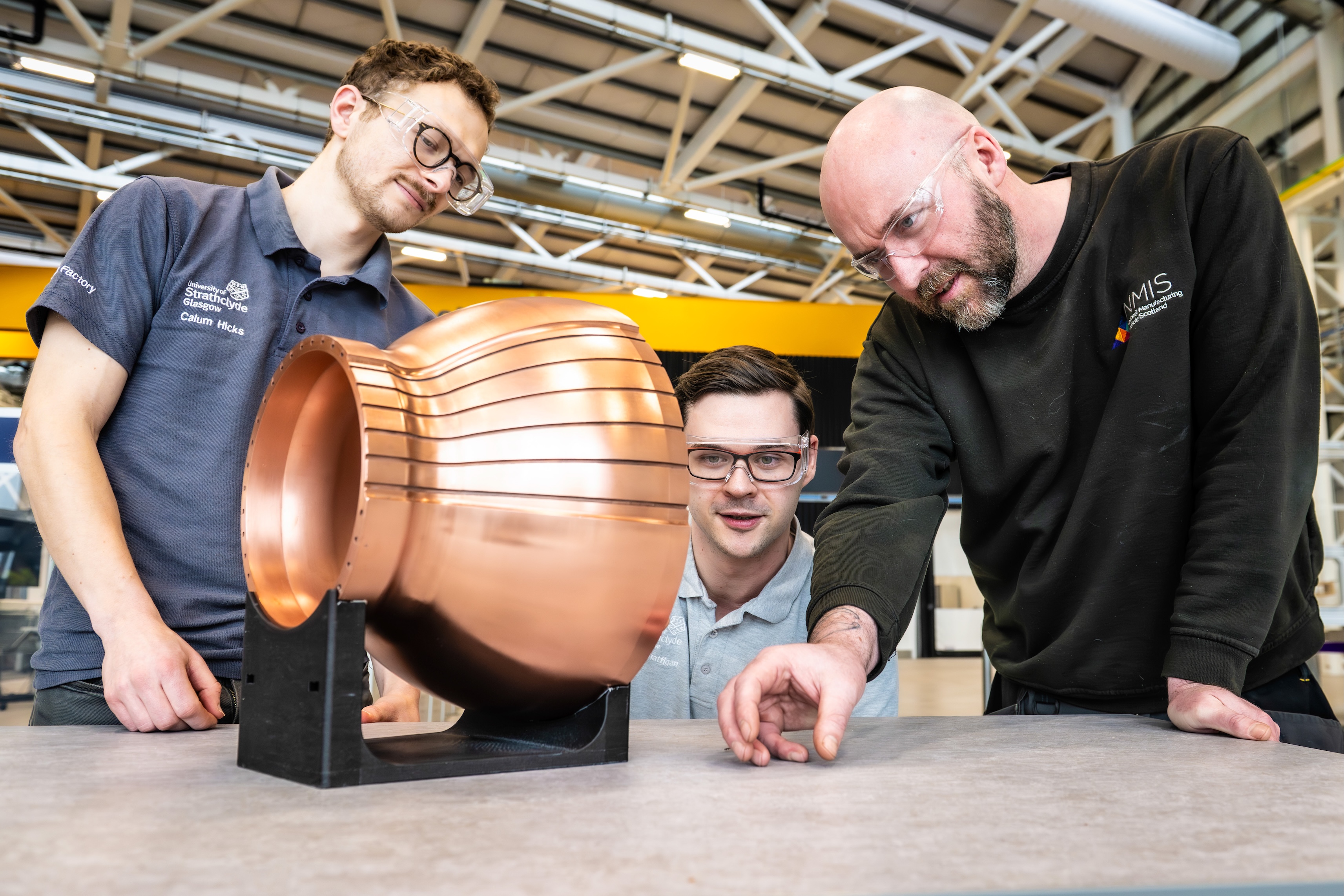
Image courtesy NMIS
The project explored a new way to manufacture large copper structures with intricate cooling channels - one of the long-standing challenges in rocket engine production. Rocket combustion chambers and nozzles are among the most critical components in spacecraft systems, operating in extreme environments where temperatures exceed the melting point of the structural materials. These conditions place significant demands on manufacturing methods to produce the challenging geometries, whilst retaining the stringent material performance and cost efficiency.

Traditional production routes are typically slow and labour-intensive, often requiring multiple fabrication stages and extensive machining. Although additive manufacturing approaches such as Powder Bed Fusion (PBF) offer increased design freedom, they are constrained by build size, limiting their suitability for large components. Electroplating is also commonly used to manufacture copper rocket nozzles, but long production lead times remain a significant challenge at the scales required. As a result, production can take several months, with high costs and limited flexibility to adapt or scale designs.
Copper presents an additional challenge. Its thermal and mechanical properties, combined with its highly reflective nature, make it difficult to process using conventional additive manufacturing techniques. This has historically restricted the production of advanced geometries, particularly the complex internal cooling features that are critical to rocket nozzle performance.
To overcome these limitations, engineers at NMIS developed a hybrid manufacturing approach centred on high-pressure cold spray technology. This high rate additive process deposits copper in a solid state, avoiding melting and significantly reducing the risk of thermal distortion or material degradation associated with traditional welding methods.
Using this approach, the main nozzle structure was built up layer by layer through rapid material deposition. The process supports large-scale production while maintaining fine geometric detail, enabling complex internal features to be integrated efficiently within the structure.
The rocket nozzle highlights the potential of high-pressure cold spray to transform how large copper parts are manufactured. With deposition rates of up to 10kg per hour, the process could cut production lead times from months to days, while significantly reducing material waste compared with conventional machining.
While developed for space application, the implications extend far beyond its immediate use. The approach offers a scalable manufacturing route for high-value sectors including aerospace, energy and shipbuilding, where robust and corrosion-resistant materials are critical. The technology can also be applied to repair and remanufacture existing components, extending asset life and supporting more sustainable manufacturing practices.
Although the method is yet to be validated through full rocket engine testing, the copper rocket nozzle provides clear evidence that large-scale, high-performance copper components can be successfully produced using high-pressure cold spray. As manufacturers seek faster, more adaptable and cost-effective production methods, the technology has growing potential to move from niche application into wider industry use.
Calum Hicks, senior technologist at the Digital Factory, NMIS, said: “This project marks an important milestone in demonstrating how advanced manufacturing can be applied to complex rocket engine components. Developing the copper rock nozzle allowed us to explore new approaches to producing high performing thermal management structures, reducing development times and improving production efficiency. This work strengthens the UK’s capabilities in the space sector and beyond.”
Ryan Devine, senior research and development engineer at NMIS, said: “The real value of this work is in showing how advanced manufacturing can move beyond experimentation into practical application. By combining engineering expertise with innovative processes such as high-pressure cold spray, we’re enabling manufacturers to rethink how complex components are designed, produced and maintained. Taking these steps allows us to support faster development cycles and more resilient manufacturing systems.”