NPL neutron facility boosts UK’s research capabilities
The NPL facility consists of a new particle accelerator and is one of only a few known facilities worldwide that offers precision traceable neutron standards.
In July 2023, the UK government outlined plans for a new series of nuclear reactors in a bid to boost UK energy security and reduce dependence on fossil fuels. As well as a roadmap that sets out how the UK will increase nuclear generation by up to four times by 2050, announced on 11th January 2024.

The new facility at NPL’s site in Teddington, south-west London, will provide all-important traceability in terms of established safety protocols and stringent regulatory compliance that ensures these new-build reactors can help drive the rapid and safe expansion of nuclear power in the UK.
More than 60 years after the installation of NPL’s first neutron measurement facility at Teddington, the new system allows the UK government to continue to “provide an enduring and resilient measurement infrastructure, ensuring that measurements can always be made in the UK with integrity and consistency”, as set out in the British Government’s 2022 UK Measurement Strategy for the National Measurement System.
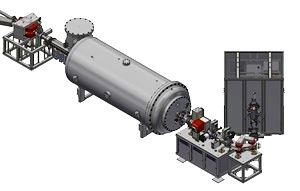
Above: Rendered image of the new accelerator system which is six times as powerful as the one it is replacing and will be a 2.0 MV Coaxial VHC Tandetron manufactured by High Voltage Engineering Europa, The Netherlands, the same company who manufactured the current KN3000 Van de Graaff accelerator over 60 years ago.
Courtesy NPL
The upgraded neutron facility addresses a number of current, future and emerging needs in the nuclear sector, including:
- The characterisation of new instrumentation and detectors required to ensure the UK’s nuclear infrastructure and future reactors operate safely and efficiently
- Provide the expertise and facilities to enable the characterisation of neutron diagnostics, neutronics benchmark and validation experiments and nuclear cross section and decay-data measurement, to support the work at UK-based world-leading fusion research organisations and their supply chains
- Produce both monoenergetic and thermal neutron fields for UK defence and security
- The characterisation and calibration of new area survey instruments and personal dosemeter products to assure the safety of workers within the nuclear sector
The upgrade has been funded by the former Department for Business for Energy and Industrial Strategy (BEIS) PSRE Infrastructure Fund.
Nuclear Minister Andrew Bowie said: “We are reviving our nuclear industry to deliver net zero and secure our energy independence, with plans to build new large and small-scale reactors.
“These upgrades to National Physical Laboratory’s (NPL) neutron facility will enable the safe and efficient operation of our new projects, as we ramp up clean and reliable nuclear power.”
Dr Peter Thompson, CEO of NPL, said: “By extending the UK’s capability in neutron standards and device calibration which leads to improved accuracy and direct measurement in place of extrapolated data and therefore helping to accelerate work on advanced nuclear technologies, we are ensuring the UK is leading in this field.”
Michael Bunce, Senior Scientist and Technical Lead at NPL, said: “This is an exciting time for UK nuclear science and this facility is a concrete example of that. With this machine we will be able to continue to provide standards to UK and international customers with greater efficiency and reliability whilst extending our research into new areas such as nuclear data measurements in support of fusion.”