OneWeb demos LEO capabilities to humanitarian community in Geneva
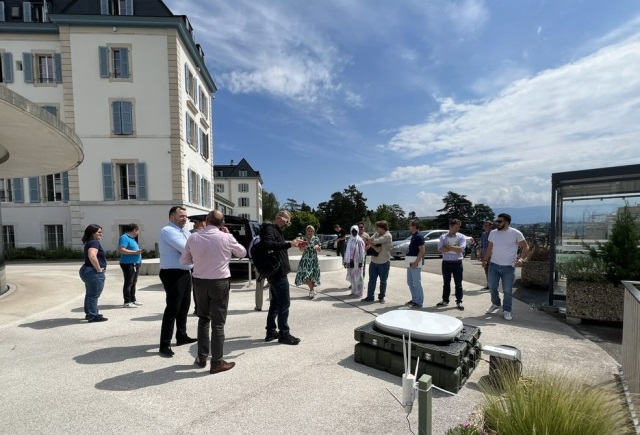
Image courtesy OneWeb
OneWeb welcomed representatives of international humanitarian organisations to the headquarters of the International Committee of the Red Cross (ICRC) in Geneva, Switzerland, last week, to take part in a successful demonstration of LEO satellite capabilities.
The meeting saw attendance from local organisations and virtual attendance from a number of United Nations’ humanitarian organisations. The annual event allows IT and Telecoms managers from across the major non-governmental organisations to experience new technology solutions in the market, relevant to their efforts and to enable discussions with key providers on their needs.

The demonstration was a significant milestone for OneWeb in the region since expanding connectivity services across Southern Europe. The team showcased the network’s capability to deliver high-speed, low latency communications through two different user terminals.
First was with the recently launched Kymeta Hawk u8 user terminal which is suited for fixed applications and mountable on moveable vehicles and vessels. Second, the team showcased the new human-portable flat panel INSTER, which slides into a backpack for increased portability for ‘any situational’ comms on the pause (COTP) and will be available in the second half of this year.
Movability is a vital aspect of natural disaster and human crisis missions where no cellular or terrestrial-based networks are available and these user terminals in OneWeb’s product line are positioned to support critical comms in emergency response situations.
For customers, OneWeb offers a secure and agile low-earth-orbit communications plan, providing end users with primary, alternate, contingency and emergency (PACE) connectivity should any specific network become disrupted or unavailable for any reason.
OneWeb, successfully streamed 4K video feeds, ran Teams and GoogleEarth applications at up to 150Mbps download speeds; up to 29Mbps upload speeds; and latency levels as low as 70ms.
OneWeb Director of Government, Charlie Clark, who conducted the demo, said: “In uncertain environments like natural disaster areas where humanitarian teams are operating in highly stressful and ever-chasing circumstances, connectivity on the move, as well as on the pause, is important.
“Teams could be operating where the ground has been destroyed or is unstable, so wheels are not an option. In this situation terminals need to be carried in and that’s where the OneWeb family of ground terminals offers flexibility for these differing needs - a flat panel like the Kymeta works well on a vehicle but when that isn’t viable the INSTER, which is lightweight, is an ideal human-portable solution.
“OneWeb is ideally placed to help compress decision cycles, provide essential situational analysis and get resilient, high bandwidth, low latency connectivity to agency teams communicating together on the ground. It was great to be able to demonstrate these attributes to the Red Cross and Humanitarian Community in Geneva as it looks to engage with space-led technologies and innovations for faster operational capabilities.
“The feedback we received from the event was extremely successful. The OneWeb offering works on many levels for organisations like Red Cross. We can operate multiple service plans on one device so the network slice can adapt and work across various teams - be it operational traffic for critical comms or welfare links for everyday internet use. This really helps with flexibility of budget splits and makes the offering more accessible.”