Advancing UK Aerospace, Defence, Security & Space Solutions Worldwide
  • Home
  • /
  • Space
  • /
  • Oxford Space Systems and Lacuna Space deploy two helical antennas

Space

Oxford Space Systems and Lacuna Space deploy two helical antennas
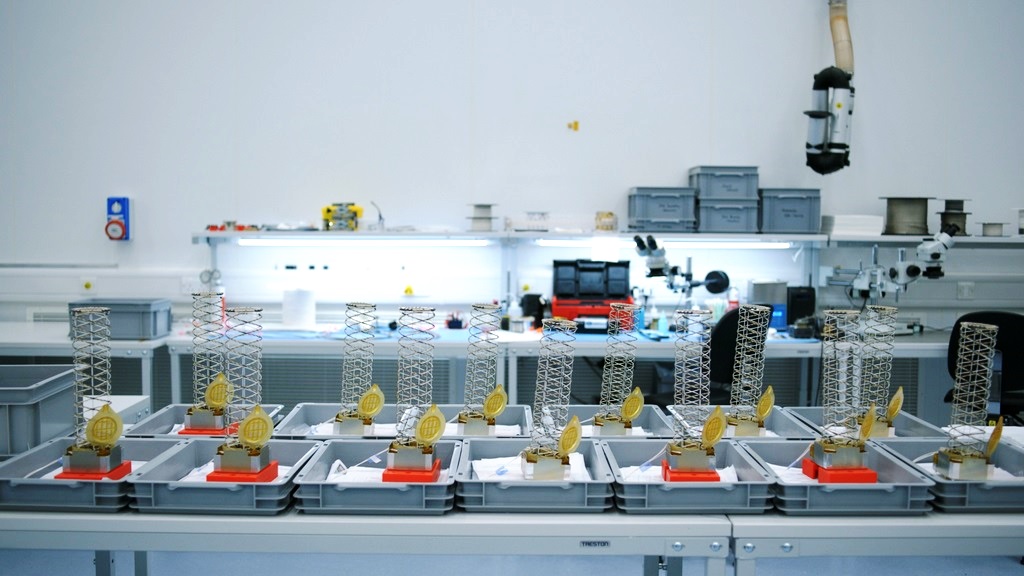
Oxford Space Systems and Lacuna Space have successfully deployed an additional two Oxford Space Systems helical antennas to add to Lacuna Space’s growing satellite Internet of Things (IoT) constellation.

Image courtesy Oxford Space Systems

These deployments mark a significant milestone: 10 successful launches of Oxford Space Systems deployable antennas with Lacuna Space over the last five years, with a 100% in-orbit success rate. The helical antenna is designed to operate within the Low Power Direct to Satellite (LPD-S) bands recently formalised by ECC, centred on 868 and 915MHz.

Advertisement
PTC rectangle

The antennas offer a lightweight structure and compact stowage volume, enabling efficient integration on CubeSat platforms with a deployment mechanism that ensures reliable operation - critical for constellation-scale missions.

Lacuna Space is building a global satellite IoT network designed to connect sensors anywhere on Earth, helping to drive innovation in agriculture, environmental monitoring, and utility management. By integrating Oxford Space Systems’ deployable helical antennas, Lacuna Space ensures robust communications while keeping costs low - a critical factor in delivering scalable, real-world solutions.

“The UK is leading the way in making satellite communications open, interoperable and affordable. At Lacuna Space, we set out to move beyond proprietary systems and build on open terrestrial standards so that anyone, anywhere can benefit from space-enabled connectivity. Oxford Space Systems’ reliable, flight-proven antennas are a key part of that vision, giving us the confidence to scale a truly global network”, said Fernando Rodriguez, CTO at Lacuna Space.

Advertisement
ODU RT

“We’re proud to see our antennas play a central role in Lacuna Space’s constellation,” commented Sean Sutcliffe, Chief Executive at Oxford Space Systems. “This is a great example of UK-built space technology moving from prototype to constellation production, proving its reliability in orbit time after time.”

With another four Lacuna Space satellites due to be launched in the coming months, both companies are demonstrating how trusted, flight-proven hardware and agile satellite manufacturing are reshaping the sector. Together, Oxford Space Systems and Lacuna Space are helping to industrialise space infrastructure - ensuring faster, more cost-effective access to critical data from orbit.


Advertisement
ECS leaderboard banner
SSTL joins Eric and Wendy Schmidt Observatory System’s Lazuli

Space

SSTL joins Eric and Wendy Schmidt Observatory System’s Lazuli

9 March 2026

Surrey Satellite Technology Ltd (SSTL) today announced its role as a key industrial collaborator in the Eric and Wendy Schmidt Observatory System’s Lazuli, a pioneering initiative that will deliver one of the most ambitious privately funded space telescopes ever conceived.

UK space tech startups target debris, wildfires and climate risk

Security Space

UK space tech startups target debris, wildfires and climate risk

9 March 2026

Six UK space tech startups have joined the European Space Agency Business Incubation Centre UK (ESA BIC UK) to develop technologies that deliver practical benefits in space and on Earth, applying space technology to some of today’s most urgent challenges, from clearing space junk to detecting wildfires in seconds.

UK National Microgravity Research Centre opens in Swansea

Space

UK National Microgravity Research Centre opens in Swansea

9 March 2026

The UK’s first National Microgravity Research Centre has been completed at Swansea University, marking the successful delivery of a £13 million project part-funded by the UK Space Agency.

Collaboration to support in-orbit pharmaceuticals manufacturing

Space

Collaboration to support in-orbit pharmaceuticals manufacturing

5 March 2026

The UK Space Agency, the Medicines and Healthcare products Regulatory Agency (MHRA), the Regulatory Innovation Office (RIO) within the Department for Science, Innovation and Technology (DSIT) and the Civil Aviation Authority (CAA) are working collaboratively to provide a supportive regulatory environment to space, biopharma and pharmaceutical ...

Advertisement
Security & Policing Rectangle
UK funding aimed at £40bn satellite communications market

Space

UK funding aimed at £40bn satellite communications market

5 March 2026

British companies developing satellite communications technology are to receive £30 million in government funding, Space Minister Liz Lloyd announced yesterday, as the UK looks to secure a larger share of a global market worth £40 billion.

Mutable Tactics secures Seraphim Space led funding

Defence Space

Mutable Tactics secures Seraphim Space led funding

4 March 2026

British robotics autonomy company, Mutable Tactics, has closed a pre seed funding round of $2.1 million led by Seraphim Space, with support from the UK’s National Security Strategic Investment Fund, Koro, Entrepreneurs First and Transpose.

Advertisement
ODU RT
Advertisement
Gulfstream banner