PHASA-35 completes critical endurance trials with sensor payload
Further to initial flight trials, PHASA-35, a 35 metre wingspan solar-electric aircraft, has successfully completed critical endurance trials which saw the aircraft operate for 72 hours in a simulated environment that models the harsh stratospheric conditions in which the aircraft is designed to operate.
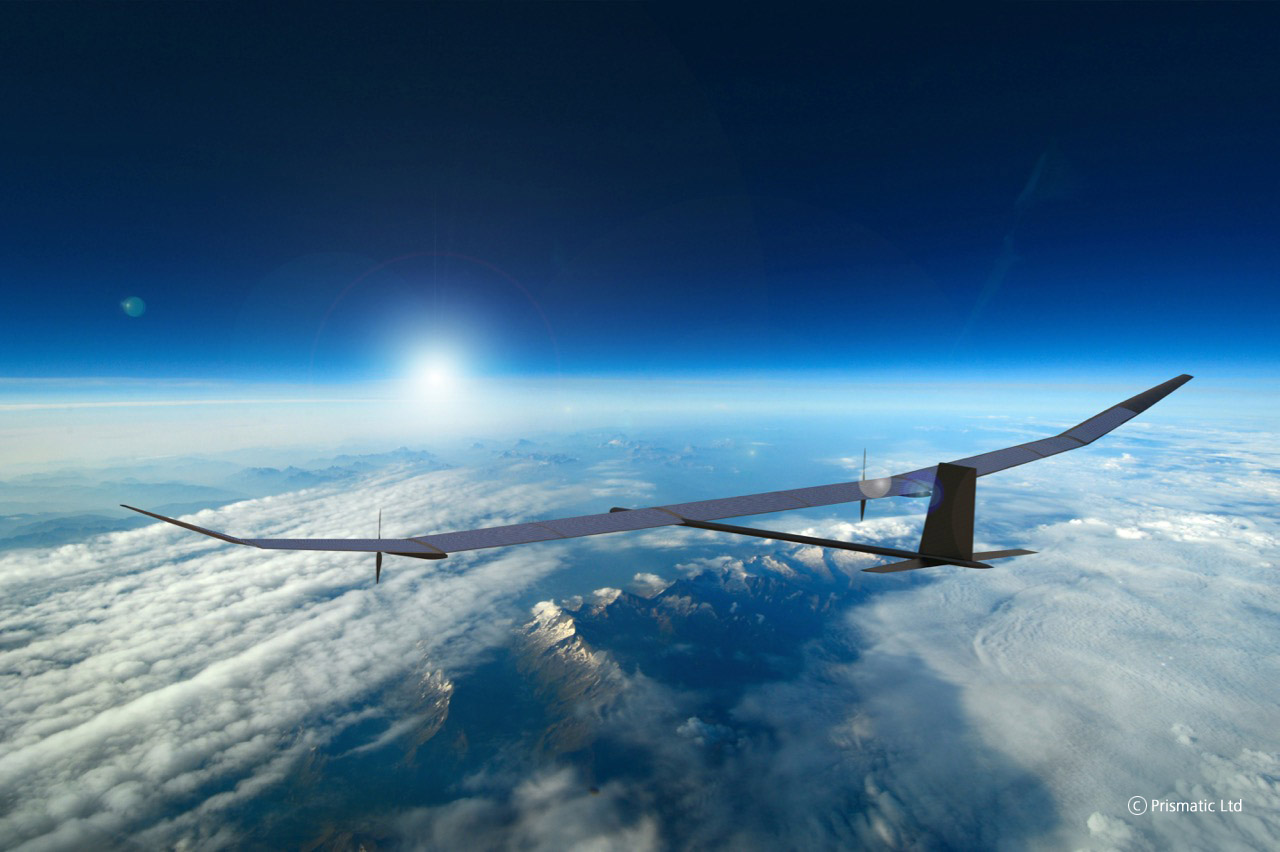
Image copyright Prismatic Ltd
The trials, a collaborative effort by BAE Systems, Prismatic and the UK’s Defence Science and Technology Laboratory (Dstl), advancing the aircraft’s operational utility.
Known as critical ‘soak’ tests, the trials demonstrated the aircraft working effectively as a fully integrated system together with Dstl’s communications sensor payload; a radio frequency sensing software defined radio that provides a real-time and secure data link.

The trials further validated that the aircraft’s systems are capable of enduring the harsh temperature and pressure extremes experienced in the stratospheric environment.
Exploiting BAE Systems’ capabilities in digital testing and flight systems has enabled the testing to be completed through a series of highly representative ground-based tests, driving pace and reducing costs in the development phase of the programme.
The tests, which were undertaken in a dedicated 40m hangar at Prismatic’s facility near Farnborough, also enabled the team to practice the various operations needed in flight, including the transition from daytime, when the aircraft is powered by the solar array, to night-time, when the aircraft’s batteries are discharged.
Paul Mather, Principal Payload Adviser, Dstl, said: “BAE Systems and Prismatic have put the integration and operation of the user payload at the heart of the PHASA-35 design and it has been very satisfying to work with the team in so clearly showing the benefits of this approach. Dstl has a proud tradition of rapid proving of new technologies which provide military and security advantage, which this latest success reinforces.”
Ian Muldowney, Chief Operating Officer, BAE Systems Air, added: “PHASA-35 is a great example of how we’ve brought together the best in British expertise and partnered to drive technological innovation and deliver critical capability. This latest success, only eight months after PHASA-35’s maiden flight, further demonstrates how UK industry and our partners are accelerating pace to deliver the UK’s vision for innovation, a Future Combat Air System and information advantage.”
Paul Brooks, Managing Director, Prismatic, said: “I am extremely proud of the efforts the team have put into making these trials a success and to do this despite the challenges that a global pandemic has brought to us all. By taking the best from the large company experience that BAE Systems offers, together with the agility of a small, innovative company such as Prismatic, we’ve been able to drive the programme forward with continued pace, culminating in the seamless integration of this first payload. This is an important milestone in bringing PHASA-35 closer to market, working alongside Dstl in the process.”
Further flight trials are due to take place in the coming months and this latest milestone is another step forward for the aircraft which could enter initial operations with customers within 12 months of completion of its flight trials programme.
The PHASA-35 high altitude, long endurance, unmanned aerial vehicle (HALE UAV), successfully completed its first flight in February, less than two years from initial design. The UAV has the potential to maintain flight for up to a year at a time, in the stratosphere, providing military and commercial customers with capabilities not currently available from existing air and space programmes.
PHASA-35 has a wide range of potential applications such as the delivery of communications networks, including 5G, as well as support to disaster relief and border protection. Its payload capacity can be adapted to meet the needs of the user to carry sensors such as cameras, thermal imaging and communications equipment.
The aircraft’s long-life battery and highly efficient solar technology allow PHASA-35 to potentially maintain flight for up to a year operating in the stratosphere, the upper regions of the Earth’s atmosphere, and will plug the gap between aircraft and satellite technology.