Pulsar Fusion Demonstrates its Sunbird Nuclear Fusion Rocket’s First Plasma at MARS Conference
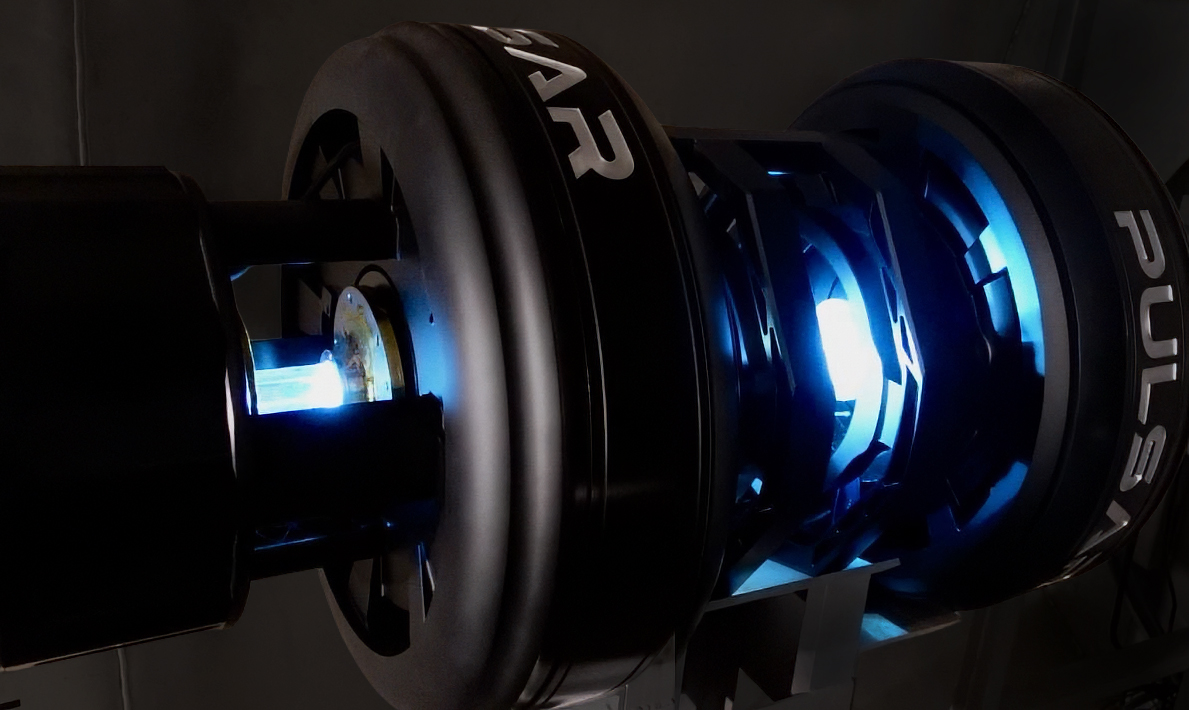
Above:Sunbird first plasma with Krypton
Image courtesy Pulsar Fusion
This achievement was demonstrated live during a dedicated technical session at Amazon’s prestigious MARS Conference, hosted by Jeff Bezos, in Ojai California, where visionary leaders in machine learning, automation, robotics and space gathered to shape humanity’s future beyond Earth.

The Sunbird demo was presented live by Pulsar Fusion CEO Richard Dinan to an esteemed group of world leading machine learning and robotics academics/entrepreneurs, Nobel laureates and astronauts. The test was performed by Pulsar Scientists in Bletchley, UK, and live streamed to the stage in California during Richard Dinan’s presentation.
This test marks an early step in development, demonstrating plasma confinement within the exhaust architecture of the Sunbird system. The experiment uses a combination of electric and magnetic fields to guide and accelerate charged particles through the exhaust channel.
The next phase of development will see Pulsar gather detailed performance data, including thrust and exhaust velocity, using a thrust balance, E×B probes, and RPA measurements. This data will enable Pulsar to plan the first Sunbird mission.
To maximize the mission lifetime of Sunbird, Pulsar has developed a research program in collaboration with the UK Atomic Energy Authority. The program will study the effects of neutron radiation on the reactor walls and magnets, a primary cause of wear within the reactor.
For this initial test series, krypton was used as the propellant, selected for its relatively high ionization efficiency and inert characteristics at the mass flow rates required for early testing.
Upcoming experiments will incorporate rotating magnetic field heating, RF heating systems, and a dedicated thrust balance to enable more detailed performance measurements.
"The Sunbird program showcased this milestone live in California at the MARS Conference, hosted by Jeff Bezos, which was an exceptional moment and a genuine privilege," said Richard Dinan, CEO of Pulsar Fusion. “There is no greater platform to share this first test than here, surrounded by an esteemed group of world leading machine learning and robotics academics/entrepreneurs, Nobel laureates, astronauts. I am grateful to the MARS Conference and Jeff Bezos.”
Looking ahead, Pulsar Fusion plans to upgrade the magnetic system to rare-earth, high-temperature superconducting magnets, enabling stronger magnetic fields and the exploration of higher plasma density and pressure conditions. This program ultimately aims to begin experimental work with aneutronic fusion fuel cycles as part of the continued development of the Sunbird propulsion system.
Why Nuclear Fusion Space Propulsion?
Today’s spacecraft rely primarily on two very different propulsion systems, each with fundamental limitations. Chemical rockets generate extremely high thrust, essential for launch and rapid maneuvers, but their relatively low exhaust velocities limit how fast spacecraft can ultimately travel through space.
Electric propulsion systems, such as ion or Hall thrusters, achieve very high exhaust velocities, making them highly efficient. However, they produce very low thrust, requiring spacecraft to accelerate gradually over long periods.
Fusion propulsion has the potential to deliver both high thrust and extremely high exhaust velocities. This combination could dramatically shorten travel times across the solar system.
For example, if a space station were being constructed around Mars, faster propulsion would allow components to be transported more quickly, enabling the station to be completed and operational much sooner. In space, transport speed is directly tied to economic growth: the faster people, materials, and infrastructure can move, the sooner those assets can begin generating value. Higher exhaust velocities therefore translate into a faster-growing space economy.
The global space industry is rapidly transitioning from a speculative venture into a core pillar of the world economy. According to the World Economic Forum and McKinsey, the space economy is projected to triple within the next decade, surpassing $1.8 trillion by 2035.