Advancing UK Aerospace, Defence, Security & Space Solutions Worldwide
  • Home
  • /
  • Aerospace
  • /
  • Rolls-Royce secures funding to build DAC demonstrator

Aerospace

Rolls-Royce secures funding to build DAC demonstrator

Rolls-Royce has secured £3 million from the UK Government to build a demonstrator Direct Air Capture (DAC) system, which could play a vital role in keeping global temperature rises to below 1.5C by removing CO2 from the atmosphere.

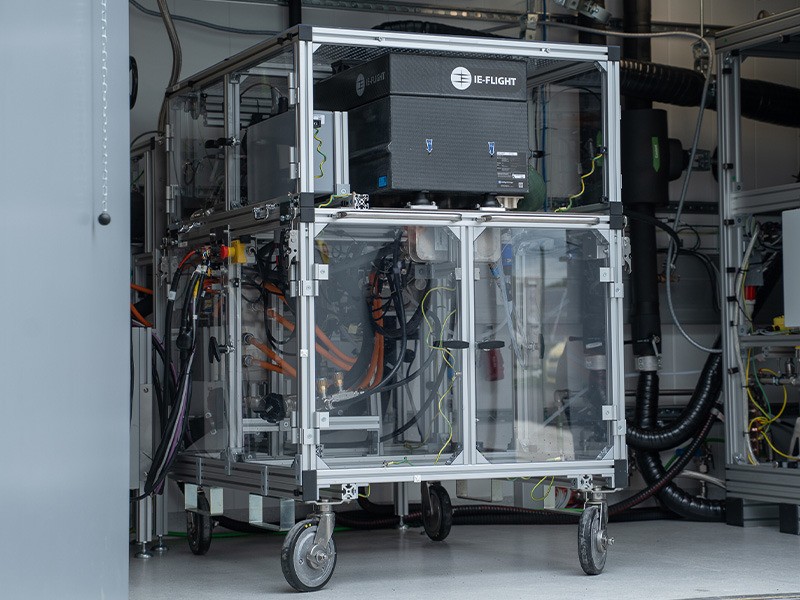
Image courtesy Rolls-Royce

The demonstrator funding comes from the Net Zero Innovation Portfolio (NZIP) through the Department for Business, Energy and Industrial Strategy (BEIS) and helps deliver on the UK Government’s 10 Point Plan for a Green Industrial Revolution. It follows initial Phase 1 funding of £250,000 awarded in 2021, that allowed Rolls-Royce to design the demonstrator in partnership with the Commonwealth Scientific and Industrial Research Organisation (CSIRO).

Advertisement
PTC rectangle

The demonstrator, to be built in Derby, UK, will be operational during 2023 and be capable of removing more than 100 tonnes of CO2 per year from the atmosphere. CO2 removed from the atmosphere by such systems can be stored ensuring that it no longer contributes to global warming. It can also be recycled to make fuel for hard to decarbonise sectors such as aviation, enabling the more rapid phase out of fossil fuels.

A full-scale version of this plant could remove 1 million tonnes per year. The UK’s target is to remove 25 million tons of CO2 per year by 2030; and the International Energy Agency (IEA) forecasts that 980 million tonnes a year will need to be removed globally to limit global warming to 1.5C.

Jess Poole, Direct Air Capture Lead for Rolls-Royce, said: “Every credible climate change model requires us to decarbonise today’s emissions, as well as removing CO2 already in the atmosphere via carbon negative technologies such as DAC. Our system combines our expertise in moving large quantities of air efficiently and integrating complex systems, which have been gained from designing world-leading jet engines, with novel DAC technology developed by CSIRO.

“Together the system works like a giant lung, sucking in air, absorbing the CO2, and releasing what is not wanted. We use a water-based liquid to wash around 50% of the CO2 from the captured air. Our technology is distinctive because very little water is used, and the liquid is recycled at low temperatures, making it energy efficient. Other technologies consume a lot of water and require substantial amounts of energy to generate heat for the separation of the CO2.

Advertisement
Security & Policing Rectangle

“This funding is great news for the team, and we’re excited about the future potential of this technology to help fight climate change.”

The demonstrator system will be built and operated by an in-house team at Rolls-Royce in an existing aerospace test facility, called Test Bed 52, on our Derby campus. This facility was previously used to test jet engines and is built for drawing in air and measuring how well new technologies perform.

The development of the DAC technology concept complements the progress Rolls-Royce has made since the launch of our Net Zero roadmap in 2021. We are making our operations and facilities net zero by 2030; improving the efficiency of our products to burn less fuel and making them compatible with sustainable fuels; and developing new net zero technologies.


 

Advertisement
ECS leaderboard banner
Wales to be UK launchpad for advanced autonomous tech

Aerospace Defence Security

Wales to be UK launchpad for advanced autonomous tech

20 February 2026

Thousands of skilled workers in Wales will be involved in the design, testing and manufacture of advanced autonomous technologies and unmanned systems, as a landmark £50 million Defence Growth Deal positions the nation at the forefront of Britain’s defence future.

NPAS increases aircraft available for deployment

Aerospace Security

NPAS increases aircraft available for deployment

19 February 2026

In January this year, the National Police Air Service (NPAS) was able to increase the number of aircraft that were available for operational deployment.

Alloyed secures ATI Programme funding to develop ABD-1000AM

Aerospace

Alloyed secures ATI Programme funding to develop ABD-1000AM

19 February 2026

Developer and manufacturer of advanced metallic components, Alloyed Ltd, has secured funding from the ATI Programme for an ambitious £1 million project to accelerate the development of ABD-1000AM, a next-generation nickel-based superalloy designed for additive manufacturing.

Birmingham Airport publishes new sustainability strategy

Aerospace

Birmingham Airport publishes new sustainability strategy

19 February 2026

Birmingham Airport (BHX) has published its new sustainability strategy for 2026 to 2030, outlining the next strategic steps on its journey to becoming a more sustainable and socially responsible business.

Advertisement
ODU RT
UK hydrogen airport trial sets out roadmap for further studies

Aerospace

UK hydrogen airport trial sets out roadmap for further studies

18 February 2026

A new report into the UK’s first airside trial of multiple hydrogen-powered ground support equipment (GSE) has confirmed that hydrogen can be safely and effectively integrated into airport ground operations, whilst setting out a series of essential next steps needed to accelerate hydrogen adoption and decarbonisation across the aviation sector.

Kent collaborates on Pre-FEED study for Eq.flight SAF demo plant

Aerospace

Kent collaborates on Pre-FEED study for Eq.flight SAF demo plant

18 February 2026

Integrated energy services partner, Kent, has collaborated with Equilibrion during a successful bid for funding from the UK Department for Transport’s Advanced Fuels Fund (AFF) and with that funding for Equilibrion and its partners, Kent is delivering the Pre-Front-End Engineering Design (Pre-FEED) for Eq.flight, an advanced power-to-liquids ...

Advertisement
PTC rectangle
Advertisement
ECS leaderboard banner