
General Atomics

Wargaming prompts changes to Royal Navy’s future minehunting motherships

How the Royal Navy is wargaming the Norwegian-designed OSVs and how the games suggest they will need some adjustments for British requirements.

Type 26 Anti submarine Frigate
Photo: Royal Navy

British Government published a statement providing an update on the planned up to three new Offshore Support Vessels (OSVs), being developed in cooperation with Norway. These are to be motherships for the Royal Navy’s future autonomous mine-hunting systems.

In that statement, the UK government writes that it worked with Dstl to “design and implement realistic mine countermeasure scenarios and inputs, enabling Royal Navy subject matter experts to rigorously test operational concepts under realistic conditions.”

The proposed OSV concept was tested in a two-day table-top exercise, and it produced some needed changes. Wargaming on proverbial tables has been an important way for militaries to plan and structure their forces and de-risk for over 100 years.

The statement stresses that mine-hunting is particularly important for the UK as the country depends on secure maritime access for economic security and NATO obligations.

These vessels are being designed to tackle tomorrow’s threats: “As mines grow more sophisticated, autonomous systems and advanced modelling are vital to stay ahead.” The wargaming saw the use of 3D-printed models combined with traditional methods. In images released, the models appear similar to Lego models.
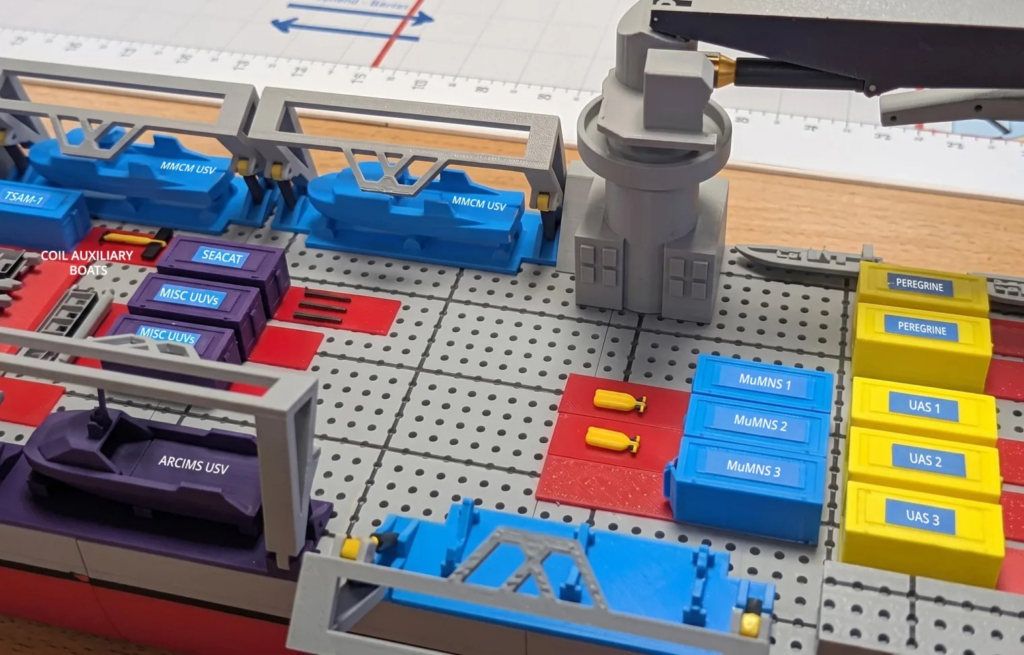
Model of Offshore Support Vessels (OSVs)
Photo: UK Government

New renders of Offshore Support Vessels

A new piece by Navy Outlook published yesterday helps to construct an image of what the future Royal Navy will look like, apparently leveraging the government’s 4 August statement.

These new OSVs look more similar to large commercial offshore vessels than more familiar conventional naval vessels, including auxiliary vessels. Officials have previously said the Royal Navy plans for three minimally modified commercial design OSV motherships to transport at least three USVs, UUVs and associated command-and-control equipment.

The concept represents a shift away from the Hunt and Sandown-class minehunters. HMS Stirling Castle and RFA Proteus provide useful points of comparison for the new mothership concept. The remaining conventional MCM vessels are due to disappear by 2032.

Navy Outlook noted that while earlier Royal Navy development work indicated a need for at least 1,000 square metres (up from 600 square metres on the HMS Stirling Castle), the Navy’s preference has evolved. Now it appears to be something closer to a “floating workshop, transport and command platform with considerable spare volume and deck area.”

Partnering with Norway in the Atlantic

The Defence Investment Plan allocates £1.3 billion to the Autonomous Mine Hunting Capability (MHC) Block 2 program for the period spanning 2026 to 2030. In addition, the plan has £90 million for offshore support vessel cooperation with Norway.

The OSVs are closely tied to Norway, along with wider naval cooperation. Britain formally joined Norway’s programme to develop OSVs for autonomous mine hunting in the 2025 Lunna House Agreement.

The major headline part of that agreement was for the Royal Norwegian Navy to operate at least five British-built Type 26 frigates and operate them as an integrated fleet with the Royal Navy’s planned eight Type 26 frigates. But the agreement also includes cooperation on the Naval Strike Missile, torpedoes, autonomous systems, and joint operations in the shared North Atlantic.

The purchase of the Norwegian-designed OSVs is seen as part of the wider strategic offset programmes and cooperation associated with Norway’s decision to purchase the frigates. It also leverages Norway’s strengths in offshore vessel design.

However, an interesting detail is that the two-day tabletop exercise produces changes needed for the Royal Navy. It remains unclear how much redesign these ships will need for British service.

Related

British Army trials tactical drone warfare skills in first “Drone Wars” competition
Tpr Harvey Chilman, Queen's Royal Hussars, flew his FPV drone to strike an enemy position during 'Drone Wars' competition. Image: MOD Crown Copyright/British Army
British Army trials tactical drone warfare skills in first “Drone Wars” competition
Held at Sandhurst, the competition showcased how drones are being integrated into reconnaissance, targeting and support roles as the Army adapts to emerging battlefield technologies.
Aerospace Defence

6 Oct 2026

Ontic opens dedicated MRO facility in Tewkesbury
As part of its Maintenance, Repair and Overhaul (MRO) expansion plans, Ontic has opened a new 72,000sq ft facility in Tewkesbury, Gloucestershire.
Aerospace Member News

6 Oct 2026

McLaughlin & Harvey breaks ground on Rolls-Royce Derby facility
Integral to Rolls-Royce's £140 million investment at its Derby site, the new facility will support future growth of the UK’s advanced manufacturing sector and strengthen its aerospace and sovereign defence capability.
Forfield alliance targets stronger supply chains for UK defence organisations
Forfield – Kuehne+Nagel, TVS SCS, Atos, Turner & Townsend collaboration delivering end-to-end supply chain solutions for the Defence sector.
Forfield alliance targets stronger supply chains for UK defence organisations
Forfield has been launched by four industry partners to improve supply chain visibility, resilience and equipment availability for UK defence organisations.
Defence

6 Oct 2026

British Army trials tactical drone warfare skills in first “Drone Wars” competition
Tpr Harvey Chilman, Queen's Royal Hussars, flew his FPV drone to strike an enemy position during 'Drone Wars' competition. Image: MOD Crown Copyright/British Army
British Army trials tactical drone warfare skills in first “Drone Wars” competition
Held at Sandhurst, the competition showcased how drones are being integrated into reconnaissance, targeting and support roles as the Army adapts to emerging battlefield technologies.
Aerospace Defence

6 Oct 2026

Tories pledge £10bn for “Britannia Shield” missile and drone defence system
Live firing tests of precision missile
Tories pledge £10bn for “Britannia Shield” missile and drone defence system
Growing concern over drone and missile threats has intensified the debate around UK air defence, with "Britannia Shield" intended to strengthen protection for critical national infrastructure and military sites.
Defence

6 Oct 2026

Excelerate Technology to build UK CNI robotic security solution
Satellite in Earth orbit
Excelerate Technology to build UK CNI robotic security solution
In a project co-funded by the European Space Agency Business Applications and Space Solutions (ESA BASS) and supported by the UK Space Agency, Excelerate Technology will build and demonstrate how space-enabled assets can provide innovative safety and security solutions, including protection of Critical National Infrastructure (CNI) at a site in the UK.
World Space Week: How British technology will help ESA return to the Moon
ESA Argonaut
World Space Week: How British technology will help ESA return to the Moon
As Europe prepares to return to the Moon, British-developed LEIA LiDAR technology will help ESA's Argonaut lander autonomously identify safe touchdown zones on the lunar surface.
Space

5 Oct 2026

Airbus delivers first next-generation satellites for OneWeb constellation
OneWeb satellites in transport container at Airbus
Airbus delivers first next-generation satellites for OneWeb constellation
A new generation of OneWeb spacecraft is heading for launch, helping Eutelsat sustain and expand its low Earth orbit connectivity network for governments, businesses and institutions worldwide.
Member News Space

5 Oct 2026

Excelerate Technology to build UK CNI robotic security solution
Satellite in Earth orbit
Excelerate Technology to build UK CNI robotic security solution
In a project co-funded by the European Space Agency Business Applications and Space Solutions (ESA BASS) and supported by the UK Space Agency, Excelerate Technology will build and demonstrate how space-enabled assets can provide innovative safety and security solutions, including protection of Critical National Infrastructure (CNI) at a site in the UK.
GA-ASI demos disaster relief comms system
An MQ-9B
GA-ASI demos disaster relief comms system
Working with SoftBank Corp., General Atomics Aeronautical Systems, Inc. (GA-ASI) has demonstrated the successful integration of a new communications payload into its unmanned MQ-9B platform, designed for situations where cellular services are unavailable.
Leonardo DRS sets up UK subsidiary and launches tactical radar production
Tactical Expeditionary Radars
Leonardo DRS sets up UK subsidiary and launches tactical radar production
Leonardo DRS has established DRS UK and launched local production of tactical radars for counter-UAS, air defence and force protection.
Defence Security

6 Oct 2026