Royal Navy tests autonomous systems against threats to critical underwater infrastructure

The Royal Navy used NATO's REPMUS exercise in Portugal to evaluate autonomous vessels, underwater gliders and other emerging capabilities designed to detect underwater threats and protect critical infrastructure.

Exercise Repmus 2026 in Portugal
Photo: NATO

The Royal Navy has worked with industry experts and NATO allies to test a range of innovative uncrewed and autonomous technology during Exercise REPMUS. The service said its ability to locate, identify, and deal with underwater threats using autonomous systems has been “thoroughly tested” by the exercise.

Exercise REPMUS (Robotic Experimentation and Prototyping with Maritime Unmanned Systems) is one of the world’s largest annual international maritime drone and uncrewed vehicle exercise and is held off the coast of Portugal, hosted by the Portuguese Navy.

For the Royal Navy, this year’s exercise focused on anti-submarine warfare (ASW), with it acting as the lead for the operational scenarios and trials.
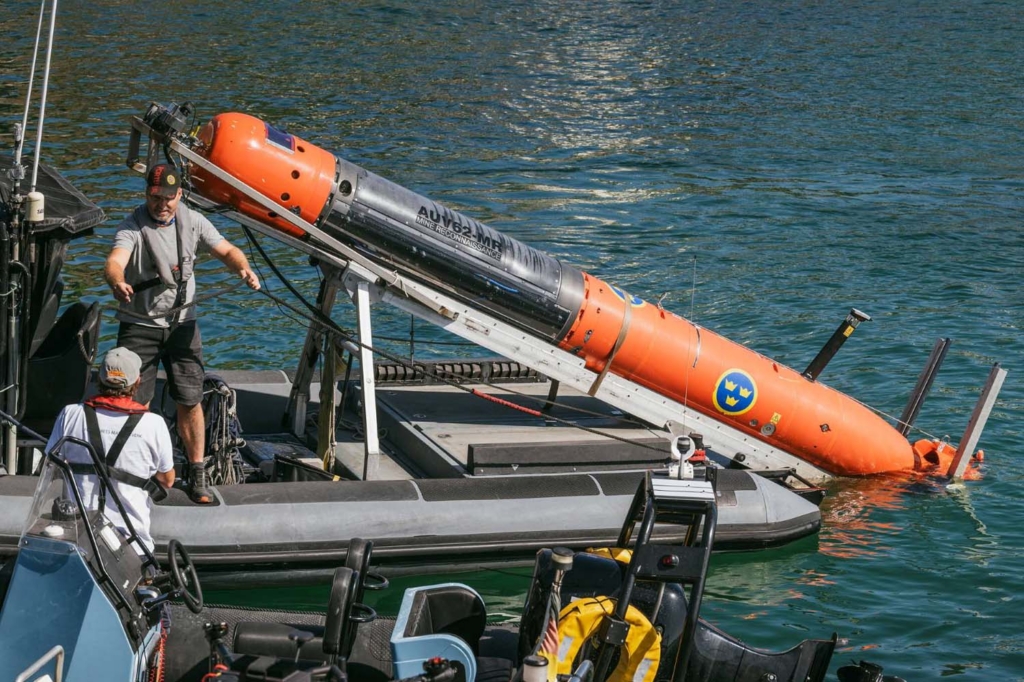
Exercise Repmus 2026 in Portugal glider
Photo: NATO

The Royal Navy contributed around 200 people to the exercise, including its sailors and industry representatives.

In a statement, the Royal Navy said they looked to “develop their ASW capabilities and their ability to conduct surveillance of underwater infrastructure.”

Opportunity for RN to field emerging capabilities

The Royal Navy is in the process of transitioning to a hybrid navy, and the exercises allowed it to field its emerging uncrewed and autonomous capabilities. It also provided an opportunity to sponsor British industry developing technologies for the RN.

The exercise allowed industry to evaluate potential technologies that have not yet been formally adopted by the Royal Navy in an international context. These technologies are expected to inform future options that will be adopted under Atlantic Bastion.
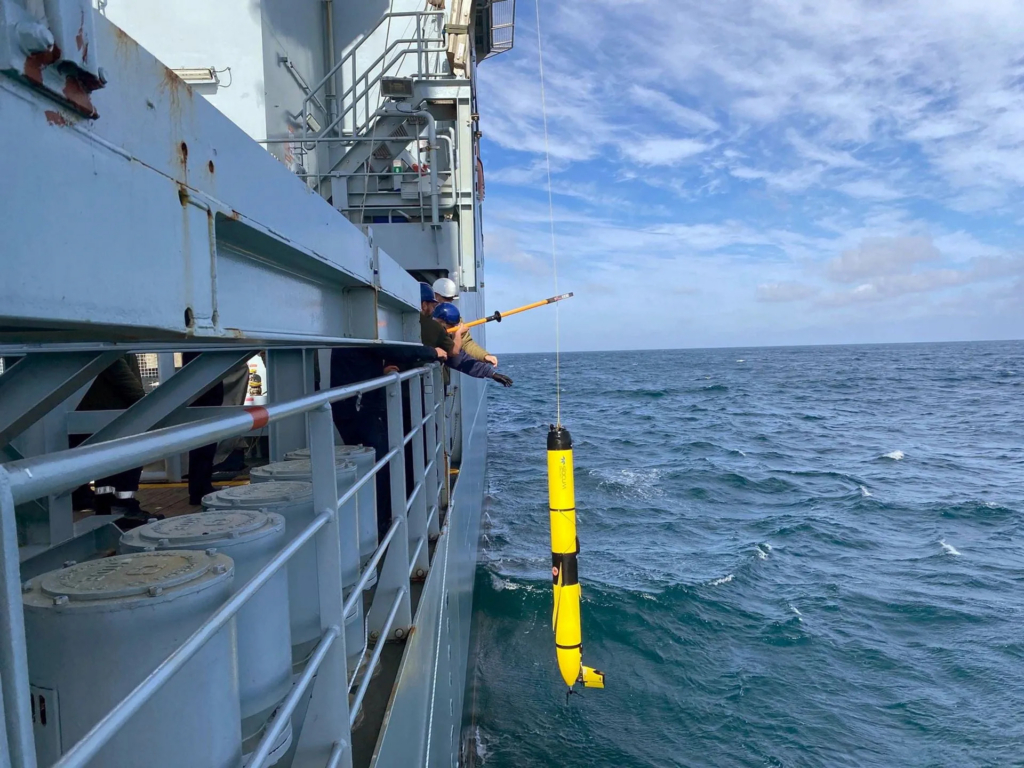
Slocum G3 gliders being recovered
Photo: Royal Navy

Atlantic Bastion was launched in December 2025. It’s the Navy’s strategic programme to strengthen anti-submarine warfare and protect critical undersea infrastructure across the North Atlantic in response to growing concerns over Russian underwater activity.

The autonomous systems used at Exercise REPMUS

The exercise saw the Royal Navy deploy several types of underwater gliders and uncrewed surface vessels. Gliders ranged from small to larger sentinel gliders that use long acoustic vertical arrays to detect and track potential threats.

Separately, the Royal Navy recently unveiled that it had a new record for its largest and longest deployment of underwater drones, by using five ‘ocean gliders’ for 64 days.

The Navy said it deployed “squads of small and medium uncrewed surface vessels.” These gathered acoustic data and provided real-time contact reports of submarine targets and were a “proof of concept for larger squads and versions of such vessels.”

Exercise Repmus 2026 in Portugal exercise
Photo: NATO

One type of autonomous USV used during Exercise REPMUS was 12 metres long, while the other measured 17 metres long. These USVs towed sonar systems, dropped sonobuoys, and launched gliders.

Anti-submarine warfare has been a key aspect of the Royal Navy’s core mission set for decades. Russia’s submarine fleet is generally considered much more capable than its surface fleet.

Related

Dowty to open UK Innovation Centre in Gloucester
Next-gen propeller systems
Dowty to open UK Innovation Centre in Gloucester
A £19 million investment from GE Aerospace will enable Dowty to open an Innovation Centre in the UK that will advance the development and pre-production of next-generation propeller systems and other innovative aerospace technologies.
Aerospace Member News

18 Nov 2026

Gatwick awards slots to GOL as airline eyes international growth
GOL Linhas Aéreas Airplane
Gatwick awards slots to GOL as airline eyes international growth
Brazil's largest low-cost carrier has secured coveted Gatwick slots for summer 2027, strengthening its long-haul ambitions and signalling potential growth in UK-Brazil connectivity.
Aerospace

18 Nov 2026

Engineering and defence jobseekers lower career ambitions, survey finds
Engineer male advance robotic machine designer team talking with electronic component part supplier business consulting in heavy machinery industry concept.
Engineering and defence jobseekers lower career ambitions, survey finds
Research from Tribepad finds that more than half of rejected jobseekers in engineering, manufacturing, aerospace and defence have lowered their ambitions.
Aerospace Defence

18 Nov 2026

92% of UK defence firms surveyed plan to use more domestic suppliers as procurement concerns persist
British-Army-Challenger-3-tank
92% of UK defence firms surveyed plan to use more domestic suppliers as procurement concerns persist
UK defence firms plan to work with more domestic suppliers over the next year, but changing contract requirements and lengthy decisions remain concerns.
Defence Security

18 Nov 2026

Four UK SMEs bring AI, aircraft and recycled materials to Leonardo’s drone swarm trials
Sovereign Hunter Leonardo UK
Four UK SMEs bring AI, aircraft and recycled materials to Leonardo’s drone swarm trials
Volander, Faculty, Uplift360 and Applied AGI supplied the aircraft and software behind Sovereign Hunter, which went from contract to flight trials in six months.
Defence Member News

18 Nov 2026

Engineering and defence jobseekers lower career ambitions, survey finds
Engineer male advance robotic machine designer team talking with electronic component part supplier business consulting in heavy machinery industry concept.
Engineering and defence jobseekers lower career ambitions, survey finds
Research from Tribepad finds that more than half of rejected jobseekers in engineering, manufacturing, aerospace and defence have lowered their ambitions.
Aerospace Defence

18 Nov 2026

University of Surrey develops electronic eye to monitor solar storms
HEPI prototype ‘electronic eye’ sensor
University of Surrey develops electronic eye to monitor solar storms
Under a £400,000 contract with the European Space Agency (ESA) and the UK Space Agency (UKSA), a team of researchers at the University of Surrey will develop an ultra-compact monitor to reveal the effects of radiation from solar storms on space infrastructure, aircraft and terrestrial systems like satellites.
Aerospace Space

18 Nov 2026

BAE Systems selected as NASA PRIMA partner
NASA’s PRIMA far-infrared space observatory, built on BAE Systems’ Evolve+ platform.
BAE Systems selected as NASA PRIMA partner
Alongside a number of international space industry providers, BAE Systems will support NASA’s PRIMA mission to survey the history and evolution of the universe and bridge current scientific gaps.
Member News Space

18 Nov 2026

First Light Fusion and STFC’s CLF partner on FLARE fast ignition
First Light Fusion team at STFC’s Central Laser Facility (CLF)
First Light Fusion and STFC’s CLF partner on FLARE fast ignition
A new collaboration between First Light Fusion and STFC’s Central Laser Facility (CLF) will develop the rapid heating stage of FLARE, advancing its progress towards low cost, high gain inertial fusion.
92% of UK defence firms surveyed plan to use more domestic suppliers as procurement concerns persist
British-Army-Challenger-3-tank
92% of UK defence firms surveyed plan to use more domestic suppliers as procurement concerns persist
UK defence firms plan to work with more domestic suppliers over the next year, but changing contract requirements and lengthy decisions remain concerns.
Defence Security

18 Nov 2026

Your business has been hacked: What should happen in the first 24 hours?
Cyber security operations
Your business has been hacked: What should happen in the first 24 hours?
A cyber attack can stop operations within minutes. New NCSC guidance explains the critical decisions businesses must make in the first 24 hours.
Security

18 Nov 2026

HM King Charles opens new National Cyber Force HQ
HM King Charles III opens new NCF HQ at Ribble House, Samlesbury, Lancashire.
HM King Charles opens new National Cyber Force HQ
The new headquarters of the National Cyber Force (NCF) at Ribble House in Lancashire has been officially opened by HM King Charles III, where he gained insights into the vital role of the NCF in strengthening the UK’s cyber capability.
Defence Security

17 Nov 2026