SAF introduced for the first time at Gatwick
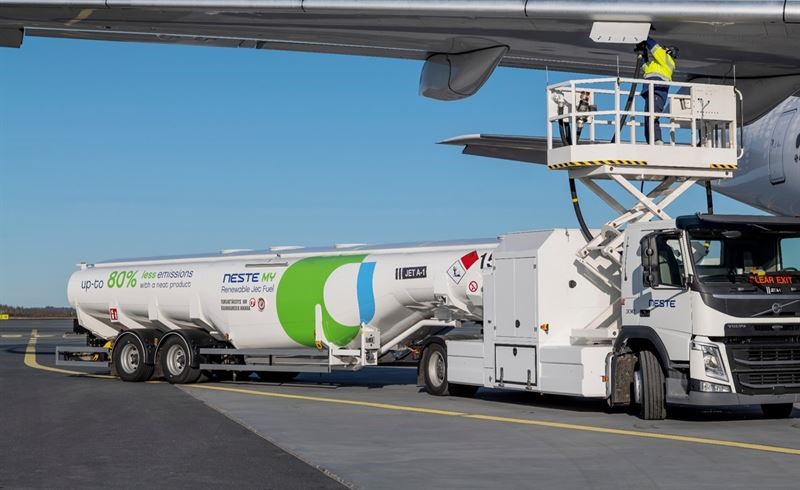
Image courtesy Neste
It confirms the strong commitment of all parties involved – international aviation fuel supplier Q8Aviation, easyJet, Gatwick Airport Ltd and Neste – to achieve a net carbon emission reduction in the fuel used in aviation and work towards an ultimate goal for aviation to reach net zero emissions by 2050.

Of the 42 flights running on Neste MY Sustainable Aviation Fuel blend, 39 of these will be the easyJet flights operating from Gatwick to Glasgow throughout the COP26 Climate Change Conference, which runs from 31st October to 12th November. Across all 42 flights, greenhouse gas emissions will be reduced by up to 70 tonnes which further signals the industry’s intentions to reduce greenhouse gas emissions on a course to reaching net zero emissions by 2050.
Q8Aviation has delivered the first supply of Neste MY Sustainable Aviation Fuel to the fuel supply at Gatwick Airport. Neste’s market-leading sustainable aviation fuel, which is fully certified, is produced from 100% renewable and sustainable waste and residue raw materials, such as used cooking oil and animal fat waste. In its neat form and over its life cycle, Neste MY Sustainable Aviation Fuel can achieve a reduction of up to 80%* of greenhouse gas emissions compared to fossil jet fuel use.
Neste-produced SAF is blended with Jet A-1 fuel at a depot upstream of Gatwick Airport to create a drop-in fuel that is compatible with existing aircraft engines and the airport infrastructure, without requiring extra investment. Q8Aviation delivered the fuel to the main storage tanks at Gatwick Airport for supply to easyJet aircraft via the airport’s hydrant system.
The incorporation of SAF into Gatwick’s operations for today’s flight is an important proof of concept for the airport in demonstrating its continued commitment to work with its aviation partners on decarbonisation. Gatwick’s own 2019 carbon footprint showed that the airport is already half-way to net zero for its own operations and is committed to achieving Net Zero direct emissions by 2040.
Jonathan Wood, Vice President Europe, Renewable Aviation at Neste said: “The aviation industry has already taken important steps to reduce its environmental impact. A key element in achieving this is the wider introduction of sustainable aviation fuel. Neste is investing as we speak to increase SAF production capacity from 100,000 metric tonnes to 1.5 million metric tonnes annually in 2023. Neste welcomes government proposals to encourage the use of SAF to reduce aviation greenhouse gas emissions. It is important that more and more airlines, airports and fuel suppliers lead the way to a more sustainable future for aviation. We are happy to welcome easyJet, Q8Aviation and Gatwick Airport among these frontrunners."
Naser Ben Butain, General Manager Q8Aviation said: “We are delighted to play our part in supplying the first sustainable aviation fuel to easyJet at Gatwick. We have forged a strong partnership with easyJet over many years, and benefit from excellent support from Gatwick Airport Ltd and Neste, and look forward to working closely with all the partners to further our sustainability objectives.”
Jane Ashton, Director of Sustainability at easyJet said: “At easyJet, we want to play our part to lead the decarbonisation of aviation. We’re pleased to announce that today we’re operating using SAF in a proof of concept flight from Gatwick having also committed to using a SAF blend on all flights operating from Gatwick to Glasgow throughout COP26, thanks to a collaborative effort with our partners involved in this project.
"The availability of SAF still needs to grow but they will be an important interim solution in our decarbonisation pathway, while we are supporting the development of zero-emission aircraft, which will be the most sustainable solution for short-haul networks such as our own in the long term. In the meantime, we are operating our flights as efficiently as possible and are currently the only major European airline to offset the carbon emissions from the fuel used for all our flights, which has an impact right now.”
Tim Norwood, Director of Corporate Affairs, Planning and Sustainability of Gatwick Airport said: “We are very pleased to work with easyJet, Q8Aviation and Neste to demonstrate SAF use at Gatwick Airport. SAF is one of several ways that UK aviation and Gatwick will reach net zero carbon by 2050, alongside carbon offsets, airspace modernisation and continued innovation in aerospace technology, including electric, hydrogen and hybrid aircraft systems. With smart Government policy to underpin investment in cost competitive UK SAF production, many more flights could be using UK produced SAF by the mid-2020s.
"Achieving Net Zero emissions by 2050 is both a great challenge and an opportunity for our industry. Sustainable Aviation’s decarbonisation roadmap and interim goals set out clear milestones and we’re ready to play our part at Gatwick, through implementing the roadmap’s first decade milestones and by keeping the roadmap updated to incorporate additional technology solutions for the 2030s.”