Sea Venom anti-ship missile hits major milestone
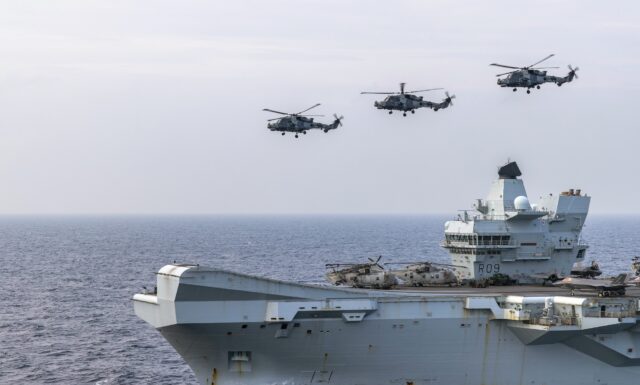
Image courtesy DE&S
Initial Operating Capability (IOC) for Sea Venom delivers unprecedented precision and reach to Royal Navy Wildcat helicopters operating on front-line duties.
This was achieved during Operation Highmast, the Royal Navy’s global deployment to the Indo-Pacific region led by flagship HMS Prince of Wales. Four Wildcats from 815 Naval Air Squadron are now armed with Sea Venom missiles across the Carrier Strike Group, distributed between HMS Prince of Wales, destroyer HMS Dauntless and Norwegian frigate HNoMS Roald Amundsen.

Each Wildcat helicopter can carry up to four Sea Venoms with the ability to engage multiple targets in a single sortie or concentrate firepower against a single high-value target. The missile carries sufficient destructive power to neutralise larger warships including corvettes and patrol vessels, whilst complementing the existing lightweight Martlet missile system designed for countering boat swarms and smaller craft.
Commander James Woods, Commanding Officer of 815 Naval Air Squadron, called the introduction of Sea Venom “a step-change in our combat power”.
He said: “This delivers a lethal combination of precision, reach, and flexibility that allows us to strike decisively against a wide spectrum of threats in the maritime, coastal and land domains.”
“This transformational capability for the Fleet Air Arm ensures we are ready to defend and protect NATO and Allied interests at home and abroad.”
Sea Venom has a sophisticated targeting system, featuring advanced ‘operator-in-the-loop’ capability allowing real-time adjustments during flight. Infra-red imagery from up to four weapons can be transmitted simultaneously back to the operator, enabling precise control over targeting and trajectory adjustments mid-flight. This level of control ensures maximum effectiveness whilst minimising collateral damage, particularly crucial when operating in complex coastal environments.
Along with engaging large coastal patrol vessels and corvettes, its versatility extends to coastal installations and land-based targets, making it a valuable asset for modern naval operations across multiple domains.
The Sea Venom forms the long-range component of the Future Anti-Surface Guided Weapon (FASGW) programme, working in conjunction with the already operational Martlet missile to provide comprehensive anti-surface warfare capabilities across all engagement ranges.
Commander Andrew Henderson, Commander of the Wildcat Maritime Force, noted the operational significance: “Its precision, range and versatility ensures that our frontline crews are equipped to meet the challenges of a multi domain and complex environment.”
Ben Turner, Programme Director for Sea Venom, said: “Declaring Initial Operating Capability for Sea Venom marks a significant milestone in the programme and is testament to the hard work and collaboration across the enterprise over a sustained period.
“This capability is critical in giving operational commanders choice in how they respond to threats today and in the future.”