Advancing UK Aerospace, Defence, Security & Space Solutions Worldwide
  • Home
  • /
  • Defence
  • /
  • SeeByte and MIT combine autonomy engines

Defence

SeeByte and MIT combine autonomy engines
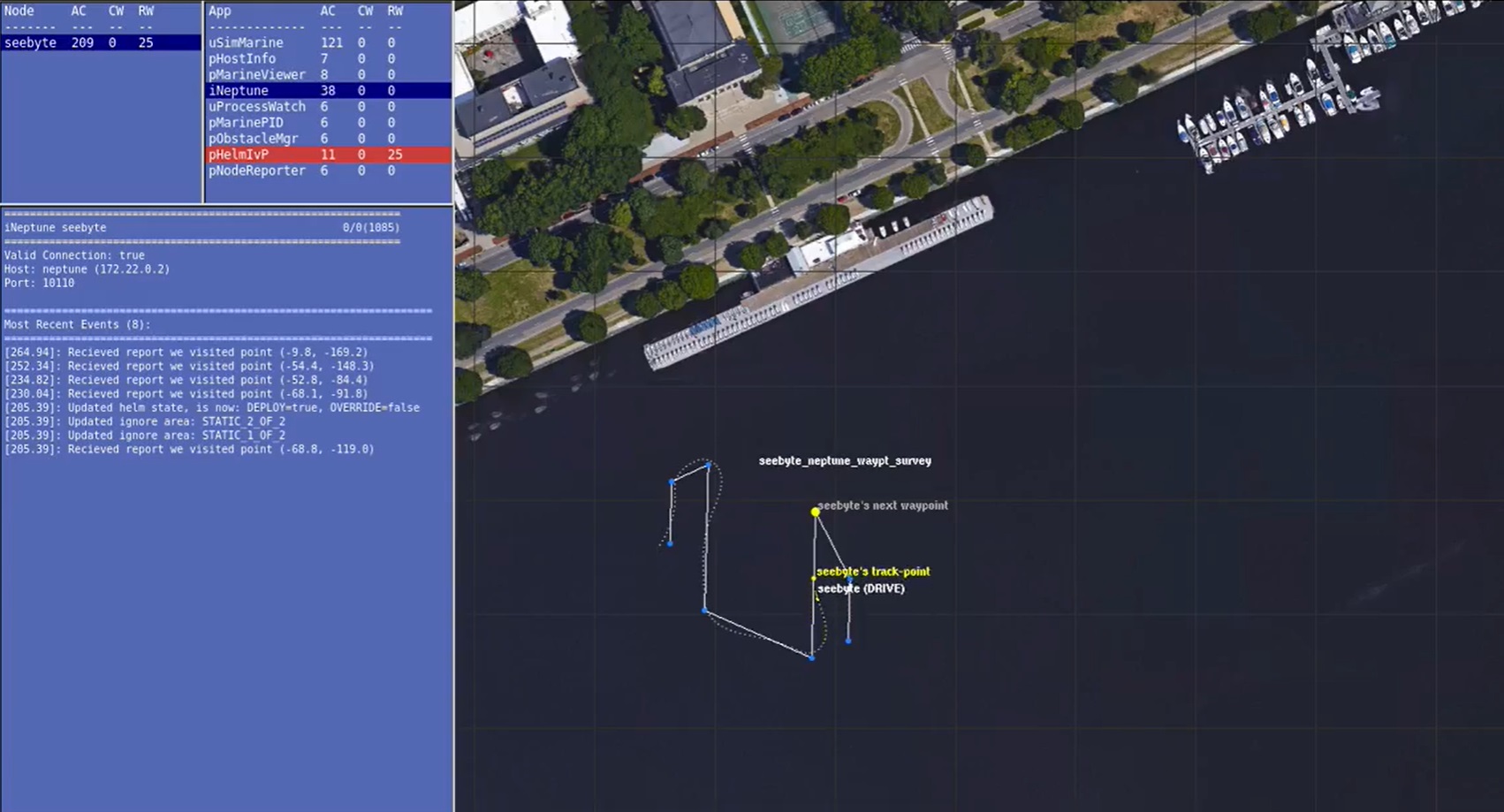
SeeByte and the Massachusetts Institute of Technology (MIT) have successfully combined SeeByte’s Neptune autonomy engine with MIT’s MOOS-IVP during the first trials to test a multi-architecture autonomy framework.

Above: Neptune and MOOS-IvP cooperatively carry out a synthetic MCM survey mission.
Courtesy MIT

The two autonomies were run together cooperatively on a single asset to carry out a Mine Countermeasure (MCM) survey mission. To support the integration, a service-oriented, multi-autonomy interface has been developed.

Advertisement
ODU RT

Andrea Munafo, Engineering Manager at SeeByte said: “The first phase of the project demonstrated how Neptune and MOOS-IvP can seamlessly work together leveraging each other’s strengths to maximise the mission performance. This is a great step towards a best of breed "system of systems'' approach, where new or updated autonomy services can be easily integrated together to improve UxV capabilities and give operators a broader range of capabilities.”

Michael Benjamin, Research Scientist at MIT commented, “Hybrid autonomy systems present several powerful options for the end user to be opportunistic, nimble and able to field newly configured platforms for rapidly evolving mission challenges."

The prototype developed is agnostic to architecture so that it may be applied to a range of autonomy architecture pairs and it is not restricted to the two systems under test.

The next phase of the study awarded by the Office of Naval Research (ONR) will explore increasingly complex delegation strategies between Neptune and MOOS-IvP and consider multi-vehicle or multi-domain scenarios.

Advertisement
Leonardo animated rectangle

SeeByte’s Neptune and MIT’s MOOS-IvP offer extendable autonomy architectures and have been used in collaborative unmanned systems demonstrations worldwide.


 

Advertisement
Babcock LB Babcock LB
Autonomous submarine Excalibur delivered to Royal Navy

Defence

Autonomous submarine Excalibur delivered to Royal Navy

12 December 2025

Excalibur, a 12-metre experimental uncrewed underwater vessel, has now been officially handed over to the Royal Navy.

UK launches new Military Intelligence Services

Defence

UK launches new Military Intelligence Services

12 December 2025

Today, the Ministry of Defence (MoD) launched the new Military Intelligence Services (MIS), designed to ensure UK military intelligence is more efficient and better able to anticipate future threats.

BAE Systems awarded US Navy contract for APKWS laser-guidance kits

Defence

BAE Systems awarded US Navy contract for APKWS laser-guidance kits

11 December 2025

The US Navy has awarded BAE Systems a new five-year, indefinite delivery, indefinite quantity contract for APKWS laser-guidance kits to equip US armed forces with tens of thousands of additional low-cost precision munitions.

JFD Global to enhance Polish Navy

Defence Security

JFD Global to enhance Polish Navy's submarine rescue capability

11 December 2025

James Fisher (JFD Global) has secured a contract with PGZ Stocznia Wojenna, which will see JFD Global integrate a combined, hyperbaric and saturation diving system into the Polish Navy’s new salvage and rescue vessel, Ratownik.

Advertisement
Leonardo animated rectangle
Avon Protection receives European order for FM50 respirators

Defence Security

Avon Protection receives European order for FM50 respirators

11 December 2025

Avon Protection has received a new European order for FM50 respirators and FM61EU filters via the NATO Support and Procurement Agency (NSPA) contract vehicle.

BAE Systems to modernise USS Forrest Sherman

Defence

BAE Systems to modernise USS Forrest Sherman

10 December 2025

BAE Systems has received a $123 million contract from the US Navy to modernise the Arleigh Burke-class guided-missile destroyer USS Forrest Sherman (DDG 98).

Advertisement
ODU RT