Skyrora conducts UK's first complete ground rocket test in 50 years
The UK’s Space race heats up as Skyrora effectively made the UK ready for launching rockets into space after a team successfully built a mobile launch complex and completed a full static fire test with the Skylark-L rocket on it – in only five days. The engineering team expertly handled a static test of the fully integrated Skylark-L launch vehicle, meaning that the second largest of its launch vehicles is ready for launch, bringing Skyrora to the forefront of putting the UK back in Space.

Skyrora's combined achievement also signifies the first vertical static fire test of this magnitude in the UK since the Black Arrow Programme, 50 years ago. The Skylark L rocket could be ready to launch from a British spaceport as early as spring 2021 and the inaugural launch of the low Earth orbital (LEO) Skyrora XL rocket by 2023.
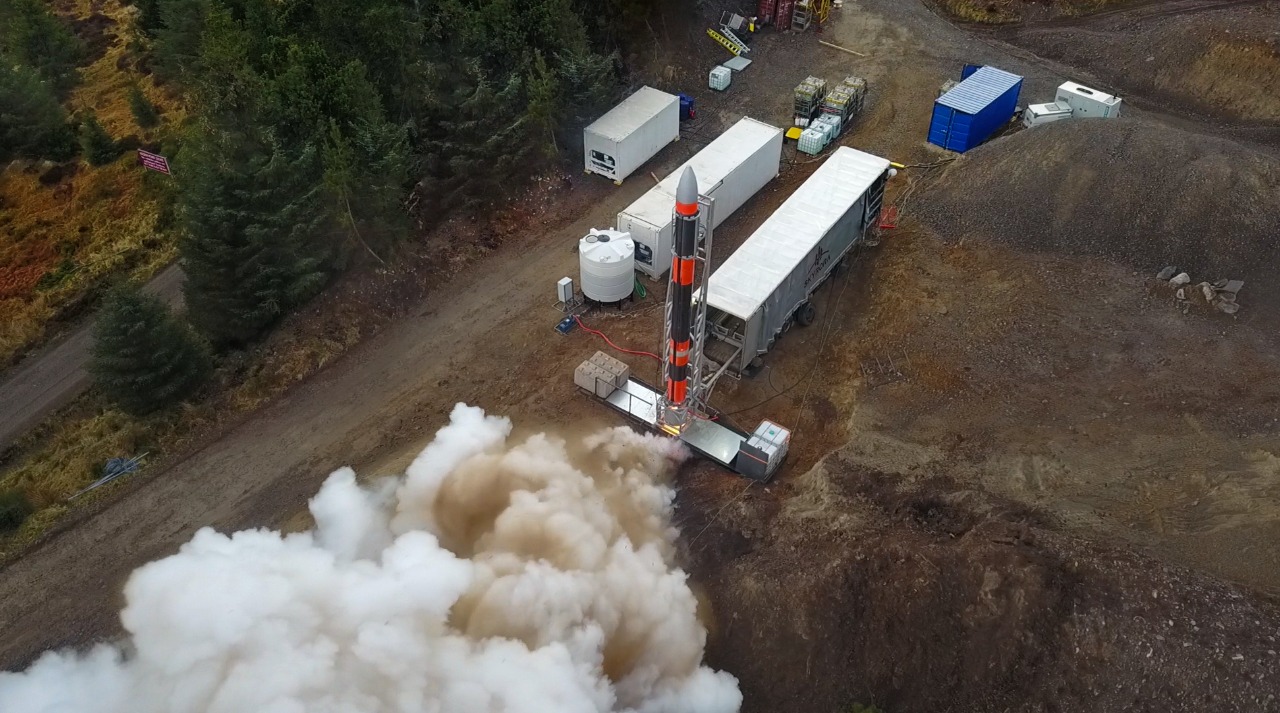
The ground test at the mobile launch complex at Kildemorie Estate in North Scotland earlier this month, saw Skyrora's launch vehicle, Skylark-L perform all actions of a launch while restrained to the ground and prevented from taking off.
Skylark-L is a bi-liquid propellent launch vehicle. It is Skyrora’s first sub-orbital flight vehicle, ready to reach a height of approximately 100km, just on the Karman line, and carry a payload of up to 60kg. Skylark-L uses a propellent combination of Hydrogen Peroxide and Kerosene which are pressure fed into a Skyrora 30kN engine. Building up to the static fire test, the rocket engine itself has gone through three hot fire tests before integration into the vehicle. When commercial, the company plans to use their own Ecosene, an equivalent Kerosene fuel made from un-recyclable plastic waste. In Skyrora’s rocket suite, its aim is to start with launching sub-orbital rockets and move to orbital by 2023.
The full static firing test, fully checked out the design and in-house manufacture, making sure the vehicle itself is ready for launch. It was also successful in the feed system validation tests leading up to the full static fire test. During the test, Skylark-L was supported by Skyrora’s transporter-erector that was fixed to the trailer.
In order to complete this test, the Skyrora team accomplished the build of a mobile launch complex in record time right in the heart of the Scottish Highlands. The mobile complex was made up of several modules including, a command centre, oxidiser and fuel handing containers and a compressed gas container. During the test, the Bells and Two Tones Fire and Rescue team were onsite ready to perform any necessary procedures if anything was to go wrong.
Leading the operations of Skylark-L’s static fire testing, Dr Jack-James Marlow said: “It is very hard to oversell what we have achieved here with this test; the whole team has pulled through again to deliver another UK first. We have successfully static tested a fully integrated, sub-orbital Skylark L launch vehicle in flight configuration. This means we performed all actions of a launch but did not release the vehicle. The rocket engine successfully burned, with all vehicle systems showing nominal operation.
“The test did not only validate the vehicle, it also tested our mobile launch complex's ground equipment and performed many cold flow and fuel/defuel tests. In all, there were over one hundred unique operations and the team has gained vital experience. This collection of tests, combined with the 25 other engine tests this year, allow us to take another step along our technology roadmap to orbital launch.
“This is the first time a launch vehicle of this magnitude has been tested in the UK for many years and I am very proud of my team for achieving this. The vehicle is now ready for flight and we are one step closer to putting the UK back into space.”
Skyrora's chief executive officer, Volodymyr Levykin said: "As the launch aspect of the UK's new Space industry starts to emerge, there will be many events that have never happened here previously and this is one of them. This was a mammoth effort in very trying circumstances, so it is quite an achievement to be proud of.
"The operation was carried out while having to adhere to very strict social distancing measures, and in an extremely remote location, providing additional challenges, all of which were handled expertly by all the team.
"We see this as being the first significant step towards reaching space from our own soil and are very proud to have taken that step as part of the UK's Space ambitions. We are now in a full state of readiness for launch. It is this milestone that is the start of the UK’s new space revolution, a fantastic example of the potential of what the UK Space holds for future.
"With the expertise in place and all the necessary hardware at the ready, we are poised to take the next steps in making the UK a serious leader in the Space business once again."