Space company takes to the skies alongside the NHS
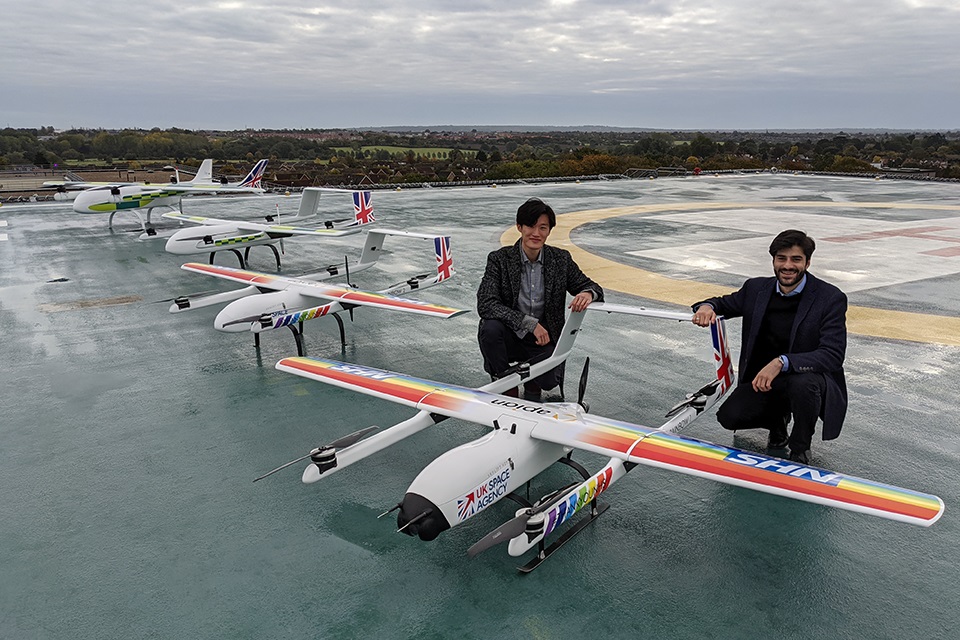
Above:
Apian founders Hammad Jeilani (right) and Christopher Law.
Courtesy UK Space Agency / ©2020 Annalisa Russell-Smith
The pandemic has seen the country pulling together, with organisations across the space sector stepping forward to help.
Apian, part of the NHS Clinical Entrepreneur Programme, aims to establish a network of secure air corridors for electric drones to navigate via satellite-enabled GPS. Each drone will be able to carry COVID-19 samples, test-kits and PPE. This will avoid courier call-out waiting times, free-up NHS staff, reduce unnecessary physical contact and minimise the risk of secondary transmission of the virus.

The project will be based at Broomfield Hospital, part of Mid and South Essex NHS Foundation Trust and will be supported by the local Anglia Ruskin University as the academic partner. Befittingly, the hospital stands on a WW1 Royal Flying Corps Airfield.
Science Minister Amanda Solloway said: "The efforts of the UK’s space sector to support our incredible NHS during the COVID-19 pandemic have been truly inspirational.
"The projects we are backing today are fantastic examples of how our leading space scientists are supporting those directly on the frontline to help prevent the spread of coronavirus."
Christopher Law, from Apian said: "COVID-19 has highlighted challenges in NHS supply chain logistics. There has never been a better time to create a faster, more dependable and environmentally friendly method of transporting medical supplies. We are confident that by setting up a medical drone delivery service, we’ll be able to fly samples to labs more regularly, reliably and quickly, improving patient health outcomes."
The healthcare drone company is one of three new projects using space-enabled technologies and services to support the NHS in the ongoing battle against COVID-19.
The UK Space Agency is also backing DriverNet – a mobile app that will use satellite technology to provide access to more affordable community transport for people wishing to go to and from COVID care providers, and those looking to participate in community sport.
By using artificial intelligence to batch patients by their ‘geolocation’ – their mobile phone location triangulated by satellites – and encouraging transport sharing, costs and miles could be cut by half. This could also help reduce the 15 million missed NHS appointments each year.
NHS workers and patients will get a notification through text or on their app when shuttle services are available in their area.
Professor Tony Young, the NHS national clinical lead for innovation, said: "At the same time as the NHS came together to fight a pandemic and treat over 110,000 severely ill people for COVID-19, staff have also gone above and beyond to create innovative ways for patients to get the care and kit they need alongside the UK Space Agency. This study which will create droneways in the sky for vital NHS supplies is the latest in a longline of projects founded by the NHS Clinical Entrepreneur Programme to provide innovative solutions to the challenges facing the NHS for the benefit of patients and staff."
Also being backed, is the delivery of a remote platform for Earth Observation learning.
The collaboration, led by the University of Edinburgh, builds on the Earth Blox (Quosient Ltd.) cloud-based software for harnessing planetary-scale satellite-intelligence.
The collaboration will provide distance learning support to students who would have been studying Earth Observation science. Earth Observation students will be our next generation of climate change specialists, weather forecasters and digital pioneers.
Earth Observation courses involve frequently being in a laboratory and completing practical exercises, and this funding will help make this possible from home – providing students at four participating universities with remote access to vast quantities of satellite data.
The projects – set to receive £1.3m of funding – have been selected as part of a joint initiative between the UK Space Agency and the European Space Agency (ESA) which has already provided one round of funding in July, worth £1.1 million, to companies developing space based solutions for issues created by COVID-19.
Initial funding went to three initiatives, including a drones company delivering test kits in Scotland and another project that used space data to support vulnerable people through a mobile application.
Emily Gravestock, Head of Applications Strategy at the UK Space Agency, said: "Once again, the UK space industry has risen to the challenge. The variety of innovative solutions continues to impress me and I look forward to seeing how satellite applications built by UK industry can improve healthcare services, reduce carbon emissions and enhance education."
The UK Space Agency and ESA are still looking to fund further bids with the call for ideas remaining open until 15th January 2021.
The UK continues to be a leading member of ESA, which is independent of the EU, having committed a record investment of £374 million per year in November 2019. This funding to support the coronavirus response comes from ESA’s Business Applications Space Solutions fund, in which the UK is the leading investor.
Nick Appleyard, Head of Downstream Business Applications at ESA’s European Centre for Space Applications and Telecommunications in Oxfordshire, said: "In 2020 we all saw the critical importance of rapid and efficient healthcare operations so, at ESA and the UK Space Agency, we asked the space applications industry to think how they could help.
"Much space-enabled technology removes the need to move people, whether this is patients, healthcare practitioners or couriers. Instead, we can use drones to move samples and equipment, or satellites to move information to reach even the most isolated communities at a speed that was impossible until now. Even when patients do need to attend hospital appointments, moving information using satellites enables them to do so in a cheaper and more environmentally friendly manner.
"Space technology will allow our health services to save more lives."
Space is already playing an important role in supporting healthcare initiatives. Last year the UK Space Agency provided £5 million for new health technologies inspired by working in space to support NHS England.
These included providing real-time diagnosis of bowel cancer, developing more compact 3D X-ray machines and a mobile app that provided exercise plans free from air pollution for those with medical conditions such as asthma.
The UK Space Agency and UKspace trade body continue to work closely together to help the space sector respond to and recover from the coronavirus pandemic.
The projects in detail
Project Dreadnought led by Apian, based in London
Partners Mid and South Essex NHS Foundation Trust, SYNLAB and Pathology First, Skylift UAV, Flyby Technologies and Electric Aviation.
Apian was founded by Hammad Jeilani and Christopher Law, trainee doctors at the Barts and The London as well as Mid and South Essex NHS Innovation Fellows. Apian is installing ‘dronepad’ infrastructure so its aircrafts can take-off from and land onto hospitals, laboratories and warehouses. In doing so, the startup is creating new standards and best practice guidelines; written by the NHS, for the NHS.
Apian will scale the work from their drone trials by creating the UK’s NHS Air Grid (NAG), a network of secure air corridors designed to safely, rapidly and effectively enable drone delivery across the NHS. Apian is creating these corridors by working closely with the Civil Aviation Authority, UK Space Agency and the emergency services.
Apian provides the interface between the healthcare and drone industries creating a more demand driven, just-in-time system for delivering smarter, faster, cleaner healthcare. Its goal is to use evidence-based research to show how drones can improve care pathways and level-up health outcomes.
While Apian’s current task to rapidly deliver COVID-19 samples and PPE is in line with both Government and NHS priorities, NHS England anticipates that the recovery-phase of this pandemic can significantly benefit from drones delivering other medical payloads including equipment, medications, blood packs and more. Therefore, investing in their solution will continue to provide the NHS with an enhanced logistics system even after the pandemic is behind us.
DriverNet Go led by ProNetixLtd, based in St Helens, Merseyside
Partners Liverpool, Blackpool & St Helens Councils, Merseyside and Cheshire NHS Trusts, Lancaster University, Daresbury, Chorley and Esoterix
This tool will, in a COVID safe way, book hospital appointments for patients who need transport from the same location at the same time to help reduce the backlog of hospital appointments post-COVID, increase appointment attendance and lower costs to the NHS. The transport will also support employees and visitors in a shuttle system, supporting the reduction of NHS traffic on the road.
This supports two of the priorities in this call.
1. Recovering health system function and handling backlogs after the crisis.
2. Logistics within the health system.
Earth Blox for Education, led by The University of Edinburgh
Partners: Quosient Ltd, Universities of, Leeds, Glasgow and The Open University, EDINA, STEM Learning Ltd
To solve the disruption to lab-based learning from COVID-19, Earth Blox will be applied to an e-learning solution allowing students, wherever they are located, to learn the practical elements of Earth Observation (EO), through distance learning as well as self-directed dissertation and project work. It uses the cloud to allow students to conduct large-scale data analysis and learn basic coding skills for EO.
There will be one 'free and open' 'introduction to EO' course to run on FutureLearn and one 10-credit online distance learning module on ‘the use of EO for SDG monitoring’, both built around Earth Blox for students to perform data analysis. Earth Blox will then be available more widely.
In essence, this will continue to train the next group of Remote Sensing Specialists during the COVID crisis while Universities cannot run computing classes in person and will also then be an exportable product, increasing the uptake of EO and remote sensing in other parts of the world.
Earth Blox is a tool that allows EO analysis without having to write code – this project will make it a mainstream tool for education and roll it out further and be ready as an exportable product.