SSTL joins Eric and Wendy Schmidt Observatory System’s Lazuli
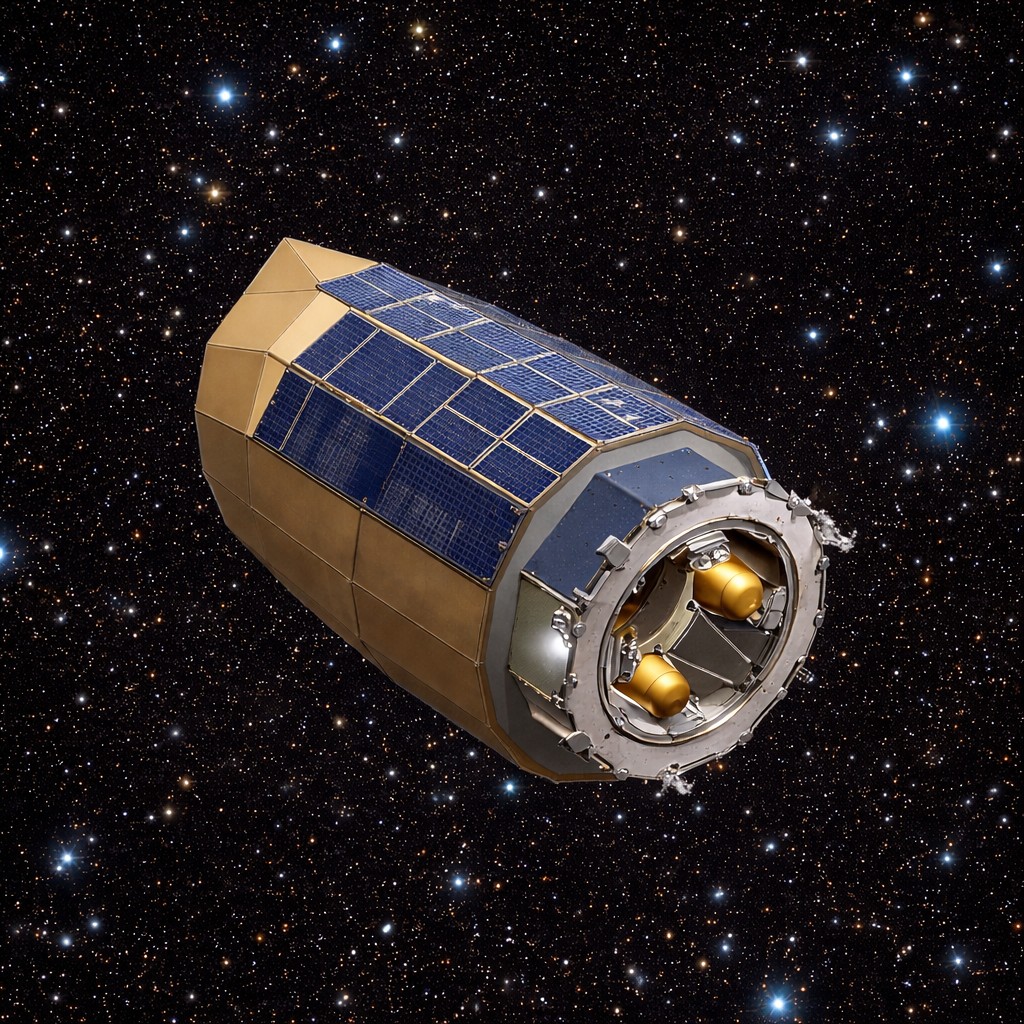
Above: A render of Lazuli in Deep Space.
Courtesy SSTL
As part of the programme, SSTL is developing the spacecraft platform for the mission, which will carry the Lazuli space observatory far beyond Earth orbit into deep space.
SSTL brings to Lazuli a long track record of delivering highly capable space missions using a fundamentally different approach to spacecraft design and delivery.

That approach was exemplified by SSTL’s Carbonite programme, where the company demonstrated how advanced space-based intelligence, surveillance and reconnaissance capability could be achieved by adapting proven ground-based technologies and combining them with agile spacecraft engineering - delivering performance traditionally associated with far larger, more expensive systems, but at a fraction of the cost and timescale.
The Lazuli Space Observatory represents an opportunity to apply that same philosophy to space astronomy: using a faster and more flexible development model to enable scientific capability that would otherwise require decades and multi-billion-dollar programmes.
While SSTL is widely known as a “small satellite” manufacturer, the term has always referred to the way SSTL works, rather than the physical size of the spacecraft itself. Lazuli demonstrates that the small-satellite approach - rapid development, pragmatic engineering, and intelligent reuse of commercial parts and proven technologies - can be applied to much larger and more ambitious missions, including deep-space observatories.
A New Kind of Deep-Space Observatory
The Lazuli Space Observatory - unveiled by Schmidt Sciences, cofounded by Eric and Wendy Schmidt, at a recent meeting of the American Astronomical Society - is designed to become the first full-scale privately funded space telescope, with a primary mirror larger than that of NASA’s iconic Hubble Space Telescope.
The observatory will carry a suite of advanced instruments, including a wide-field camera, an integral-field spectrograph and a coronagraph, enabling rapid and responsive studies of exoplanets, supernovae and transient cosmic events.
SSTL’s deep-space platform will provide the precision pointing, propulsion capability and communications needed to deliver and operate the observatory in a stable deep-space orbit well away from Earth, supporting the mission’s demanding scientific objectives.
Lazuli forms part of the wider Schmidt Observatory System, which combines rapid development, open data access and global collaboration to dramatically lower barriers to participation in frontier astronomy.
By applying SSTL’s agile spacecraft philosophy to deep-space science, the programme aims to show that world-class astronomy missions can be delivered faster, more flexibly and at significantly lower cost than traditional approaches.
Andrew Cawthorne, Managing Director, SSTL said: “SSTL has a way of doing space differently. Our heritage shows that you don’t need to rely on vast, exquisite systems to deliver extraordinary capability. Lazuli takes that same thinking into deep space. While SSTL is known for small satellites, ‘small’ has always described our approach, not the size of the satellite - and certainly not our ambition. Lazuli is a powerful example of how that philosophy can scale to enable a new generation of deep-space science missions.”
With launch anticipated by the end of the decade, Lazuli is set to demonstrate how innovative engineering approaches can unlock scientific ambition on entirely new terms.