General Atomics

SSTL joins Eric and Wendy Schmidt Observatory System’s Lazuli

Surrey Satellite Technology Ltd (SSTL) today announced its role as a key industrial collaborator in the Eric and Wendy Schmidt Observatory System’s Lazuli, a pioneering initiative that will deliver one of the most ambitious privately funded space telescopes ever conceived.


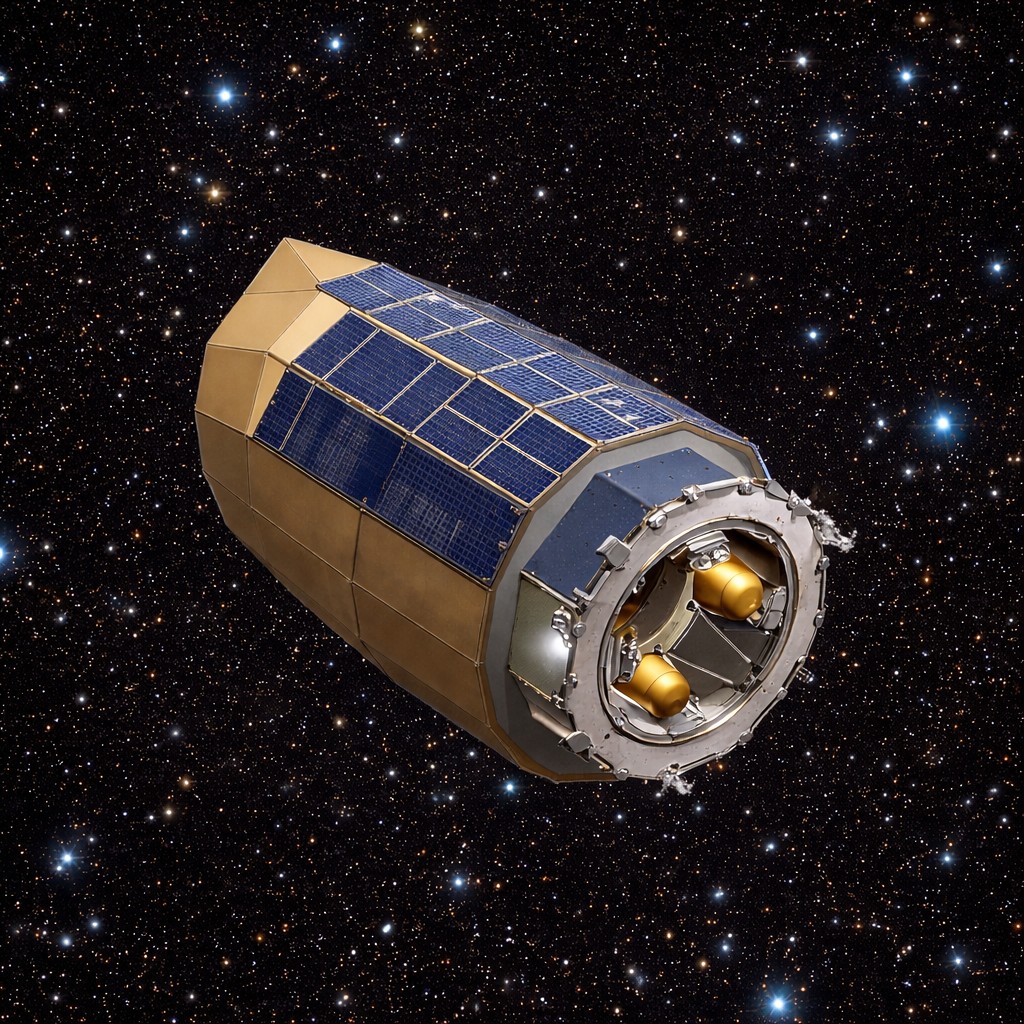
Above: A render of Lazuli in Deep Space.
Courtesy SSTL


As part of the programme, SSTL is developing the spacecraft platform for the mission, which will carry the Lazuli space observatory far beyond Earth orbit into deep space.

SSTL brings to Lazuli a long track record of delivering highly capable space missions using a fundamentally different approach to spacecraft design and delivery.

That approach was exemplified by SSTL’s Carbonite programme, where the company demonstrated how advanced space-based intelligence, surveillance and reconnaissance capability could be achieved by adapting proven ground-based technologies and combining them with agile spacecraft engineering – delivering performance traditionally associated with far larger, more expensive systems, but at a fraction of the cost and timescale.

The Lazuli Space Observatory represents an opportunity to apply that same philosophy to space astronomy: using a faster and more flexible development model to enable scientific capability that would otherwise require decades and multi-billion-dollar programmes.

While SSTL is widely known as a “small satellite” manufacturer, the term has always referred to the way SSTL works, rather than the physical size of the spacecraft itself. Lazuli demonstrates that the small-satellite approach – rapid development, pragmatic engineering, and intelligent reuse of commercial parts and proven technologies – can be applied to much larger and more ambitious missions, including deep-space observatories.

A New Kind of Deep-Space Observatory
The Lazuli Space Observatory – unveiled by Schmidt Sciences, cofounded by Eric and Wendy Schmidt, at a recent meeting of the American Astronomical Society – is designed to become the first full-scale privately funded space telescope, with a primary mirror larger than that of NASA’s iconic Hubble Space Telescope.

The observatory will carry a suite of advanced instruments, including a wide-field camera, an integral-field spectrograph and a coronagraph, enabling rapid and responsive studies of exoplanets, supernovae and transient cosmic events.

SSTL’s deep-space platform will provide the precision pointing, propulsion capability and communications needed to deliver and operate the observatory in a stable deep-space orbit well away from Earth, supporting the mission’s demanding scientific objectives.

Lazuli forms part of the wider Schmidt Observatory System, which combines rapid development, open data access and global collaboration to dramatically lower barriers to participation in frontier astronomy.

By applying SSTL’s agile spacecraft philosophy to deep-space science, the programme aims to show that world-class astronomy missions can be delivered faster, more flexibly and at significantly lower cost than traditional approaches.

Andrew Cawthorne, Managing Director, SSTL said: “SSTL has a way of doing space differently. Our heritage shows that you don’t need to rely on vast, exquisite systems to deliver extraordinary capability. Lazuli takes that same thinking into deep space. While SSTL is known for small satellites, ‘small’ has always described our approach, not the size of the satellite – and certainly not our ambition. Lazuli is a powerful example of how that philosophy can scale to enable a new generation of deep-space science missions.”

With launch anticipated by the end of the decade, Lazuli is set to demonstrate how innovative engineering approaches can unlock scientific ambition on entirely new terms.

Related

UK aerospace and aviation contribute £11 billion a year to South West economy
Airbus Landing Gear inspection in Filton
UK aerospace and aviation contribute £11 billion a year to South West economy
A new industry report highlights the sector's wider impact, supporting over 89,800 jobs and helping drive investment, tourism and international connectivity across the region.
Aerospace

9 Sep 2026

From 66 aircraft to £62.9 billion: The extraordinary evolution of Farnborough International Airshow
Farnborough International Airshow
From 66 aircraft to £62.9 billion: The extraordinary evolution of Farnborough International Airshow
This week, Farnborough International Airshow celebrates 78 years since the first airshow took place. Here's how Farnborough has become a global marketplace for aerospace and defence... and what's next.
Aerospace Defence Space

8 Sep 2026

UK flights disrupted after NATS flight processing system failure
Heathrow Tower.
UK flights disrupted after NATS flight processing system failure
Departures from airports across the UK have been restricted after a technical problem struck the system used by NATS to process flights.
Aerospace

8 Sep 2026

From 66 aircraft to £62.9 billion: The extraordinary evolution of Farnborough International Airshow
Farnborough International Airshow
From 66 aircraft to £62.9 billion: The extraordinary evolution of Farnborough International Airshow
This week, Farnborough International Airshow celebrates 78 years since the first airshow took place. Here's how Farnborough has become a global marketplace for aerospace and defence... and what's next.
Aerospace Defence Space

8 Sep 2026

UK military to practise mobilising 95,000 veterans for war
Soldiers on patrol
UK military to practise mobilising 95,000 veterans for war
The UK will test how quickly it can recall and equip former military personnel as the MoD prepares its 95,000-strong Strategic Reserve for a potential major conflict.
Defence

8 Sep 2026

MBDA opens Poland missile facility as UK defence partnership deepens
MBDA facility Czosnow, Poland
MBDA opens Poland missile facility as UK defence partnership deepens
In an initiative that supports the UK’s commitment to reinforcing NATO’s eastern flank by bolstering Polish air defences, a new facility built with British expertise has been opened in Poland.
From 66 aircraft to £62.9 billion: The extraordinary evolution of Farnborough International Airshow
Farnborough International Airshow
From 66 aircraft to £62.9 billion: The extraordinary evolution of Farnborough International Airshow
This week, Farnborough International Airshow celebrates 78 years since the first airshow took place. Here's how Farnborough has become a global marketplace for aerospace and defence... and what's next.
Aerospace Defence Space

8 Sep 2026

SaxaVord secures £60m funding to expand its launch capability
SaxaVord Spaceport, Shetland
SaxaVord secures £60m funding to expand its launch capability
Operating the only licensed vertical launch spaceport in the UK, SaxaVord is looking to advance its launch capability with fresh funding from the UK Government and private investors.
Space

8 Sep 2026

UK unveils £7.8bn space strategy as threats in orbit grow
View of the UK from the International Space Station.
UK unveils £7.8bn space strategy as threats in orbit grow
The UK will invest more than £3 billion in military space capabilities under a new £7.8 billion strategy covering defence, security and connectivity.
Defence Space

8 Sep 2026

MBDA opens Poland missile facility as UK defence partnership deepens
MBDA facility Czosnow, Poland
MBDA opens Poland missile facility as UK defence partnership deepens
In an initiative that supports the UK’s commitment to reinforcing NATO’s eastern flank by bolstering Polish air defences, a new facility built with British expertise has been opened in Poland.
Chess introduces AI-enabled Low SWaP CHARM50
Low-SWaP-CHARM50
Chess introduces AI-enabled Low SWaP CHARM50
Chess Dynamics has expanded its Vision4ce CHARM portfolio with the introduction of its Low SWaP CHARM50, a new compact AI-enabled edge video processing module which supports growing demand for smart sensors, distributed sensing architectures and low-SWaP ISR applications.
UK firms exposed by simulated attacks on satellites, subsea cables and financial infrastructure
Lockheed martin cybersecurity
UK firms exposed by simulated attacks on satellites, subsea cables and financial infrastructure
How a new FCS exercise brought financial firms and the MoD together to gain a better understanding of modern threats to British financial services and how to better prepare.
Defence Security

8 Sep 2026