Stress Map celebrates new capability
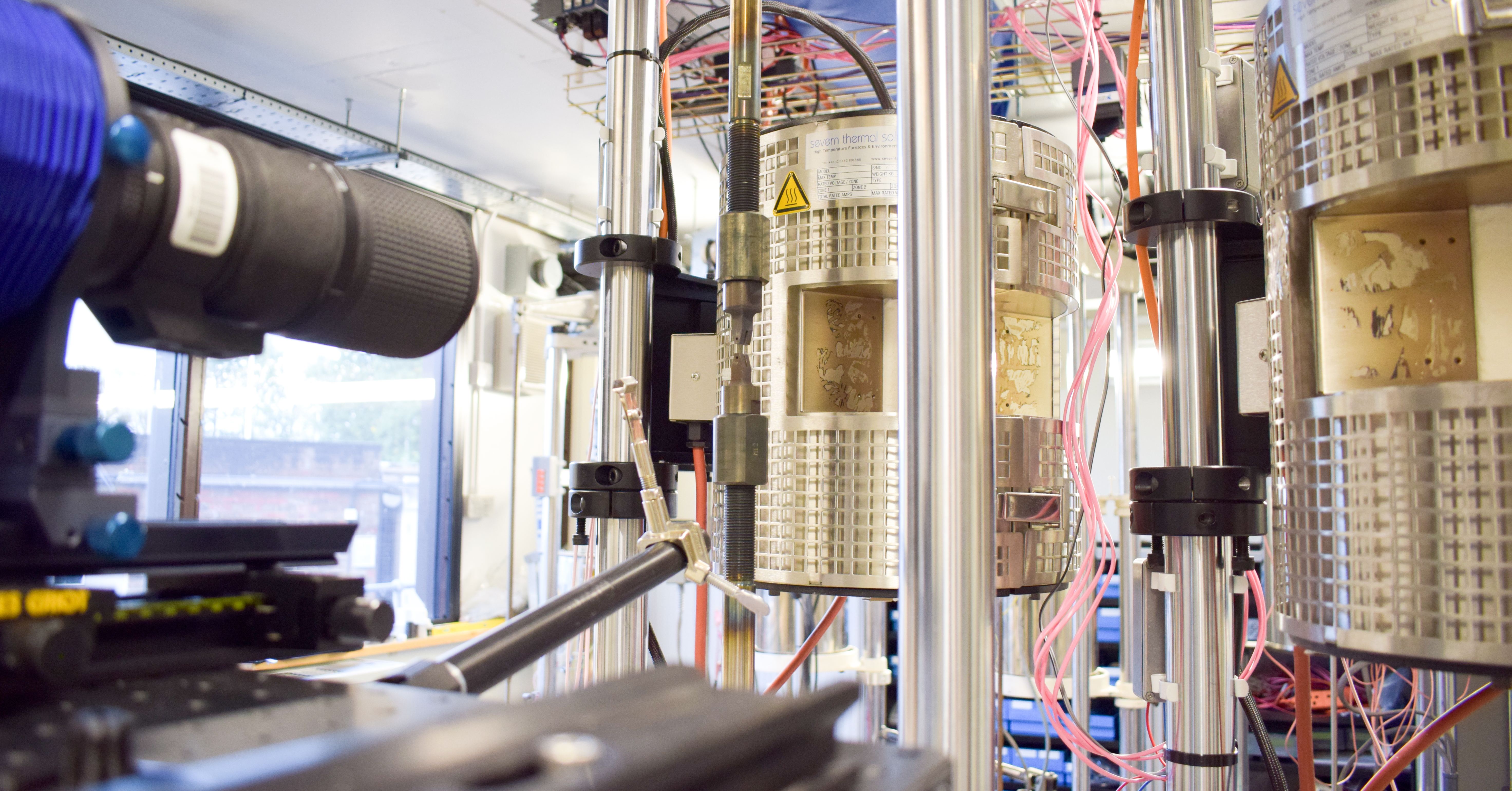
Image courtesy Stress Map
Stress Map, Provider of residual stress metrology by the contour method, Stress Map, celebrates its 10th anniversary this month and has invested in two new capabilities to help their customers prolong the life and control distortions of critical mechanical components in the aerospace and defence industries.

In its quest to making cutting-edge residual stress engineering technology available to industry, StressMap has just designed, built and commissioned a new wire cutting machine, specifically to enable contour method measurements in polymers, ceramics and composites. Before this machine was created, only electrically conductive materials (mainly metals) could be measured, since the only cutting technique available was wire electro-discharge machining (wEDM).
StressMap’s new invention is the fruit of a year’s worth of research and is the only machine in the world that can cut these non-conductive materials with the required quality. The first results obtained in a PEEK pipe has been presented and scrutinised by specialist researchers at a conference in the Spring and further structures are being tested
Another capability for StressMap has invested in is a new laser peening machine. This will be tested in collaboration with an F1 team on its engine components. This technique induces beneficial residual stress at the surface of key components, preventing cracking and prolong their life.
Over the past decade StressMap has delivered over 150 projects for 80 customers across the world. Applications of their residual stress measurement expertise vary widely, for example: additive manufactured titanium components and nickel superalloys for turbine discs, to name a few.
It has also developed strain scanning simulation software in conjunction with STFC in Harwell Oxfordshire to improve the quality of neutron diffraction measurements by maximising accuracy in strain measurements and providing a high level of positional accuracy and repeatability.
Other achievements include:
- Mapping hoop residual stresses in welded pipes for power generation and oil and gas industries
- The first company to use the contour method to analyse a metal-matrix composite
- Development of strategies to reduce plasticity errors in contour measurements, from over 10% to making this source of errors completely irrelevant in results
The company invests heavily in R&D, with two or three PhD students at any one time throughout these 10 years, developing capability, creating new techniques and working with customers to solve their most pressing measurement problems. Indeed the project to reduce measurement errors was part of a PhD, as was the composites-metal analysis. The company is now developing the measurement of carbon fibre reinforced plastic, polymers, ceramics, glasses and other materials.
Stress Map is part of the Open University with full access to state-of-the-art facilities. It offers a range of residual stress measurement techniques, including the contour method, slitting, hole drilling, X-ray diffraction, neutron diffraction and more. The company plans to double in size in the next two years and then double again within five.
To celebrate the birthday, the company has opened a contest and is offering a free residual test measurement project to the winner. The contest is open to application and will be reviewed by industry experts. To apply, please send a one page synopsis of your project to contact@stressmap.co.uk. The deadline is the end of January and further details on the competition can be found on StressMap’s website stressmap.co.uk.
Dr Jeferson Araujo De Oliveira, Stress Map’s Managing Director, said: “The only way to ensure a component can withstand the demanding load and stress conditions in its service life is to test it.
“We’ve been offering cutting-edge techniques, straight from academia to industry for a decade and have developed the knowledge, skills and experience to help our customers to understand the impact of residual stresses and ensure their safety-critical components will perform as expected in service.
“To celebrate StressMap’s anniversary, we have invested in new capability, so we will be able not only to check the soundness of a component but also make that component physically stronger and more long-lasting without redesigning it. It’s a win-win. We have also developed a contour test of composites, polymers and ceramics – a world first. ”
Residual stresses are present in virtually all solid components and they can cause unexpected failures or in other cases, extend the life of load-bearing parts in service. These stresses depend heavily on the manufacturing process and they add (or subtract) to the service loads experienced by the material.
In most cases, optimising the residual stress distribution in a mechanical component can unlock gains in performance without adding weight, changing the design or material of the part. In addition, simply understanding these residual stresses in a particular component allows for accurate fatigue life predictions, which is particularly important in safety-critical applications, such as aerospace structures and pressure vessels, as well as where fine safety margins are essential, such as in high-performance parts and space applications.