

Thales Alenia Space signs contract with ESA to develop Argonaut lander

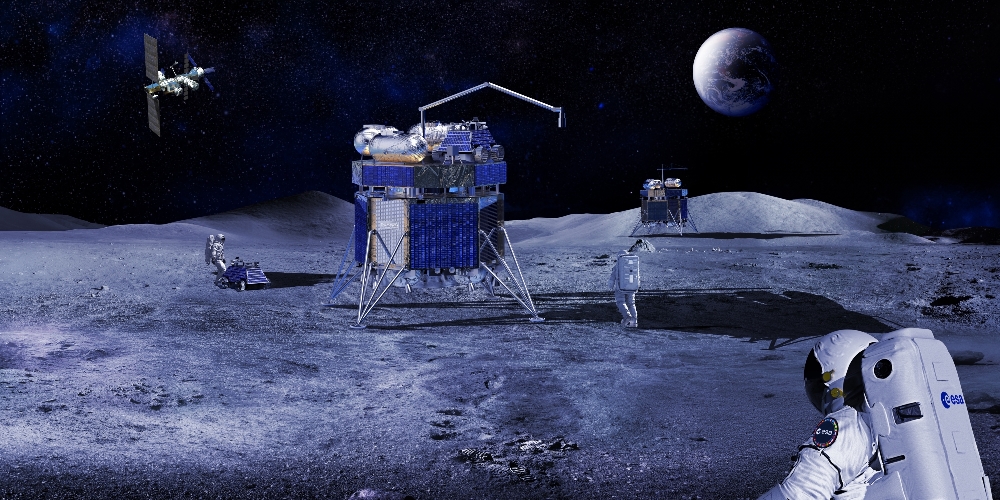
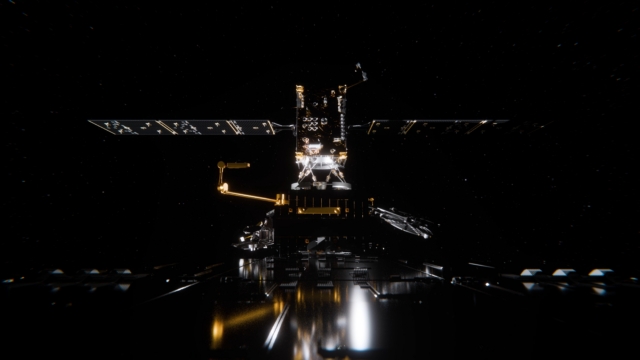
Image / copyright Thales Alenia Space
Thales Alenia Space, joint venture between Thales (67%) and Leonardo (33%), has signed a contract with the European Space Agency (ESA), worth €862 Million, related to the design, the development and the delivery of the Lunar Descent Element (LDE) for ESA’s Argonaut Mission, including responsibility for mission design and integration.
Planned to be launched from the 2030s, Argonaut will deliver cargo, infrastructure and scientific instruments to the Moon’s surface, assuring the European autonomous access to the Moon.
The first mission is envisioned to deal with delivery of dedicated navigation and telecommunication payloads as well as energy generation and storage system, as European enterprises to explore the Lunar southern area.
Argonaut
The Argonaut spacecraft consists of three main elements: the lunar descent element (LDE) for flying to the Moon and landing on the target, the cargo platform one, which is the interface between the lander and its payload, and finally, the element that the mission designers want to send to the Moon.
Adaptability is a key element of Argonaut’s design, which is why the cargo platform is designed to accept any mission profile: cargo for astronauts near the landing site, a rover, technology demonstration packages, production facilities using lunar resources, a lunar telescope or even a power station. The project will strengthen Thales Alenia Space’s skills in several technological areas essential to space exploration beyond the Moon.
The future space ecosystem requires new solutions dedicated to the transport and return of cargo from low Earth orbit and lunar orbit, as well as crew transport to low Earth orbit. Thales Alenia Space is ready to put in place what is needed to prepare for humanity’s future life and presence in Space, laying the foundations for the post-ISS era and meeting new economic needs for research and science.
Argonaut consortium: who does what?
Thales Alenia Space is the prime contractor for the development of the Lunar Descent Element. The overall mission responsibility, ie the use of the LDE and integration with payload, will be the subject of a separate procurement in the future. The Lunar Descent Element is an independent architecture block of the international lunar exploration activities, namely a versatile system to support a variety of missions.
As prime contractor and system integrator of the Lunar Descent Element, Thales Alenia Space in Italy will lead the industrial consortium that will be responsible for the system, the entry descent and landing aspects, as well as the general and specific architectures of the thermomechanical, avionics and software chains.
Thales Alenia Space in France and in the UK will respectively focus on data handling systems and propulsion. OHB System AG as additional core team member of the Thales Alenia Space consortium will be responsible for guidance, navigation and control (GNC), electrical power systems (EPS) and telecommunications (TT&C) aspects.
Hervé Derrey, Thales Alenia Space CEO, said: “Argonaut lunar lander means a lot to our company. Thanks to this astonishing space vehicle, tons of cargo will be delivered to the Moon’s surface, including rovers, scientific missions and many more. This new element of the Artemis programme will serve at facilitating longduration manned lunar exploration missions and will be crucial to increase European autonomy in lunar exploration.
"The Moon will also serve as a stepping stone for crewed missions into deep space, with Mars being the next stage of the journey. I wanted to express my gratitude to ESA for awarding this new contract to our company. Today’s major achievement strengthens more than ever Thales Alenia Space’s leading positions in the fields of space transportation systems, orbital infrastructures and space exploration.”
Giampiero Di Paolo, Deputy CEO and Senior Vice President, Observation, Exploration and Navigation at Thales Alenia Space, said: “We are truly honoured that ESA has renewed its trust in our company by awarding Thales Alenia Space this major contract to develop the European lunar lander that will enable Europe to access autonomously to the Moon’s surface.
“Today, with its longstanding expertise in space exploration infrastructure and vehicles, our company, in line with ESA’s and ASI’s visions, has decided to enhance its competitiveness by investing in the development of technological solutions to help Europe achieve its goals.
"Supplying a significant proportion of the International Space Station’s pressurised volume, playing a major role on board Artemis, manufacturing the backbone of Orion’s European service module and leading flagship transportation programmes such as IXV or Space Rider, Thales Alenia Space is more than ever at the forefront of exploration and space transportation systems.”
Sign up for our newsletter and get our latest content in your inbox.
Similar Reads

Sign up for our newsletter. Select all sectors relevant to you.
Related