Tiberius Aerospace achieves world-first with howitzer launched liquid-fuelled ramjet
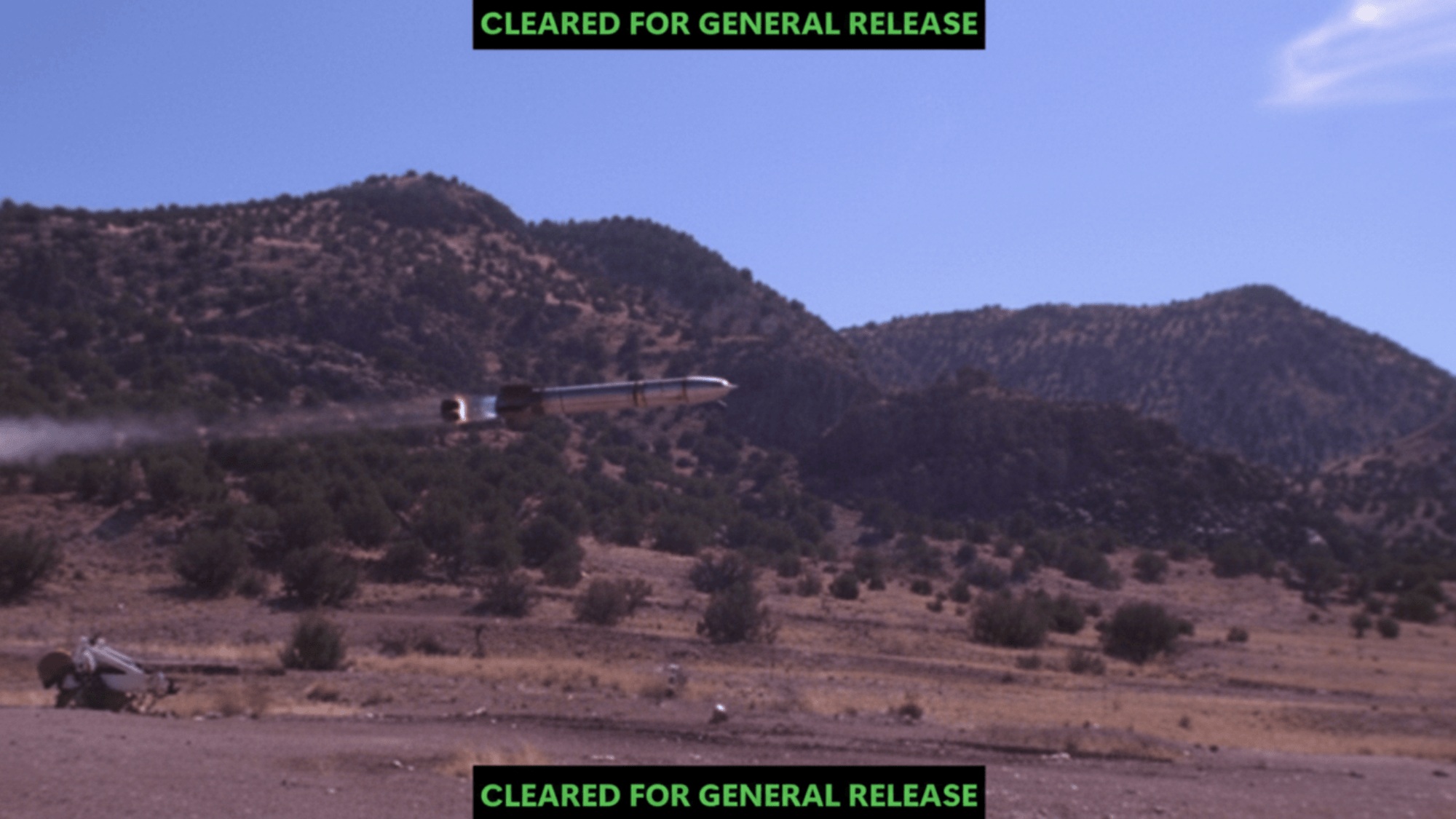
Above: Sceptre (TRBM 155HG) Test Firing, New Mexico.
Courtesy Tiberius Aerospace
This liquid fuel breakthrough, achieved during recent test firings of its Sceptre system in New Mexico, represents a fundamental shift in what artillery systems are capable of delivering on the modern battlefield.
Sceptre is a 155mm precision-guided munition designed for full compatibility with existing NATO-standard artillery systems. The latest round of testing confirmed that it can reach ranges of up to 150 kilometres, travel at speeds of approximately Mach 3.5 and operate at altitudes exceeding 65,000 feet beyond typical jamming range. It delivers a 5.2kg payload with a circular error probability (CEP) of less than five metres, even in GPS-contested environments and requires no modifications to current artillery platforms.

The system is designed with a modular, open architecture that allows for continuous upgrades and uses widely available fuels such as diesel variants (JP-4 and JP-8), reducing the logistical burden associated with deployment.
A critical milestone in these trials was the successful ignition of the liquid-fuelled ramjet following exposure to launch forces of approximately 18,000 g, alongside the validation of stable flight dynamics, controlled rotation and the effective deployment of in-flight stabilisation systems.
Together, these results demonstrate that the technology is not only viable in theory but can function reliably in operationally relevant conditions. In practical terms, this successful test firing shows that it is now possible to combine the long range and speed typically associated with missile systems with significant cost savings, flexibility and the deployability of traditional artillery. This creates a new category of capability that sits between conventional artillery and high-end missile systems, addressing a long-standing gap in military capability.
While missile systems provide range and accuracy, they remain expensive and constrained in supply. Conventional artillery, by contrast, is scalable and cost-effective but limited in range and capability. Sceptre bridges this gap by offering missile-like performance while retaining the production advantages and flexibility of artillery systems.
When enabled by Tiberius Aerospace’s AI-powered GRAIL platform, Sceptre has the potential to materially increase the volume of precision firepower available to allied forces, reduce reliance on high-cost missile inventories and enable faster, more scalable production at a time when industrial capacity is under strain.
Crucially, the system is designed to support licensed domestic manufacturing, enabling allied nations to produce Sceptre within their own industrial base, strengthening sovereign capability, shortening supply chains and accelerating time to field. It also supports a shift towards more resilient, sovereign and distributed manufacturing models across allied defence ecosystems.
Chad Steelberg, Founder and CEO of Tiberius Aerospace, said: “This is a genuine world first breakthrough. These tests prove not only the technology but a new way of delivering capability at pace, at scale and at significantly lower cost. Having successfully proved our design and engineering methodologies, we now need to move to much larger ranges to deliver the next phase of testing, validation and certification. Sceptre is an ambitious and complex project but these successful US test firing results prove we are quickly advancing along the right trajectory.”