UK hydrogen airport trial sets out roadmap for further studies
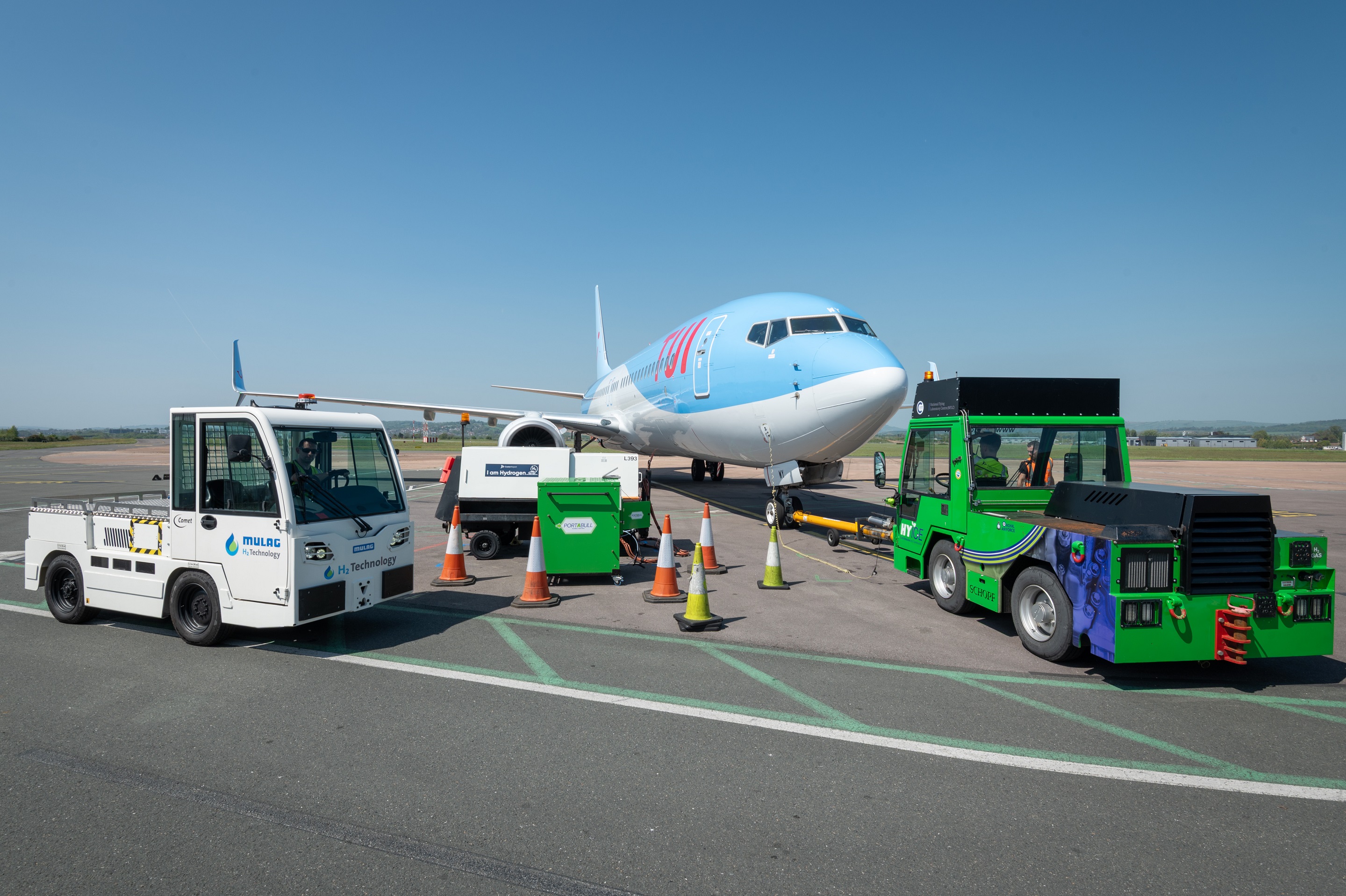
Image courtesy Regional & City Airports
The Zero Carbon Turn project, led by Exeter Airport (part of Regional & City Airports) in collaboration with Cranfield University, TUI, ULEMCo, Boeing and MULAG and supported by the CAA as part of the Hydrogen Challenge Sandbox programme, brought together three different hydrogen technologies to support a live turnaround of a TUI Boeing 737.

Its objective was to demonstrate, test and evaluate multiple hydrogen-powered ground support technologies in a real airport environment to build operational knowledge, safety cases and evidence to support future hydrogen use and net zero ambitions at airports.
The trial, conducted at Exeter Airport, successfully demonstrated a hydrogen internal combustion tug, a hydrogen fuel cell baggage tractor and a hybrid hydrogen–diesel GPU operating together airside, achieving several UK firsts.
Although the first regular commercial operations of hydrogen aircraft may still be some years away, there is a recognised need to lay the groundwork in terms of developing the regulatory framework and industry know-how to support hydrogen aircraft once they enter service.
Following its success, a further trial will take place at Exeter Airport later this month in partnership with Cranfield University and ULEMCo, using a hydrogen-powered GPU to simulate a series of aircraft turnarounds in winter conditions. The work is being funded by the Connected Places Catapult and will provide further insight into how hydrogen systems perform in real-world operating conditions.
Cranfield University has now published a technical report into last April's Zero Carbon Turn project, setting out its achievements, key learnings and next steps.
While the report highlights the opportunity for airports to adopt hydrogen technologies to support decarbonisation initiatives in the very short-term, is also emphasises the need to shift from one-off demonstrations to longer, broader and more integrated trials.
Dr Thomas Budd, Associate Professor of Airport Decarbonisation, Cranfield University and author of the report, said: “This project delivered several UK firsts, but its greatest value lies in what it tells us about the road ahead. To prepare for hydrogen-powered aircraft and large-scale adoption of hydrogen GSE, the industry must expand research to further real-world conditions, explore storage and refuelling approaches and formalise knowledge-sharing across the sector. Airports want to decarbonise and GSE manufacturers are rising to the hydrogen challenge, but there is a pressing need to bridge the infrastructure gap."
Stephen Wiltshire, Managing Director or Exeter Airport, which is part of the Regional & City Airports group, said: “The Exeter trial has proven that hydrogen ground equipment works - and works safely - in a real operational environment. As the report highlights, regional airports like ours will be among the first to handle hydrogen-powered aircraft, and we are natural testbeds for developing these technologies. The priority now is to build on this progress. Our winter trial this month is an important next step in strengthening the evidence base for wider hydrogen adoption across UK aviation.”
The Cranfield report highlights a number of UK first from the Zero Carbon Turn project including:
- The first concurrent use of multiple pieces of different hydrogen fuelled equipment at a UK airport.
- The first time a hydrogen fuelled GPU has been used to power a commercial aircraft in the UK.
- The first time a hydrogen fuelled aircraft tug has been used with a commercial passenger aircraft in the UK.
- The first application of a hybrid hydrogen/diesel dual-fuel piece of equipment at an airport.
- The first application of green hydrogen (produced via electrolysis using renewable energy) at an airport in the UK.
Looking ahead, the report identifies the need to conduct longer-duration trials in varied, real-world conditions; the need to test alternative hydrogen storage and refuelling models; the need for a formal knowledge-sharing platform for the industry to avoid duplication and accelerate progress; and the need to refine regulatory pathways to accommodate further trials.
Download a copy of the report here.