UK research into mine detecting drones may alter land warfare
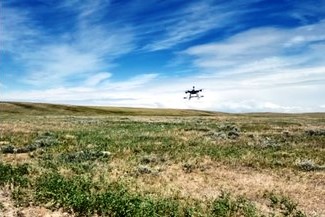
Image courtesy Dstl
Dstl scientists and engineers are conducting crucial research into the new drone technology, which would see mined areas cleared faster and more safely, ramping up protection for Armed Forces personnel.
Maintaining freedom of movement and mobility at pace for the Armed Forces is vital for safety and mission effectiveness and this is significantly reduced by surface laid mines, explosives or buried munitions.

The Dstl team with industry partners participated in trials with NATO allies in Spain and at the Suffield Research Centre in Canada. Advances in uncrewed aerial vehicles (UAVs) and low size, weight and power (SWaP) sensing have led to the development of innovative concepts for explosive threat detection by combining these technologies and systems.
Minister for Defence Procurement, James Cartlidge MP said: “We’ve all seen the threat to safety and military advancement that mines can still pose.
“The UK and our NATO allies are spearheading research into this technology, which has the potential to not only enhance protection for our Service Personnel, but also speed up battlefield progress.”
Defence Science and Technology Laboratory Chief Delivery Officer, Matt Chinn said: “Converging the latest drone and sensing technologies could give us the ability to detect and destroy deadly mines and explosives without putting lives at risk.
“It could also give us the ability to clear mined areas better, quicker and cheaper – allowing military operations or humanitarian missions to proceed.”
Researching technologies such as mine-detecting drones has the potential to change the approach to land warfare, by significantly reducing the threat and effectiveness of ground mines.
Technologies that can be used to detect these threats in advance can be vital in determining the next course of action on the battlefield.
Defence Science and Technology Laboratory Chief Executive, Dr Paul Hollinshead said: “This is Dstl working with UK industry and international partners at its best. Highly innovative, developing new concepts, sharing expertise, and harnessing cutting-edge science and technology to save lives.”
The two-week NATO trials aimed to give international and academic organisations the opportunity to showcase their UAV-mounted sensor concepts and to share ideas, knowledge and solutions. The resulting experiments demonstrated a range of modified, novel and bespoke sensing technologies.
The UK system performed well under the trials, and the intention is to use the results of the assessments to prioritise the next stages of research and development. As part of an overarching research project commissioned by MOD’s Chief Scientific Advisor, it will be developed over the next decade into the frontline command funded equipment programmes, such as the Ground Area Reconnaissance and Assurance (GARA) project.