UK’s first ISS tech takes off
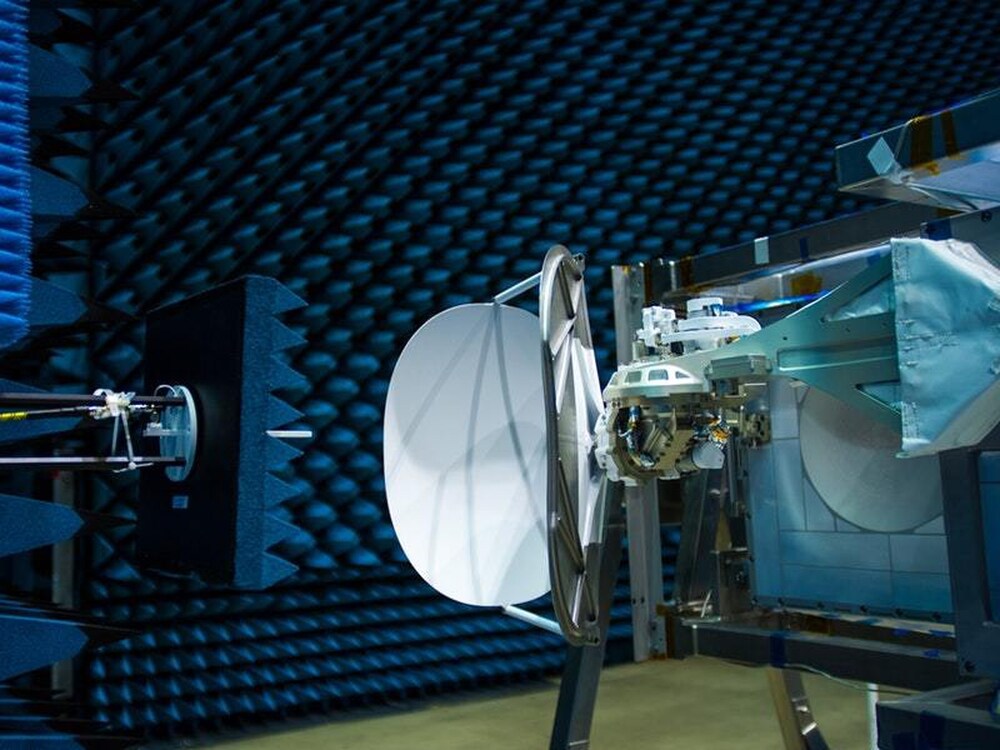
Above:
COLka undergoing testing in the Hertz test chamber at the European Space Agency in The Netherlands. COLKa’s radio signals are being recorded. The blue spikes isolate the room from electromagnetic interference, recreating the radio frequencies of space.
Courtesy ESA–M. Cowan
Called COLKa for ‘Columbus Ka-band Terminal’, the system will allow astronauts and researchers to benefit from a direct link with Europe at home broadband speeds, relaying data from experiments on the ISS back to Earth almost instantaneously.

The fridge-sized device is due to launch aboard a Cygnus supply ship from Wallops Island, Virginia just before 9pm UK time on Friday. Two astronauts will carry out a spacewalk later this year to mount it to the outside of the Columbus module on the ISS.
Dr Graham Turnock, CEO of the UK Space Agency, said: "This is the first major industrial contribution from the UK to the ISS and it will revolutionise the ability of scientists in the UK and Europe to access the results of their experiments.
"This is yet another example of the UK economy benefiting, through investment, jobs and new skills, from our continued collaboration with the European Space Agency."
The data will be transmitted to a ground station at Harwell, Oxfordshire, near ESA’s European Centre for Space Applications and Telecommunications, and from there it will be transferred to the Columbus Control Centre and user centres across Europe.
Columbus was conceived and designed over 20 years ago, when the internet was in its infancy. The laboratory was launched to the Station in 2008 and uses the Station’s network and NASA’s infrastructure for communications with the Columbus Control Centre.
The upgrade will ensure faster communications, independent from the NASA system, to relay much more data from experiments allowing researchers on Earth to see the results of their experiments in near real time.
David Kenyon, Managing Director at MDA UK based in Harwell, which designed and built COLKa, said: "The COLKa programme has firmly established MDA in the UK as a leading provider of high quality space equipment, positioning us for continued business growth and new jobs in both communications and space sensor markets.
The know-how gained from designing, building and running COLKa could be used for ESA’s communications package that is being designed for the Lunar Gateway – an outpost over 1,000 times further from Earth than the International Space Station.
The contract was awarded to MDA following the UK Space Agency’s investment of £40 million in ESA’s space exploration programme in 2012. In November 2019 the UK committed a further £180 million to the global exploration programme, which, along with the lunar gateway and lunar communications, will include bringing back the first samples from Mars and support the US ambition to have a sustainable presence on the Moon through the Lunar Gateway and the lunar communications programme to support astronauts and robots on the Moon.