UKSA funding set to make satellites more sustainable
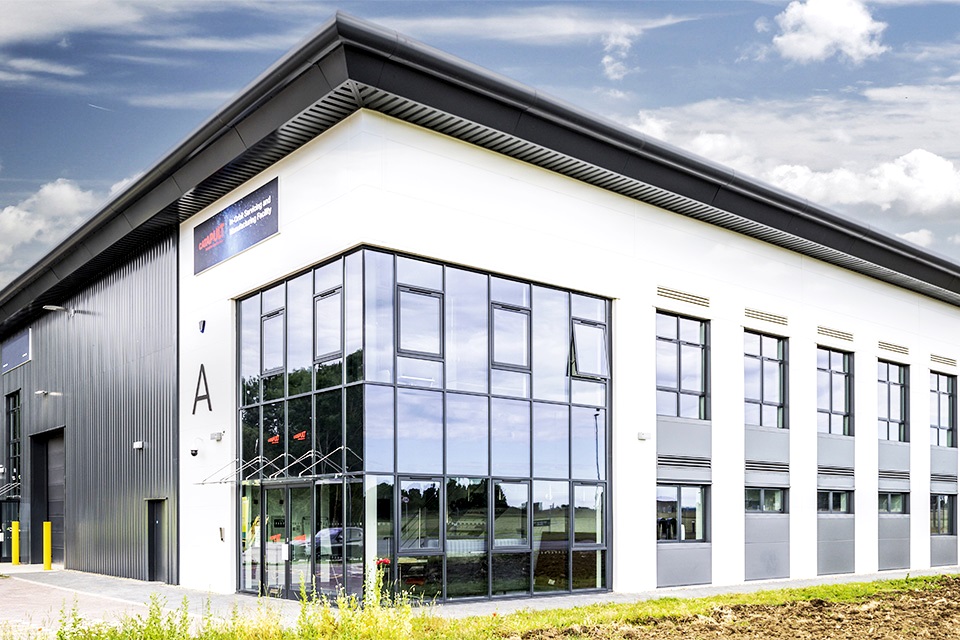
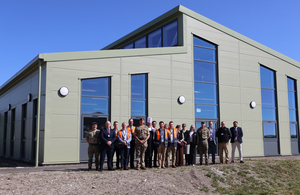
Above: Satellite Applications Catapult’s In-Orbit Servicing and Manufacturing (IOSM) facility at the Westcott Space Cluster in Aylesbury.
Courtesy Satellite Applications Catapult / ShedShooters Ltd
The package includes a £2 million upgrade to the Satellite Applications Catapult’s In-Orbit Servicing and Manufacturing (IOSM) facility at the Westcott Space Cluster in Aylesbury. The facility will provide unique capabilities in the UK where companies can verify, validate and demonstrate a range of in-orbit operations including manufacturing, servicing, inspection, repair and assembly.

In addition almost £1.5 million is going into feasibility studies on refuelling satellites in space, to extend their life and reduce the amount of space debris.
There are now around 37,000 pieces of space debris in orbit measuring more than 10cm, and an estimated one million pieces sized 1-10cm. With increasing numbers of satellites being launched, the UK is taking leadership on this global issue.
Andrew Griffith MP, Minister for Space at the Department for Science, Innovation and Technology, said: "Tackling space debris and maintaining ease of navigation in space is vital to allowing future exploration and protecting the everyday services we all rely on, from location and financial services to weather forecasting and broadband.
"To ensure that long-term sustainability, we are funding new technologies for satellite refuelling and upgrading this important national facility at Westcott to help bring innovations to market faster, in turn growing our economy."
The UK’s IOSM facility at the Westcott Space Cluster will become the first in the UK capable of verification, validation and demonstration of in-orbit operations.
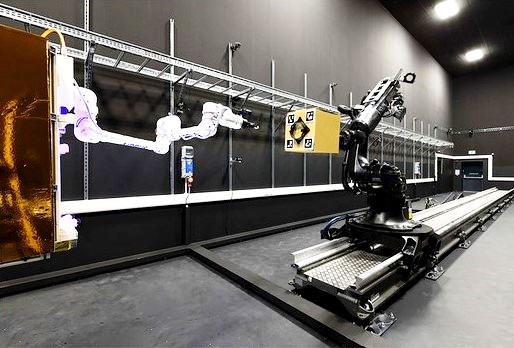
Above: Satellite Applications Catapult’s In-Orbit Servicing and Manufacturing (IOSM) work yard.
Courtesy Airbus Defence and Space
The upgrade will support the growing IOSM sector within the UK, providing access to the large-scale equipment needed to replicate orbital conditions and flight dynamics. This includes expanding the core capabilities to enable dynamic tracking, real-time positioning, a gravity off-load system, and enhancing the orbital simulation environment. The in-orbit simulation robots will benefit from increased digital twin capabilities, which act as a proxy for the space environment and enable testing in the virtual world.
Lucy Edge, Chief Operating Officer at Satellite Applications Catapult, which owns the IOSM facility, said: "IOSM is predicted to be worth £11 billion globally by 2031, and the UK has the expertise to capture at least 25% of this market. To achieve that, it’s critical that the UK’s IOSM companies have access to infrastructure to test their technologies and operations under mission conditions. Our new upgraded facility offers exceptional IOSM testing capabilities and supports the Catapult’s goals to grow the entire space industry in the UK.
"It will help to meet goals within the National Space Strategy for in-orbit servicing, and help with UK Space Agency-funded work developing space sustainability standards, including exploring the design and operation of sustainable spacecraft."
Satellite life extension through refuelling
Three new refuelling feasibility studies will support the UK’s efforts to lead on space sustainability by demonstrating the ability to refuel the UK national debris removal mission and explore opportunities for refuelling a commercial satellite.
Ray Fielding, Head of Space Sustainability at the UK Space Agency, said: "Until recently, satellites have been designed as one-shot items: non-refuellable with mission lifespans coming to an end when the satellite can no longer manoeuvre effectively.
"This package of funding shows the UK Space Agency is leading work to develop UK capabilities in performing in-orbit tasks, such as refuelling, and demonstrating leadership in more sustainable space operations. Facilities like the IOSM centre at Westcott will support the UK’s ambition to become a leading nation in IOSM within the next decade."
Contracts have been awarded to Astroscale, ClearSpace and Orbit Fab for refuelling research:
- Astroscale will adapt their existing ‘COSMIC’ debris removal spacecraft to a new refuelling servicer product, partnering with TAS, Airbus Defence & Space, Orbit Fab and GMV
- ClearSpace’s ‘REFUEL.ME’ mission extension will draw on their existing ‘CLEAR’ debris removal mission, partnering with Orbit Fab, Satellite Applications Catapult and Know.space
- Orbit Fab will leverage their unique Rapidly Attachable Fuel Transfer Interface (RAFTI™) and the Grappling and Resupply Active Solution for Propellants (GRASP) to develop the ‘RAFTEA’ mission, partnering with MDA, ClearSpace, D-Orbit and BryceTech