Virgin Atlantic flies first 100% SAF transatlantic commercial airline flight
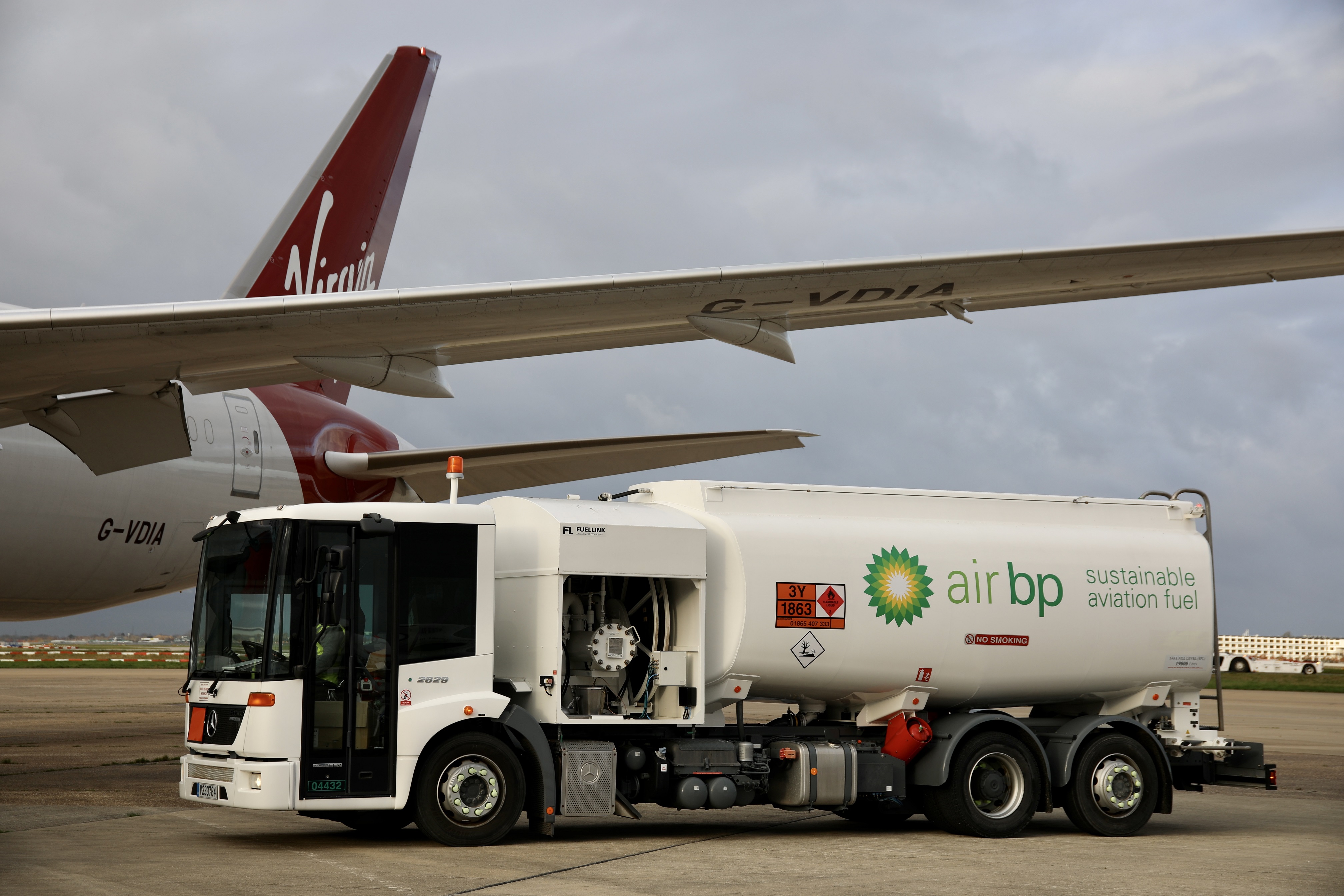
Above:
Air bp fuels first ever 100% SAF transatlantic flight by a commercial airline.
Courtesy Air bp
SAF has a significant role to play in the decarbonisation of long haul aviation, and pathway to Net Zero 2050. The fuel, made from waste products, delivers CO2 lifecycle emissions savings of up to 70%, whilst performing like the traditional jet fuel it replaces.

While other technologies such as electric and hydrogen remain decades away, SAF can be used now. Today, SAF represents less than 0.1% of global jet fuel volumes and fuel standards allow for just a 50% SAF blend in commercial jet engines. Flight100 will prove that the challenge of scaling up production is one of policy and investment, and industry and government must move quickly to create a thriving UK SAF industry.
As well as proving the capabilities of SAF, Flight100 will assess how its use affects the flight’s non-carbon emissions with the support of consortium partners ICF, Rocky Mountain Institute (RMI), Imperial College London and University of Sheffield. The research will improve scientific understanding of the effects of SAF on contrails and particulates and help to implement contrail forecasts in the flight planning process. Data and research will be shared with industry, and Virgin Atlantic will continue its involvement with contrail work through RMI’s Climate Impact Task Force, which is part-funded by Virgin Unite.
The SAF used on Flight100 is a unique dual blend; 88% HEFA (Hydroprocessed Esters and Fatty Acids) supplied by Air bp and 12% SAK (Synthetic Aromatic Kerosene) supplied by Virent, a subsidiary of Marathon Petroleum Corporation. The HEFA is made from waste fats while the SAK is made from plant sugars, with the remainder of plant proteins, oil and fibres continuing into the food chain. SAK is needed in 100% SAF blends to give the fuel the required aromatics for engine function. To achieve Net Zero 2050, the innovation and investment needed across all available feedstocks and technologies must be harnessed to maximise SAF volumes as well as continuing the research and development needed to bring new zero emission aircraft to market.
Virgin Atlantic is committed to finding more sustainable ways to fly, taking action across every part of the journey. Already operating one of the youngest and most fuel and carbon efficient fleets in the sky, Flight100 builds on the airline’s 15-year track record for leading on the development of SAF at scale. Collectively, industry and government must go further, to create a UK SAF industry and meet aviation’s 10% SAF by 2030 target, capitalising on the significant social and economic benefits it will bring – an estimated contribution of £1.8 billion in Gross Value Added to the UK and more than 10,000 jobs.
Shai Weiss, Chief Executive Officer, Virgin Atlantic said: “Flight100 proves that Sustainable Aviation Fuel can be used as a safe, drop-in replacement for fossil-derived jet fuel and it’s the only viable solution for decarbonising long haul aviation. It’s taken radical collaboration to get here and we’re proud to have reached this important milestone, but we need to push further. There’s simply not enough SAF and it’s clear that in order to reach production at scale, we need to see significantly more investment. This will only happen when regulatory certainty and price support mechanisms, backed by Government, are in place. Flight100 proves that if you make it, we’ll fly it.”
Sir Richard Branson, Founder, Virgin Atlantic said: “The world will always assume something can’t be done, until you do it. The spirit of innovation is getting out there and trying to prove that we can do things better for everyone’s benefit.
“Virgin Atlantic has been challenging the status quo and pushing the aviation industry to never settle and do better since 1984. Fast forward nearly 40 years, that pioneering spirit continues to be Virgin Atlantic’s beating heart as it pushes the boundaries from carbon fibre aircraft and fleet upgrades to sustainable fuels.
“I couldn’t be prouder to be onboard Flight100 today alongside the teams at Virgin Atlantic and our partners, which have been working together to set the flight path for the decarbonisation of long-haul aviation.”
Sheila Remes, Vice President of Environmental Sustainability, Boeing said: “In 2008 Virgin Atlantic and Boeing completed the first commercial SAF test flight on a 747 and today we will accomplish yet another significant milestone utilising a 787 Dreamliner. This flight is a key step toward our commitment to deliver 100% SAF-compatible airplanes by 2030. As we work toward the civil aviation industry’s net-zero goal, today’s historic journey highlights what we can achieve together.”
Simon Burr, Group Director of Engineering, Technology & Safety, Rolls-Royce plc, said: “We are incredibly proud that our Trent 1000 engines are powering the first ever widebody flight using 100% Sustainable Aviation Fuel across the Atlantic today. Rolls-Royce has recently completed compatibility testing of 100% SAF on all our in-production civil aero engine types and this is further proof that there are no engine technology barriers to the use of 100% SAF. The flight represents a major milestone for the entire aviation industry in its journey towards net zero carbon emissions.”
Federica Berra, senior vice president, Air bp, said: “Air bp is honoured to participate in this first ever 100% SAF fuelled transatlantic flight by a commercial airline, as one of the consortium’s preferred SAF suppliers. This is a milestone moment for aviation and for our industry and helps build evidence for the reliability and safety of using 100% SAF in today’s aircraft. Collaboration with industry partners is vital to successfully scale SAF, as is long-term policy support to foster supply and demand. Our expert team has worked for months in preparation for today’s flight, drawing upon their deep knowledge and skills in fuel handling, blending and logistics, overall, ensuring product quality and safety standards have been met.”
Transport Secretary Mark Harper said: “Today’s 100% SAF powered flight shows how we can decarbonise transport both now and in the future, cutting lifecycle emissions by 70% and inspiring the next generation of solutions.
“This Government has backed today’s flight to take-off and we will continue to support the UK’s emerging SAF industry as it creates jobs, grows the economy and gets us to Jet Zero.”