World's blackest coating makes space debut

The material’s ability to absorb virtually all incident light improves the performance of the satellite's star tracker-based positioning control system.
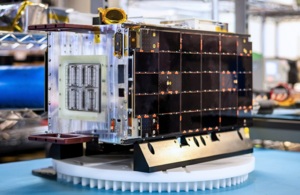
Kent Ridge 1 is a low earth orbit (LEO) microsatellite developed by Berlin Space Technology (BST) in conjunction with the National University of Singapore. It carries two hyper-spectral imaging systems and a high resolution video camera for Earth observation.

The Vantablack coating minimises interference resulting from stray-light inside the star trackers. The new S-VIS version of Surrey NanoSystems' Vantablack is used for this application as it is ideally suited to coating complex space-borne components, and its performance far outstrips that of traditionally-used black paints. Vantablack S-VIS is so effective it traps 99.8% of light hitting its surface.
The star tracker is a key element of BST's microsatellite design. On previous satellite missions, BST has used a super-black paint on the baffles inside the optical positioning system to minimise internal reflections and provide an accurate position reference based on a map of the stars.

Above: Example of a three-dimensional bowl-shaped object spray-coated with Vantablack - the world's blackest coating material. The broad applicability of Vantablack S-VIS is now available for all to see (or not) at the Science Museum in London. The spray-on version of Surrey NanoSystems’ Vantablack carbon nanotube (CNT) coating traps more than 99.8% of incident light, making it virtually impossible to see.
The availability of Surrey NanoSystems' Vantablack coatings, which utilise an innovative carbon nanotube structure to absorb light, decreases the amount of reflected light by an order of magnitude compared with conventional coatings and extends the angular range over which the star tracker is able to operate in the presence of bright light sources such as the Sun and Moon. This improves the robustness of the Earth observation instruments on the satellite, and reduces the need for gyroscope-aided position control that can introduce drift errors over time.
On the Kent Ridge 1 mission, BST decided to apply Vantablack to an existing baffle design, allowing its performance to be compared with previous generation instruments through measurement of the best ‘sun exclusion angle’. However, BST anticipates that it will be able to further reduce the size and weight of its star tracker systems in future, thanks to Vantablack enabling the design of shorter and lighter baffles offering the same high performance.
When BST first heard about Vantablack, the development process of the Kent Ridge 1 satellite was already at a late stage, and there were only a few weeks left before the equipment design was scheduled to be frozen. To meet this challenging timescale, Surrey NanoSystems coated baffles for BST within a time window of around five weeks - a process that included the provision of specifications and many detailed technical discussions. The speed of the production cycle was aided by the use of the S-VIS version of Vantablack, which is applied in a process that is similar to spray painting. The versatility of applying this material made it easy to coat the thin aluminium sections and sharp-edges of the complex 3D baffle shapes.
"A star tracker's performance relies on achieving high sensitivity," says Tom Segert, Director of Business Development for Berlin Space Technology. "We believe that Vantablack will reduce the effects of many common sources of error that affect the performance of star tracker systems - allowing the star identification algorithm to function over a considerably wider range than before."
"The Vantablack coating was originally developed to improve the efficiency of optical systems in space, and this BST satellite project gives us a very early opportunity to prove its performance," says Ben Jensen, chief technology officer of Surrey NanoSystems. “The material can be used to improve the performance of satellites, but also to dramatically reduce weight and size of optical systems - which could be crucial for future space missions."
Kent Ridge 1 - which launched in December 2015 - is the latest in a series of successful microsatellites developed by Berlin Space Technology. The company's philosophy of employing highly simplified satellite designs to enhance reliability, and COTS (commercial off the shelf) technology, has resulted in a unique record of satellite launches and operations.

The ultra-black Vantablack S-VIS material is so effective that its performance far outstrips that of any other conventionally applied coating, typically achieving a reflectance of less than 0.2%. Unlike other black absorbers, it offers this exceptional performance across a wide-range of viewing angles and wavelengths, which is critical for optical instruments.
The active element of Vantablack S-VIS is a carbon nanotube matrix. The coating is applied using a proprietary process that includes a number of pre- and post-application steps to achieve its ultra-low reflectance. Vantablack S-VIS can be applied to most stable surfaces, making Vantablack S-VIS suitable for many types of engineering-grade polymers and composite materials. The process is scalable and suitable for high-volume production on a range of substrate sizes.
Vantablack has the highest thermal conductivity and lowest mass-volume of any material that can be used in high-emissivity applications. It has virtually undetectable levels of outgassing and particle fallout, thus eliminating a key source of contamination in sensitive imaging systems. It withstands launch shock, staging and long-term vibration, and is suitable for coating internal components, such as apertures, baffles, cold shields and micro electro mechanical systems or MEMS-type optical sensors.
A British breakthrough, Vantablack - which was debuted at the Farnborough International Airshow 2014 - is manufactured using Surrey NanoSystems’ NanoGrowth-Catalyst systems at the company's state of the art R&D centre in East Sussex, UK.