
General Atomics

UK hydrogen airport trial sets out roadmap for further studies

A new report into the UK’s first airside trial of multiple hydrogen-powered ground support equipment (GSE) has confirmed that hydrogen can be safely and effectively integrated into airport ground operations, whilst setting out a series of essential next steps needed to accelerate hydrogen adoption and decarbonisation across the aviation sector.


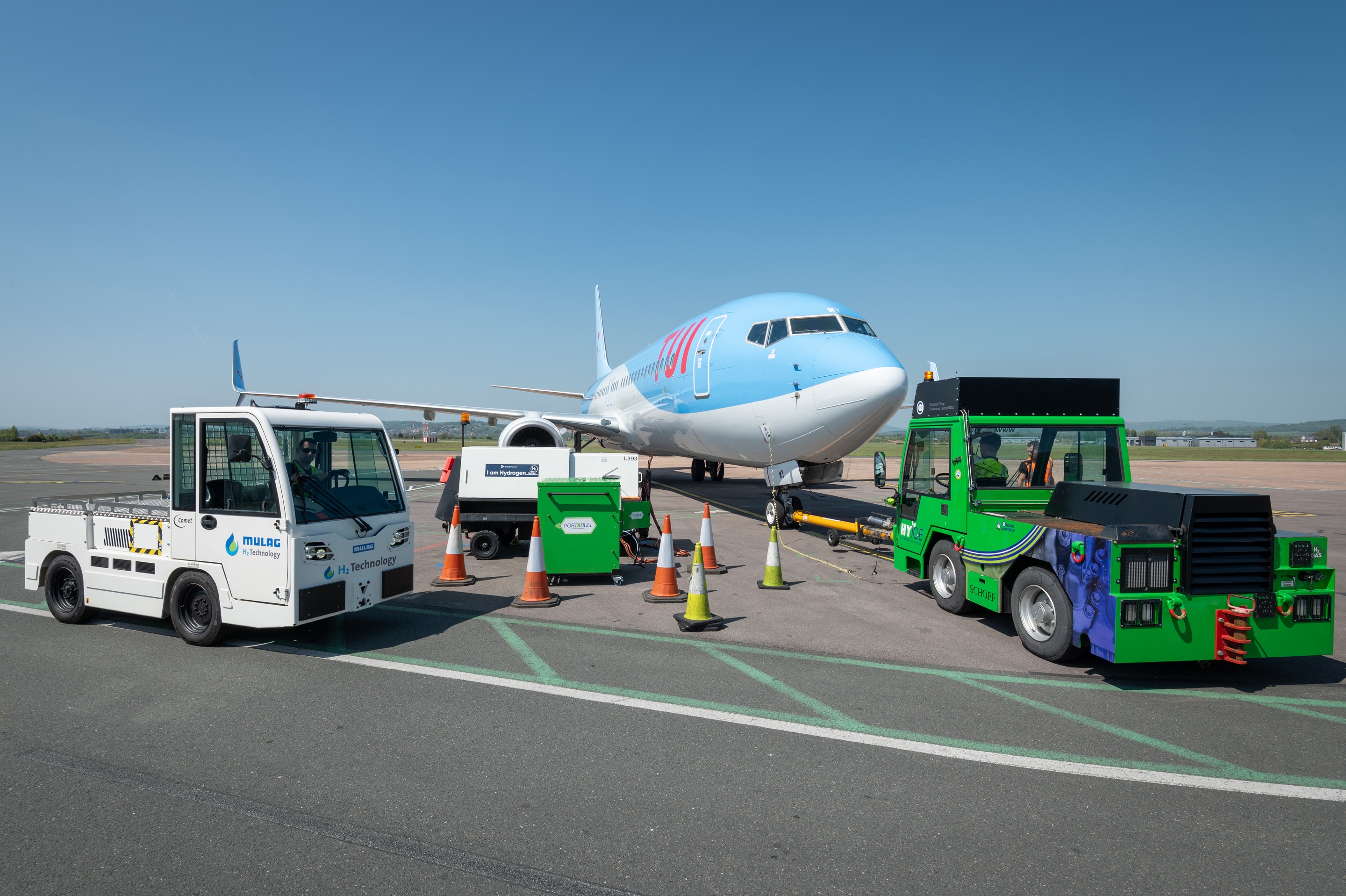
Image courtesy Regional & City Airports 


The Zero Carbon Turn project, led by Exeter Airport (part of Regional & City Airports) in collaboration with Cranfield University, TUI, ULEMCo, Boeing and MULAG and supported by the CAA as part of the Hydrogen Challenge Sandbox programme, brought together three different hydrogen technologies to support a live turnaround of a TUI Boeing 737.

Its objective was to demonstrate, test and evaluate multiple hydrogen-powered ground support technologies in a real airport environment to build operational knowledge, safety cases and evidence to support future hydrogen use and net zero ambitions at airports.

The trial, conducted at Exeter Airport, successfully demonstrated a hydrogen internal combustion tug, a hydrogen fuel cell baggage tractor and a hybrid hydrogen–diesel GPU operating together airside, achieving several UK firsts. 

Although the first regular commercial operations of hydrogen aircraft may still be some years away, there is a recognised need to lay the groundwork in terms of developing the regulatory framework and industry know-how to support hydrogen aircraft once they enter service.

Following its success, a further trial will take place at Exeter Airport later this month in partnership with Cranfield University and ULEMCo, using a hydrogen-powered GPU to simulate a series of aircraft turnarounds in winter conditions. The work is being funded by the Connected Places Catapult and will provide further insight into how hydrogen systems perform in real-world operating conditions.

Cranfield University has now published a technical report into last April’s Zero Carbon Turn project, setting out its achievements, key learnings and next steps.

While the report highlights the opportunity for airports to adopt hydrogen technologies to support decarbonisation initiatives in the very short-term, is also emphasises the need to shift from one-off demonstrations to longer, broader and more integrated trials.

Dr Thomas Budd, Associate Professor of Airport Decarbonisation, Cranfield University and author of the report, said: “This project delivered several UK firsts, but its greatest value lies in what it tells us about the road ahead. To prepare for hydrogen-powered aircraft and large-scale adoption of hydrogen GSE, the industry must expand research to further real-world conditions, explore storage and refuelling approaches and formalise knowledge-sharing across the sector. Airports want to decarbonise and GSE manufacturers are rising to the hydrogen challenge, but there is a pressing need to bridge the infrastructure gap."

Stephen Wiltshire, Managing Director or Exeter Airport, which is part of the Regional & City Airports group, said: “The Exeter trial has proven that hydrogen ground equipment works – and works safely – in a real operational environment. As the report highlights, regional airports like ours will be among the first to handle hydrogen-powered aircraft, and we are natural testbeds for developing these technologies. The priority now is to build on this progress. Our winter trial this month is an important next step in strengthening the evidence base for wider hydrogen adoption across UK aviation.”

The Cranfield report highlights a number of UK first from the Zero Carbon Turn project including:

  • The first concurrent use of multiple pieces of different hydrogen fuelled equipment at a UK airport.
  • The first time a hydrogen fuelled GPU has been used to power a commercial aircraft in the UK. 
  • The first time a hydrogen fuelled aircraft tug has been used with a commercial passenger aircraft in the UK.
  • The first application of a hybrid hydrogen/diesel dual-fuel piece of equipment at an airport.
  • The first application of green hydrogen (produced via electrolysis using renewable energy) at an airport in the UK.

Looking ahead, the report identifies the need to conduct longer-duration trials in varied, real-world conditions; the need to test alternative hydrogen storage and refuelling models; the need for a formal knowledge-sharing platform for the industry to avoid duplication and accelerate progress; and the need to refine regulatory pathways to accommodate further trials.

Download a copy of the report here.

Related

UK aerospace R&D returns £14 for every £1 invested says ATI
ATI Group shot
UK aerospace R&D returns £14 for every £1 invested says ATI
Sustained investment in research and development, innovation, skills and advanced manufacturing is helping strengthen the sector’s international competitiveness.
Aerospace

27 Aug 2026

First Islander from reshored Britten-Norman production line begins ground testing
Britten Norman UK built islander starts ground tests
First Islander from reshored Britten-Norman production line begins ground testing
The aircraft is expected to fly for the first time in September before being delivered to the Falkland Islands Government Air Service.
Aerospace

27 Aug 2026

Manchester Airports Group reports cyber security incident
Manchester Airport
Manchester Airports Group reports cyber security incident
Manchester Airports Group has reported a cyber security incident involving customer data, amid growing concern over cyber attacks in the UK.
Aerospace Security

27 Aug 2026

Cadets are helping young people build skills for life
Calvin Bailey MBE MP, Minister for Veterans and People at RAF Waddington
Cadets are helping young people build skills for life
Ahead of the UK’s inaugural National Cadets Week, adult volunteers and cadets across Lincolnshire and Essex are developing activities to help young people gain the skills that will stand them in good stead, whatever they choose to do in life.
Defence

27 Aug 2026

Royal Navy commanders receive advanced synthetic training in record time
UK Commando Force
Royal Navy commanders receive advanced synthetic training in record time
Delivered almost a year ahead of schedule, the Maritime Command and Staff Trainer (MCAST) is providing Royal Navy commanders with a virtual synthetic training system to run complex command, staff and operational exercises.
Defence Member News

27 Aug 2026

The Hawk was built in Britain. Its replacement may only be assembled here
Hawk T1 Jet
The Hawk was built in Britain. Its replacement may only be assembled here
Foreign-designed trainers are competing for the RAF requirement, leaving the UK to decide whether final assembly provides enough jobs, skills and sovereignty.
Defence

27 Aug 2026

Scottish space tech to power self-consuming rocket engine
Alpha Impulsion
Scottish space tech to power self-consuming rocket engine
Aurora Avionics is to supply crucial electronic systems that will deliver key electrical power functions for a pioneering new rocket engine, that aims to cut propulsion costs and support next-generation spacecraft.
Space

27 Aug 2026

STFC reveals latest Ernest Rutherford Fellows
space nebula
STFC reveals latest Ernest Rutherford Fellows
Backed by an investment of £6 million, seven early-career physicists have been awarded Ernest Rutherford Fellowship’s by the Science and Technology Facilities Council (STFC), supporting research, from the search for dark matter to the physics of black holes.
Space

25 Aug 2026

Austrian ENPULSION moves to acquire UK space propulsion specialist Lift Me Off
Enpulsion space propulsion manufacturer buys UK company lift me off
Austrian ENPULSION moves to acquire UK space propulsion specialist Lift Me Off
Austrian spacecraft propulsion manufacturer ENPULSION has agreed to acquire British specialist Lift Me Off, bringing together electric and chemical propulsion capabilities in a deal that will require UK Government approval.
Member News Space

21 Aug 2026

Manchester Airports Group reports cyber security incident
Manchester Airport
Manchester Airports Group reports cyber security incident
Manchester Airports Group has reported a cyber security incident involving customer data, amid growing concern over cyber attacks in the UK.
Aerospace Security

27 Aug 2026

Why the role of dogs in security is misunderstood
Sniffer dog
Why the role of dogs in security is misunderstood
The role of dogs and their use within today's security sector is often not fully appreciated, including their extraordinarily unique capabilities - which even the most sophisticated new technologies cannot match - and their incredibly selfless bravery.
Member News Security

27 Aug 2026

Cellebrite reveals ruggedised C-TEK forensics field kit
Soldiers on patrol
Cellebrite reveals ruggedised C-TEK forensics field kit
With its portable forensics field kit, Cellebrite has brought together rugged hardware and software to allow mission-critical data and intelligence to be captured and actioned in the field, enabling forward-deployed teams to quickly triage data from phones, SIM cards, drones and portable media to advance their mission advantage.